Author: Paul Rincon

Trumbo: The Right Film for the Right Time

Director Jay Roach’s biopic Trumbo has come along at just the right moment, to remind us of the costs of vilifying our political enemies, to remind us of the ideals that our country is supposed to represent, and to remind us of the costs for failing to live up to these ideals.  Written by John McNamara, and based on a book by Bruce Cook, this film deals with the extremism of that American political staple, the political witch-hunt.  Filled with an all-star cast (Bryan Cranston of Breaking Bad as Dalton Trumbo, Diane Lane as his wife Cleo, Helen Mirren as Hedda Hopper, John Goodman as Francis King, and Louis C.K. as Arlen Hird), the film tells the tale of the House Un-American Activities Committee‘s investigation into what was called the “Hollywood Ten,” and the effects of that investigation on the lives of those involved.

The movie depicts Hollywood screen writer Dalton Trumbo as an unapologetic Communist, whose party affiliation and sympathies lead to his fight with HUAC, resulting in a conviction for contempt for Congress (for failing to respond as desired to HUAC’s questioning).  Trumbo serves time in jail, as do some of his cohorts; and he is later joined in jail by Congressman J. Parnell Thomas (chairman of HUAC in 1947) on charges of corruption.  In reality, Trumbo and Thomas served time in different prisons; but two other members of the Hollywood Ten did serve in the same prison as Thomas, and at the same time.  After his release from prison, Trumbo continues to work underground for the film industry, as film-makers and producers need his talents but are unwilling to let his name be attached to their work.  A few of Trumbo’s films win Oscars; but with other writers taking credit for the screenplays.  Trumbo’s name and career are ultimately rehabilitated in part through the help of luminaries such as director Otto Preminger, actor Kirk Douglas (insisting that Trumbo get the writing credit for Stanley Kubric’s Spartacus) and President John F. Kennedy (who crossed right-wing picket lines to see the movie, and urged other film-goers to do the same).

As the movie’s erstwhile hero, Trumbo is actually quite flawed.  He is shown as a less than available husband and father to his family, putting many demands upon them, but not showing much in the way of affection or sympathy.  And the movie makes it plain to the viewer that, unlike many Americans who were unfairly judged for sympathies they did not have, or may never have had, Trumbo remained every bit a Communist.  The film also pokes some fun at Trumbo’s pre-blacklist success in Hollywood, becoming quite rich, an unlikely economic position for someone claiming to be a Communist.  What the film shows is not that the accusation of Trumbo’s being a Communist was itself inaccurate; but that it is constitutionally irrelevant.  As an American citizen, Trumbo demanded (and legally had, whatever the courts may have decided) the right to have and to speak his views, especially as he was not in any way involved in any kind of power politics or calling for the violent overthrow of the government.  As nothing more than a screenplay writer, there was no legal or constitutional basis for his, or the rest of the “Ten’s” persecution.  And yet, as he noted, lives were lost, and more lives destroyed, solely because of either their political views or their connections to others with unfashionable political views.

The importance of the role played by this film is not merely as a typically Hollywood presentation of the “fighting the good fight” feel-good movie, or as an historical portrayal of typically questionable accuracy.  Rather, the importance lies in the very notion of America, as a country that promises each of us the room to be what we want to be, so long as we abide by the most basic laws.  When that promise is broken, when our nation persecutes those merely because of where we (or our ancestors) came from, or what religions or politics we believe in, or whom we wish to associate with or work with (especially when they, too, have broken no actual laws), then we lose all of the moral high ground claimed by our City on the Hill.  While it was unfortunate indeed that during the Red Scare, some Americans were punished for beliefs that they no longer (or possibly never) had, it is also unfortunate – and was, in fact illegal and unconstitutional – to punish even those who were Communists, even those who expressed sympathies with our Cold War adversary, the Soviet Union, so long as they were not themselves conspiring to take over the nation through means other than electoral politics.  The Red Scare was a typically Orwellian notion, recalling of course Erich Fromm’s introduction to 1984, in which Fromm warned readers that Orwell’s book was not about the Soviet Union; but was a warning to the West that in struggling against Communism, the West was going to assume the worst sins of Communism.  The persecution of Communists, in complete abandonment of all our constitutional principles and of all of our expressed beliefs in the rightness of our civil liberties, was a withdrawal from a high place of superiority justifying our struggle with the Soviet Union, to the lowest depths in which we and the Soviet Union became briefly, and frighteningly, one.  And today, as Americans consider terrorism abroad (and ignore its presence in our midst); as we vilify those claiming allegiance to a religious faith indistinguishable from that held by a majority of our own citizens; and as we view each other’s political parties with suspicion and distrust, we need this film and others like it to remind us that our freedoms are not a mere convenience, to be discarded when inconvenient; but are the centerpiece of what we fight for and what makes our nation worth fighting for.

Headline image via Google Search

The American Cultural Divide: Freedom for One, or Freedom for All?

When candidates for political office debate or make short public statements, they sometimes wax on vague notions such as their vision of America and the nature of freedom.  They try to connect with voters by referencing what many Americans think are basic national virtues.  However, the cultural divide between Right and Left has widened over the last half century, and the very definitions of essential American virtues have themselves been changed with this divide, as the two sides redefine these virtues through increasingly divergent perspectives.  The most essential divergence between Right and Left is on the definition of that most seemingly American value: that of freedom itself.

While both the Right and Left view themselves as fighters for freedom, the two view freedom through substantially different perspectives.  The Right views freedom from within the context of a zero-sum game, in which freedom and personal rights are finite and competitive.  One person’s freedom limits another’s, and the expansion of one’s freedom means a contraction of another’s.  The Left, on the other hand, views freedom as inherently indefinite and communal; the extension of freedom for any member of the community expands overall communal freedom, benefiting all other members.  This cultural divide informs both sides’ views on the nature of the American community, with the Right portraying the community as a Darwinian survivalist competition, a dog-eat-dog collection of individuals each seeking to survive at the expense of the others, while the Left sees the American community as a shared environment which itself strengthens the community’s individual members, each member gaining from the extension of freedom to any of their own.

The cultural divide, and the differing perspectives on American community, plays out through both large-scale approaches and specific issue positions.  Both sides, alike, recognize that the American culture largely evolved from the social dominance in Europe, colonial America, and the post-revolutionary United States, of rich, white, European, Christian men.  However, while the Right sees any movement to extend rights, freedom, opportunity, and wealth to other classes and identities, as an effective attack on the rights of existing dominant groups (in effect, a “culture war”), the Left sees the expansion of freedom not as a “war” upon some within society, but as a strengthening of freedom for all in society including the existing dominant groups (especially considering that those dominant groups themselves are often core supporters of both the Right and Left).  To the Left, freedom is not a war between groups for power over the others, but a bounty which any can access, and which itself grows with the size of the population able to access it.  The Left therefore champions multiculturalism, to extend freedom as much as possible, to grant access to freedom to as many as possible, to better improve and increase the freedom of all.  The more freedom we share, the more allies we have against groups trying to take that freedom away; and the more freedom we share, the harder it is for the courts to legitimize restrictions on those freedoms.  The Right, however, sees multiculturalism as a “culture war” or “class war” against the existing freedom of prevailing dominant groups.  The Right sees society as “one against all, and all against one,” (in essence an “army of one” against oppression), while the Left sees society as “one for all, and all for one” (effectively a mutual defense treaty against oppression).

We can see these large-scale approaches in specific issue platforms.  For example, on the same-sex marriage issue the Right sees the expansion of rights to marriage as an “attack on marriage” (thereby necessitating the now overturned Defense of Marriage Act), whereas the Left sees any expansion of access to the legal rights extended to married couples as effectively strengthening the institution of marriage and the freedoms and benefits accruing to it.  The Right does not care that more kinds of people getting married takes nothing away from those already allowed that right; the expansion of freedom must, they feel, somehow decrease their own agency and freedom whatever the reality might be.  There is, of course, a greater cultural war by the Right to delegitimize those not like them, and restricting access to traditional institutions is a part of that cultural war to keep freedom from being shared or expanded.  Meanwhile, the Left cannot fathom any kind of logical basis for conservative reaction against same-sex marriage, as those on the Left come from the perspective that more people getting married can only create a greater social push toward providing protections and benefits to all married couples, regardless of what groups they represent.  The Right sees marriage as a zero-sum game; the Left sees it as a freedom shared by and strengthening the community.

Other issue positions are similarly determined by the large-scale approaches of the zero-sum competition and the shared-rights community.  For example, the Right exploits racism and xenophobia by directing national urges to fix our problems toward hatred against immigrants seeking to join our City on a Hill, while the Left reaches out to those communities.  Although the Right, when in power, never actually pursues any “solution” to “immigration problems” (because they are ultimately dependent on exactly those population groups that would be affected by such “solutions”), they fan the flames (especially when not in power) to gain political points by speaking about freedom and opportunity within the framework of a competitive zero-sum, in which “they” are coming to take “our” freedom and jobs.  The Left is informed and supported by ethnic groups who have themselves created jobs and expanded American freedoms by their very arrival and work here, making our nation ever greater, stronger, and richer.

Other lesser examples can be found in cultural symbols like the conservative myth of a so-called “War on Christmas,” seeing multiculturalism as somehow taking away Christmas or Christ from those celebrating such images.  The majority of Leftists who are themselves Christians obviously see things differently, understanding that the expression “Happy Holidays” is not an attack on their faith, or a restriction of what they can believe or celebrate, but merely an inclusion of others into the national merriment that the dominant Christian majority has always vocalized and expected everyone to join.  Another lesser example can be found in the recent “flagger” debate between some southerners (who generally gained the sympathies of the Right) feeling that the Confederate battle flag represents southern history and culture; and those (north and south, and generally gaining the sympathies of the Left) who feel that the South has plenty of legitimate, non-racist symbols of pride, and that the selection of a symbol with an obvious racist legacy therefore also demonstrates what image of the South pro-flag advocates want to portray:  a white-dominated, racially ordered and enforced community of racially selective freedom.  The “flaggers” prefer a symbol of the zero-sum approach (where blacks fighting to secure their freedoms have to fight against whites for those freedoms, and take away white freedoms in the process), whereas other southerners prefer other symbols of the South that portray its greater, diverse community and the South’s many champions for freedom for all races and peoples.

The Right also prefers some issues precisely because they do show a tendency toward zero-sum competition for rights.  The right to bear arms (under the ambiguous language of the Second Amendment) is an excellent example.  The Right believes that the Second Amendment rights of those Americans seeking to use them trump the rights to life, liberty, and the pursuit of happiness recognized by the Constitution’s preamble as the cornerstone for all American rights.  Second Amendment rights are to the Right more important than the basic rights of the 40,000 Americans killed by gun-fire each year to life, liberty, and the pursuit of happiness; and those deaths (roughly equivalent to losing the Vietnam War all over again every single year) are an acceptable “cost of doing business” for those demanding the justice of an overarmed populace.  Of course, with violent crime in the US at an all-time historic low, the Second Amendment is itself a greater threat to our freedom than those threats seemingly recommending a nation-in-arms.  Such an argument relegates the protection of individuals and families to police and communal law enforcement (taking rights to such away from gun-owners, and confirming the zero-sum nature of this particular issue); but also recognizes the greater rights of the greater American community to the most essential freedom, that of life itself.

While both those on the Right and those on the Left claim to believe in and defend the American promise of freedom, their vision about what that promise holds has diverged into conflicting perspectives on the nature of community in America.  The Right insists on, and fights to preserve, an anarchic collation of competing individuals and forces, living in an environment of restricted and finite freedoms, which cannot be shared or realized communally (at least not without taking away such freedoms from the individual).  The Left insists on, and fights to preserve, a vision of a community of shared rights, with every individual’s own rights extending the rights of others in the community, and of the community as a whole.  The Left’s vision is far more compatible with the earliest vision of American community, John Winthrop’s “City on a Hill” vision of an America acting as a greater, cohesive community to foster greater agency, greater responsibility, and greater morality at both individual and communal levels.  The Right’s vision, on the other hand, is effectively a failure of faith in the expansive nature of freedom, in the nature of the American community, and in the nature of the religious faith to which American conservatives often pretend to defer.  The Left’s vision is more compatible with the traditional American vision, with the argument on American exceptionalism, and with the Christian faith upon which that vision and that argument were originally based.  Whether the core of American conservatism will find its way back from the great divide, and embrace an expansive vision of American freedom, shall remain to be seen.

Of Refugees, Welfare, and Thanksgiving

On Thanksgiving, Americans traditionally have family dinners, typically with turkey and lavish side dishes and desserts.  We watch parades and football games.  We remember times gone by.  We talk, or argue, about politics, culture, and values.  We say that we do all this as a means of somehow giving thanks.  But how do lavish feasts and parties in the wealthiest, most overfed nation on Earth give thanks to anyone?  Whom are we thanking, and for what?

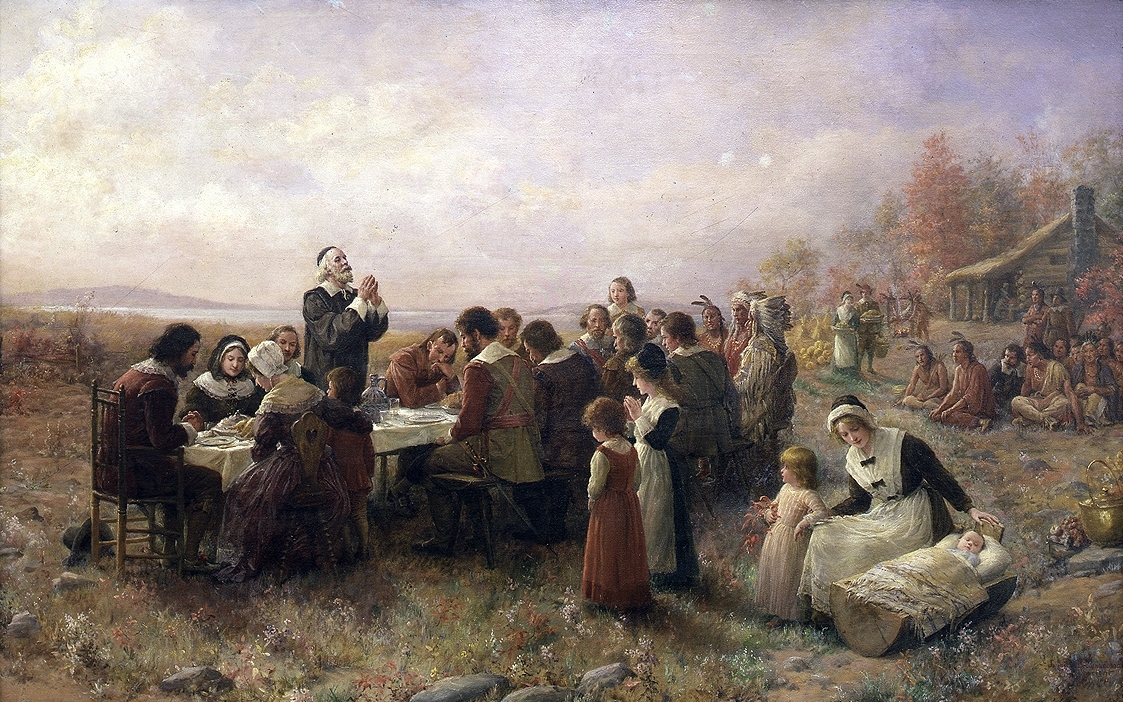
Thanksgivings are a normal part of Christian societies, and while not legislated into permanent existence in the United States until 1863, America had seen countless Thanksgivings before that, whereby Americans gave thanks to their God for the bounties of the earth and of their work.  The traditional “First Thanksgiving” was held by English Dissenters of the Plymouth Colony in 1621.  Those colonists who had lived through the first winter celebrated their survival and the success of their first harvest.  Their survival and their harvest success were both due in part to help from the local Wampanoags under under Massasoit, who provided food and helped teach corn cultivation.  The English Dissenters were refugees from the violent religious warfare that ripped through Europe in the 16th and 17th centuries; and these refugees with a completely alien religion, language, ethnicity, and political values were nonetheless welcomed and given welfare by the Americans already here.  For that, and for their survival of the first year’s trial in their newly adopted home, the colonists gave thanks to their God.

A decade later, John Winthrop (later the governor of the Massachusetts Bay Colony) delivered his “Modell of Christian Charitie.”  Winthrop articulated a vision of a new America to come.  He expresses essentially the sentiment of “there but for the grace of God,” arguing that we are all born into circumstances at God’s pleasure.  The rich and poor alike, Winthrop asserts, have God to credit with their status (not their own labors or failures); and those born into – and escaping from – areas of terror and violence are likewise responsible only for their own agency in escaping their condition, not for the violence from which they strive to escape.  This argument played successfully with the various schools of English Christian immigrants in America, who sought refuge from the horrific religious and political turbulence tearing Europe apart.  However, those surviving the journey (itself a dangerous ordeal), and those fewer who survived their first hungry winters, gave thanks for making it through the trials of their odyssey.  Winthrop’s City on a Hill was built by the refugees who were wise enough to save themselves, strong enough to survive cold and hunger, and humble enough to accept a helping hand from an alien people.

Since the founding of our City on a Hill, the United States has been a nation of refugees and immigrants, and of people brought here in chains.  All of these people were taken into an alien land, society, and culture.  Refugees, immigrants, slaves, and servants are who we are, and are who built this country.  Refugees seeking to escape violence, and immigrants seeking a better life created the new America; and the new America was built into a giant through slavery and forced labor.  While slaves built a massive cotton economy in the south, northern free workers (many of them recently arrived immigrants and refugees from famines and revolutions and turbulence in Europe and elsewhere) built mills, factories, roads, bridges, and railroads.  Slave-masters and company bosses both fought to keep their labor forces in chains, with blood spilt south and north alike by their efforts.  Banks and corporations were built by a government providing public resources and revenues to men of wealth, many of them going bankrupt despite these gifts and despite underpaying their workers, through sheer mismanagement.  Slave labor, and immigrants and refugees, built our cities and our farms; our infrastructure and institutions; our massive economy, our social system, and our political values.  Slaves, immigrants, and refugees are what we Americans are.

It is for the labor of those who came before us that we owe our wealth, our education, our security, and all else that we have.  It is for their labors we must give thanks, and it is for the gifts enabled by their labors that we owe a great debt.  We cannot repay that debt to slaves whipped to death, or to workers cut down by strikebreakers.  We cannot repay the debt to Native Americans killed by diseases brought to them by Europeans, or pushed off their lands later by Europeans or white Americans.  We cannot repay the debt to those no longer with us.  But the debt remains, and must be repaid, as a cost of maintaining our City on a Hill.  Our thanks is a beginning, but is not enough.  The debt can only be paid, and our thanks can only be truly given, by continuing to build the City our predecessors created.  The debt is paid, our thanks given, by welcoming new refugees into our land as new Americans, just as our Native American forebearers did – taking in a people looking, sounding, and thinking differently, because they need our help.  The debt is paid, our thanks given, by opening our borders to immigrants.  The debt is paid, our thanks given, by helping the sick and poor and hungry.  The debt is paid, our thanks given, by honoring descendants of slaves and free workers alike, making sure these people whose ancestors died building our nation have every opportunity to reap from the seeds sown by their fathers and mothers.  It is for the sacrifice and labor and strength; for the blood, sweat and tears; for both the liberties and personal agency as well as for the sacrifice and suffering of those who built this nation that we give thanks.  But just cutting a turkey, or watching the Lions lose, does not give thanks.  Building the City on a Hill, welcoming strangers and foreigners, using our wealth to fulfill the City’s mission by caring for our needy, and eradicating poverty and social inequality, are the only means our nation has, to give thanks and repay the debts incurred for our fortunes.

On Thanksgiving, enjoy your bounties, and enjoy your friends and family.  These have been given to us by those gone before us.  But remember that our bounties came at a cost which must be repaid.  And the repayment of that debt is simple to understand – we must fight to maintain and to build our City on a Hill, and welcome those coming to our nation as newfound builders and new celebrants of our freedoms and our wealth.  This is a positive feature of our nation; that we can move forward and achieve even more, but only if we repay those debts from the past.  Repay them, give thanks, and have a Happy Thanksgiving.

[image used, The First Thanksgiving at Plymouth, oil on canvas by Jennie Augusta Brownscombe (1914), found on Wikipedia.]

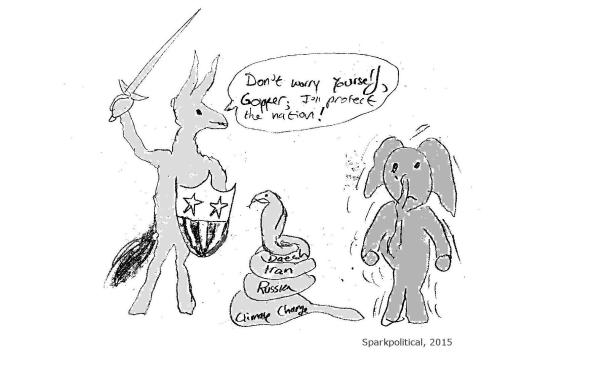
Why the Democrats are the New National Security Party

Gopper

Following a series of terrorist attacks in the Middle East and France, national security has become a vital issue in the continuing contest between the Democratic and Republican parties for the hearts and minds of the American voters.  Americans were particularly shocked by the Paris attacks, in a city seemingly far removed from the conflict zone of the Middle East, and especially considering the long and close relationship between the US and France.  Reacting with an almost post-911 frenzy, American pundits and social media commentators ratcheted up the panic level to maximum.  Seemingly reading the temperature of frightened Americans, the US House of Representatives pushed through House bill 4038, restricting the entry of Syrian and Iraqi refugees to the US.  Numerous state governments also issued arguably illegal restrictions of refugees to their own states as well, ignoring increasing evidence that refugees in France were not involved in the attacks (perpetrated by French and Belgian nationals), and contradicting France’s own immediate response of welcoming even more refugees.  As the election year draws ever closer, American voters will consider the two major parties’ (and their candidates’) responses to terror and their positions on national security policy.

First on the radar screen at the moment is Daesh (or the Islamic State; the author prefers the former term particularly as the group finds that term to be offensive to their image), the group behind last week’s terror.  Sadly, neither party has a cohesive plan (let alone an exit strategy) for pursuing war, with both parties apparently employing a “one-piece-at-a-time” chess-game strategy.  Candidates from both parties are reluctant to engage in another seemingly indefinite ground war, and the complexities of the Syrian civil war perplex the candidates on all sides.  Trump, Cruz, Bush and Christie (and Clinton on the Democratic stage) all urge a greater use of US airpower (most unrealistic is Trump’s focus on destroying oil facilities, which are of only minimal value in petroleum-poor Syria).  Trump and Carson both urge a greater ground effort in Iraq (containing Daesh to Syria, though neither candidate is willing to use the term “containment” to describe their strategy).  Bush has, since the latest wave of attacks, begun to favor the use of ground forces, but has not specified where or how, or how many, or with what objectives.  Paul wavers indecisively between calling the use of ground forces “unconstitutional,” and stating that he would use “…overwhelming force.  I wouldn’t mess around.”  He is as devoid of details as Bush, however.  Kasich favors invoking Article V of the NATO agreement, to “take care of business and come home,” but also has not said how either the deployment or the coming home would actually work.  Finally, Sanders, still trying to maintain relevance against Clinton’s rising popularity among Democrats, calls for a new, greater coalition (including Russia as well as the Muslim states of the Middle East).  Sanders, however, has not been able to explain how to defuse the increasing hostility and suspicion between the US and Russia.  With Russia bombing anti-Assad groups who have been aided by the US, there is much to do if Russia and the US are to work together instead of seeing the war as a zero-sum conflict between themselves.  No one on either side of the partisan divide has successfully addressed that issue.

Another issue of the Syrian war is the status of refugees seeking to escape the war zone.  On this issue, the parties have spelt out their differences far more prominently.  Republicans pushed through the House bill, and most of the state efforts to restrict refugees have come from Republican governors.  Republican candidates have said little to oppose restrictions, and have even called for “religious tests” denying Muslims refuge in favor of Christians.  Trump has even echoed Nazi racial programs by calling for the “registration” of Muslim refugees.  Sanders and Clinton have both (in league with President Obama) attacked such as un-American and un-Christian; and that argument has resonated with the evangelical community (normally a Republican stronghold).  Various commentators have linked Republican language of restrictions to Daesh’s specific goal of dividing America from the Muslim community, calling the Republicans out for surrendering in one fell swoop the terrorists’ most immediate political objective.

Taking the bipartisan confusion about the Syrian war together with the clear partisan divergence on the greater philosophy of conflict and engagement, we can define a reluctant tendency of a few Republican hotheads to push for a greater “imperial overreach,” while most candidates agree that a new war may simply not be in our national interest.  The Democrats, while being only slightly more (but questionably) reasoned and willing to lean on allies and other powers, see a clear link between the pursuit of war policy in the Middle East and maintaining our “shining City on a Hill” through one of our most American and liberal values, the compassion for refugees seeking a better life in a civil society.  Republicans are more willing to sink to the lowest common denominator of popular suspicion and resentment of the “Other,” and choose to empower themselves in a confusing conflict by taking power from those seeking asylum.  As with so many other issues, the Democrats’ approach seeks to build the City on a Hill; whereas the Republicans want only to wave the flag while denying its true meaning and value.  The Democrats’ approach also de-emphasizes the military aspect of the conflict in favor of the greater political conflict, while the Republicans confusedly wallow in the mud over tactical military problems without a greater appreciation of the politics driving the issue.

Iran is another issue more cohesively dividing the parties, both as an actor in the Syrian war, and as a power seeking a greater role in regional affairs.  All candidates recognize that Iran and Daesh are inherently opposed to each other, but they also fear what an increased role for Iran in Syria would mean for Israel, Lebanon, Iraq, and other regional states and issues.  Clearly as the US looks to regional states to step up and defeat Daesh, Iran’s massive and well-equipped military poses as a major potential ally; but a sudden US-Iran relationship could not be formed from that foundation alone, particularly as long as Iran and Israel both remain inherently hostile to each other.  As with Russia, Iran shows something of a zero-sum game approach to the conflict, with an Iranian defeat of Daesh as not necessarily in the strategic interest of the US (and with Iran viewing a potential US defeat of Daesh through a similar lens).  Neither US political party has developed a viable pathway to a US-Iran partnership on Syria.

Iran’s search for greater regional power and relevance further conflicts with American security policy on the nuclear weapons issue.  Flanked by  a hostile, nuclear-armed Israel to one side, and a hostile, nuclear-armed Pakistan to the other, and faced continuously by US naval forces in the Persian Gulf (themselves obviously backed by a massive nuclear deterrent), Iran has obvious motivations for acquiring a nuclear weapon.  Such a capability would force the US to use greater reflection before employing its military forces against Iran, and could theoretically increase Iranian prestige in the region (albeit also triggering a regional arms race, as Iran’s other regional rivals would seek to acquire their own nuclear deterrents).  The US, wishing to keep its military options on the table (and also fearing a potential Israeli-Iranian nuclear exchange), wishes also to keep Iran from getting a nuclear weapon.  This issue has driven the past year’s antagonistic partisan debate over the Joint Comprehensive Plan of Action (JCPOA) and related agreements, by which Iran has agreed to surrender the vast majority of its nuclear weapons production potential (in both its on-hand materials and its processing capacity).  Republicans responded to their growing irrelevance in international politics with alarmist misrepresentations of the agreement (relying on their supporters’ reluctance to read 160-page technical agreements).  The Democrats, on the other hand, were able to brush aside Republican arguments, although they did face some difficulties over Republican accusations regarding “secret language” in the Additional Protocols.  Nevertheless, the Democrats secured a victory both internationally as well as domestically, in first pushing Iran to the peace table (through Clinton’s construction, as Secretary of State, of a rigid international sanctions environment), and second in getting the agreement approved over the opposition of the conservatives of both nations.

Another major security problem for the US is Russian expansionism.  Republicans have scored points by recalling Obama’s 2012 criticism of Mitt Romney, telling the governor that US-Russian conflict was a thing of the past.  Sanders hopes in effect to prove Obama right by developing a more productive relationship with Russia; but has not indicated how he would make that happen.  The Republicans dither between Trump and Fiorina imagining themselves using their corporate boardroom experience to build a better relationship (disregarding the historic lack of success that American business leaders have had in using business strategy in international politics), and Carson’s details-free “position of strength” exhortations.  Clinton is the only candidate with actual experience in negotiating with Russia and Putin; although her track record there is a combination of both successes and failures.  Otherwise, Republicans do not actually say what they would do differently from each other, or from Obama.  They attack Obama as somehow impotent in the face of Russian expansion into the Ukraine and Syria; but they ignore their own party’s failure in preventing or halting an actual outbreak of war between Russia and Georgia in 2008.  They have offered no actual solutions not already explored or implemented, only insisting that their sheer Republicanness would somehow force Putin to back down (despite the fact that that did not work the last time they tried it).  The Democrats, with Sanders’ vague intent to partner with Russia, and Clinton’s actual experience in doing so, therefore show a modest superiority over the Republicans, who seem more confused and torn over what to do (and over how to frame a campaign statement about it).

Finally, the Democrats claim a right to a major national security interest that the Republicans have traditionally denied en masse: the threat posed by climate change.  A few of the current flock of “clown car” candidates, however, see the issue as an arena in which to grab moderate American voters, and so the GOP’s diversity on that issue has grown.  Trump, Huckabee, Cruz, and Carson are still flatly in denial; while Fiorina, Rubio, and Paul are willing to concede that something freaky is happening, but all demonstrably oppose any  government action to limit or reverse the process.  Kasich, Christie, and Bush all recognize climate change as the real result of human actions; but they only see the need for the most limited of government action to curtail the problem.  Clinton can also be shown as having only limited commitment, having (while serving as Secretary of State) pushed fossil-fuels development as a key to foreign states’ overall energy independence; but her language is far more hawkish and she supports the president’s Clean Power Plan.  She may well have been steered to the left by Sanders’ more inflammatory language (describing climate change, at least before the recent wave of attacks, as the greatest threat to the US).  Martin O’Malley has fought for relevance from his single-digit approval ratings by in part pushing a far more detailed and comprehensive Clean Energy plan than have either of his Democratic rivals.  Both parties have therefore used the issue not merely to hammer the other party, but as an in-party arena to attract different political constituencies.  However, across the board, the Democrats have called unapologetically for greater action, while the Republicans’ most “radical” elements call simply for limited action at best, preferring to rely on private corporations’ good will to accomplish energy transformation and ecological protections.  The most popular Republican candidates fall on the flat denial side (although collectively those “most popular candidates” still poll at less than half among total Republican supporters).  Overall, the Democrats continue to be the party most willing to pursue actual reform on environmental and energy policy.

The Democrats can lay claim, therefore to being the US’s “National Security Party,” having by far the more coherent view of American security interests, as well as potential solutions to current problems.  Neither party really has much of a vision for Syria; but the Republican “fire and forget” military strategy applied in Iraq (and which created the Daesh problem in the first place) still remains their preferred alternative.  The Democrats see the need for a more philosophically consistent political conflict, between the American City on a Hill and an extremist, deliberately antidemocratic way of life, using our nation’s greatest assets and the power of modern information systems to push Daesh into irrelevance while using limited military efforts to neutralize physical targets as they manifest themselves.  The Democrats also have a far better plan (and history) of dealing with Iran, although there, too, both parties suffer from strategic myopia.  Even more short-sightedness is evident on the Russian front; but the Democrats have the greater experience and willingness not just to talk but also to listen, a fundamental step to repairing relationships.  Finally, on climate change, the Democrats have a much clearer vision of both the scope of the problem and the venue for solutions, a vision far more consistent with the actual data acquired by climate scientists.  As we near the start of the election year, the Democrats have demonstrated themselves as the party most capable of facing and solving our most vital national security problems.

Detroit Area Witnesses Calls for Peace and Condemnations of Violence Following ISIS Wave of Terror

On Saturday evening (November 14, 2015), there were two vigils held in the Detroit area to commemorate the victims of a wave of terrorist activity of the past few days, a terror campaign which included a double bombing attack in Beirut on Thursday killing some 43 people, a series of mass terror incidents in Paris on Friday the 13th, in which over 120 people were killed, and a separate suicide bombing in Baghdad on Friday, killing some 20 people.  All operations have been attributed to the Islamic State (ISIL or ISIS) organization, as the organization expands its regional campaign of violence into a greater international terror campaign.

In Dearborn, Michigan, the local chapter of a Shi’a group, Who Is Hussain?, sponsored and led the “Care for Humanity” vigil at the Islamic Center on Ford Road, condemning violence as an anti-Muslim value, and denying ISIS’s right to claim an identity as a Muslim organization.  Speakers representing Who Is Hussain? noted the attempts of the 7th century Shi’ite leader Hussain ibn Ali to foster peace among the factions of the divided Muslim community, and looked to Hussain’s life as an example of interpreting the Quran as a message of peace.  Attendees of the vigil lit candles (placing a sign composed of tea-candles on the ground, spelling the word, “humanity”), and observed a moment of silence in honor of the victims of the past few days’ violence.  They also held small signs displaying the Eiffel Tower Peace Sign.  The speakers urged world leaders to seek a peaceful solution to the confrontations ripping apart the Middle East.

A second vigil was also held an hour later near the Ambassador Bridge in Detroit by the Saint Anne de Detroit Catholic Church.

Vigil

Photos ©2016, Sparkpolitical.  All rights reserved.

Spark! Special Report: The Friday the 13th Attacks on Paris

Image: Victim's body in street close to Bataclan concert hall early Saturday

A victim’s body in a street close to the Bataclan concert hall in Paris, France, early on Saturday.  Getty Images (photo and caption as reported by NBC).

Friday night, November 13, 2015, saw a wave of terror attacks ripping through the French capital of Paris, with multiple locations in the tenth and eleventh arrondissements being targeted by shootings, explosions, and a hostage situation. Six locations experienced the greatest carnage, including diner shootings (by assailants spraying automatic weapons fire from Kalashnikov assault rifles), explosions outside of the Stade de France football stadium and elsewhere, and mass terror in the Bataclan theater where an American rock group, the California-based “Eagles of Death Metal” was playing. The area of terror was adjacent to the neighborhood of the attacks against Charlie Hebdo earlier this year, in January.

The Stade de France was hosting a game (a so-called “friendly”) between Germany and France, attended by the President of France, Francois Hollande. While no incidents took place in the stadium, explosions could be heard outside, and the president was evacuated. The game, however, continued, and the French attendees sang the national anthem, “Marseilles,” as they left the stadium after the game’s conclusion.

Bataclan was held by several assailants in a hostage situation until a police assault, which apparently triggered suicide detonations by the assailants. While the site was the center of gravity of the night’s death toll, the band playing there is reported to be safe and all their people accounted for. There were, however, numerous other Americans involved in the events of the night, including dead and injured.

During the carnage, seven assailants killed themselves with suicide detonations, and an eighth was shot and killed by the police. Latest reports by AP, NBC, and other agencies have the police continuing a search for possible additional assailants or accomplices; none are currently known (or at least publicly reported) to be at large, however. One of the assailants was a French citizen, known to have links to “Islamic extremist activity” (as AP reports); and another reportedly had a Syrian passport, but his nationality has not been reported. As of Saturday morning, no other personal information has been reported on any of the assailants.

During the attacks, the French government declared a state of emergency, and tightened security at the border (mostly through repealing open-border measures enacted through the European Union). In addition, airport security was heightened, with NBC reporter Cassandra Vinograd describing “hours-long delays” at the airports. The terror of Friday the 13th is described by some reporters as constituting the deadliest attack on France since World War II, with (as of Saturday morning) 127 reported dead, and some 200 injuries, dozens critically.

In the wake of the attack, ISIS supporters have circulated unconfirmed statements of responsibility for the action. NBC reports that, “ISIS has previously threatened France due to its military operations against the group in Syria and Iraq.” Assuming their claims of responsibility are true, and with the likelihood that the recent downing of a Russian airliner in the Sinai was also an ISIS operation, the group’s opponents may now be facing an expanded terror campaign, as ISIS moves its area of operations beyond Syria and Iraq. President Hollande has vowed to attack ISIS “without mercy” in response to the attacks, which he described as “an act of war that was prepared, organized, planned from abroad with internal help.”

On Friday night, and Saturday morning, France was greeted with international support from multiple quarters. President Obama called the attack an atrocity against “all humanity,” and the FBI’s legal attache in Paris aided French officials in their investigations. In the meantime, the US Department of Homeland Security determined that there was “no credible threat to the US.” However, some US cities, like LA, saw a greater police presence at certain key sites and public venues. Other expressions of support to France poured in from foreign leaders like British Prime Minister David Cameron, German Chancellor Angela Merkel, and Russian Foreign Minister Sergei Lavrov (as well as President Putin). Iranian President Hassan Rouhani condemned the attacks as a “crime against humanity,” and the Kuwaiti, Qatari, Saudi, and Indonesian governments uttered similar condemnations and expressed their solidarity with France. Facebook saw numerous expressions of personal solidarity with France; and Facebook deployed its “Safety Check” capability developed last year, enabling survivors to post their status to friends and loved ones (the capability sends a message about the sender’s safety, that appears in FB friends’ notification lists, therefore taking precedence over regular posts).

On Saturday morning, as police continued to search for accomplices and more answers, numerous public facilities and sites were closed throughout and nearby Paris, including museums, schools, the Eiffel Tower, the Disney theme park, etc. Border and airport security remained tightened. In the meantime, France and the rest of the world have to consider the ramifications of a post-911 world, as more and more groups and causes embrace the use of terror to push their message and agenda.

Hillary’s Hard Choices: What Her Resume Says to the Voters

Hard ChoicesIn June, 2014, before announcing her candidacy for president (in April 2015), Hillary Rodham Clinton published a massive tome of 600 pages, Hard Choices, cataloging her experience as the 67th US Secretary of State (serving from January, 2009 to February, 2013).  While a great many politicians, and especially former Secretaries of State, have published memoirs and other works based on their experiences, it was clear from the start that this book was meant to be more, from an author who herself intended to continue with her political career to the next step – the path to the presidency.  And indeed, Hard Choices reads like an overwhelmingly fleshed-out resume.  Taking the book as an argument for her qualification for the next job in her sights, the book argues clearly (as a resume should) about the candidate’s experience, training, professionalism, relevance, and attitude.  Clinton’s detractors may condemn her self-congratulation for solving major problems, and for explaining away those episodes (especially the Benghazi consulate attack) that the conservatives have used to attack her.  The book may, in part, have been written in the intention of finding allies against such attacks.  However, despite ending her book with uncertainty about whether to run (and considering that question as her next “hard choice”), Clinton clearly wrote the book to market herself for the next major job ahead.

Taking Hard Choices as Clinton’s resume, Clinton argues, in effect, that her foreign policy experience and philosophy is her key asset as a prospective president, rather than her domestic issues platform.  At the very least, the book is an argument that Clinton’s foreign-policy platform is well grounded (and her campaign since releasing the book and announcing her candidacy has striven to beef up her domestic issues portfolio).  Clinton describes her basic approach to foreign policy as “smart power,” tying “soft power” elements of diplomacy, technological development, humanitarian assistance and relief, cultural ties; and a multilayered involvement moving past governments and foreign ministries to include businesses and corporations, students, unions, NGOs, and other institutions of civil society (and especially political non-state actors who are growing in international political power and significance); with “hard power” elements of military force and alliance systems (p. 33).  Throughout her book, Clinton details her involvement with all of these elements of international strategy and foreign policy.

Clinton argues that her executive experience is strong, and that it shows her ability to face crises and make the “hard choices” posed by both unexpected and long-developing events, conditions, and situations.  Her executive experience is of course the main study of her argument, depicting the world from the point of view of the office of Secretary of State.  Clinton shows herself to be not merely an office-dwelling paper-pusher, but an activist solver of problems, flying millions of miles in the course of her four-year term to a multitude of nations across the world.  She clearly believes in an up-close and personal “shuttle diplomacy” style of engagement, visiting with foreign leaders (political and otherwise) directly, and negotiating settlements and agreements directly.  Clinton argues that, particularly in Asia, a key region of modern global development and policy, personal relations and in-person conversations are central to building close international ties (and Pew Research Center polling indicates that, indeed, global popular approval of the US spiked during Clinton’s term as Secretary of State; although it is likely that Obama’s presidency beyond Clinton’s own work may have helped generate global support for the US).

Clinton’s close and personal style of foreign policy has helped build relations with world leaders, and she describes her work with Russian Foreign Minister Sergei Lavrov, Israeli Prime Minister Benjamin Netanyahu, German Chancellor Angela Merkel, etc., not just in terms of effective policy but in terms of her own personal connection with these leaders.  She argues in effect that the US can best be served by having a leader who already knows, is friendly with, and has had positive and successful dealings with the many players on the stage of global affairs.

The title and concept of Clinton’s book themselves also argue that Clinton is capable of facing crises and taking risks, a necessary qualification for any President and Commander in Chief.  She depicted risky, multilayered approaches to foreign policy problem areas such as China, where while negotiating for trade and political agreements, she still pushed human rights (and specifically defended certain “celebrity dissidents,” such as Chen Guangchen and Gao Yaojie), and she defended the smaller powers of southeast Asia from a Chinese attempt to dominate the region during ASEAN talks in July 2010.  In Afghanistan, while leading efforts to wean both lesser members and higher heads of the Taliban away from the movement (or at least toward reconciliation with Karzai’s regime), she continued and expanded efforts to build agency and opportunity for women (which many Islamic fundamentalists consider to be a deal-breaker).  Afghanistan also figures as an example of Clinton’s “smart power” approach, where “hard” military operations were linked to nation-building efforts (by both military and civilian organizations), and by other “soft” power venues.  Clinton also describes the “Russian reset” during Medvedev’s term as president, with the US engaging cooperatively with Russia on issues where possible, working with other powers to “contain” Russian expansionism where not, and working at local, “popular” levels to build relations with the Russian people and with non-governmental actors.  Despite Putin’s own later “reset” upon returning to the presidency (transforming Medvedev’s more cooperative Russia back into Putin’s more aggressive state), Clinton notes the successes of the American “reset” in “…imposing strong sanctions on Iran and North Korea, [and] opening a northern supply route to equip our forces in Afghanistan…” (p. 235).  Clinton also described her management of crises in Libya (working with the ground forces of the revolution to remove Gaddafi from power), the Gaza War (using “shuttle diplomacy” and her personal relationship with Netanyahu to tone down the tense and violent conflict with a limited cease-fire), and Haiti (leading the effort to rebuild after a massive earthquake, and supporting the peaceful transfer of power from President Préval to Michel Martelly).

Clinton uses both the overall narrative of the book, as well as a dedicated chapter, to argue that she in particular has been a dependable soldier for human rights.  From a controversial speech as First Lady in Beijing, declaring that “women’s rights are human rights, and human rights are women’s rights,” to a similar speech in Geneva as Secretary of State, using the same phraseology to argue that LGBT rights are human rights, to steering US support to political activists in Belarus, helping dissidents in China and Burma, aiding Haiti in a rare, peaceful transition of power, connecting with women’s rights activists in Yemen and Afghanistan, Clinton demonstrates her commitment to human rights.  She argues that as Secretary of State, her commitment helped to realize a noticeable improvement in human rights across the world.

There are subtler messages in Clinton’s narrative which, while not tangible arguments, manage to bleed through the lines to argue for her candidacy.  Her work with Obama is demonstrated as a principle of pushing past political fights and working with political opponents, and therefore reads as an argument that she can also work with other political rivals within the Democratic Party, with Republican conservatives, and perhaps even with Tea Party extremists.  Her depiction of her husband Bill Clinton’s mission to North Korea to arrange the release of two American journalists effectively argues that, as a team, the two Clintons would make a formidable political force if given once again the powers of the White House.  Clinton also depicts the events leading up to, and including, the US special forces operation killing Osama bin Laden.  While she does not take credit for the operation, her narrative seems to argue a right to “collateral credit” for being in the room and for supporting the operation with her own diplomatic forces.

If viewed as a resume, Clinton’s Hard Choices does what a resume should do.  It is a document told from the point of view of a prospective candidate for a job, selling and focusing on the strengths of the candidate for that job, and minimizing (or at least explaining) the candidate’s failings and mistakes.  A resume is sometimes used to blow up a candidate’s actual, smaller role in previous jobs into a greater fiction; and Clinton’s detractors may well see a similar, self-serving message in her narrative.  The length of the tome may also discourage less enthusiastic or interested readers; and therefore suffers from the tendency to preach to the choir.  On the other hand, the principal rule of marketing is: first, last, and always, market to your existing customers.  This Clinton’s book purports to do.  As to how much of her message will reach, and will resonate with, the rest of her party, and the rest of the nation, the next year of campaigning will have to tell.

Three Reasons Why I’m Buying a Cup of Starbucks Coffee Tomorrow

Starbucks

Normally, I’m not that big a fan of Starbucks.  It’s not so much a political or moral thing; I mostly just don’t like their coffee that much.  However, tomorrow, I’m looking past all this and buying a cup of Starbucks.  Why?

  1.  The dark side of Christian conservatism, that wants to see a “war on Christmas” in everything they see, thinks red Christmas cups without dancing snowflakes make the Baby Jesus cry.  I’m going to enjoy a warm cup of Jesus tears; maybe a latte.
  2. Starbucks has just announced a program to provide a gay-friendly safety environment for victims of hate crime.
  3. Starbucks has also just announced it is increasing substantially its program to provide educational funding for dependents of veterans (if those vets are company employees).

Today (November 10, 2015), there is a strike against companies not paying a living wage (which Starbucks vowed to do last year, effective this past January); so I’ll wait to make Jesus cry until tomorrow.  But tomorrow, I’m going to give Starbucks some money.

While the Parties Continue to Fight, MSNBC’s “First in the South” Forum Beats Out CNBC’s Debate By a Wide Margin

Dem Forum

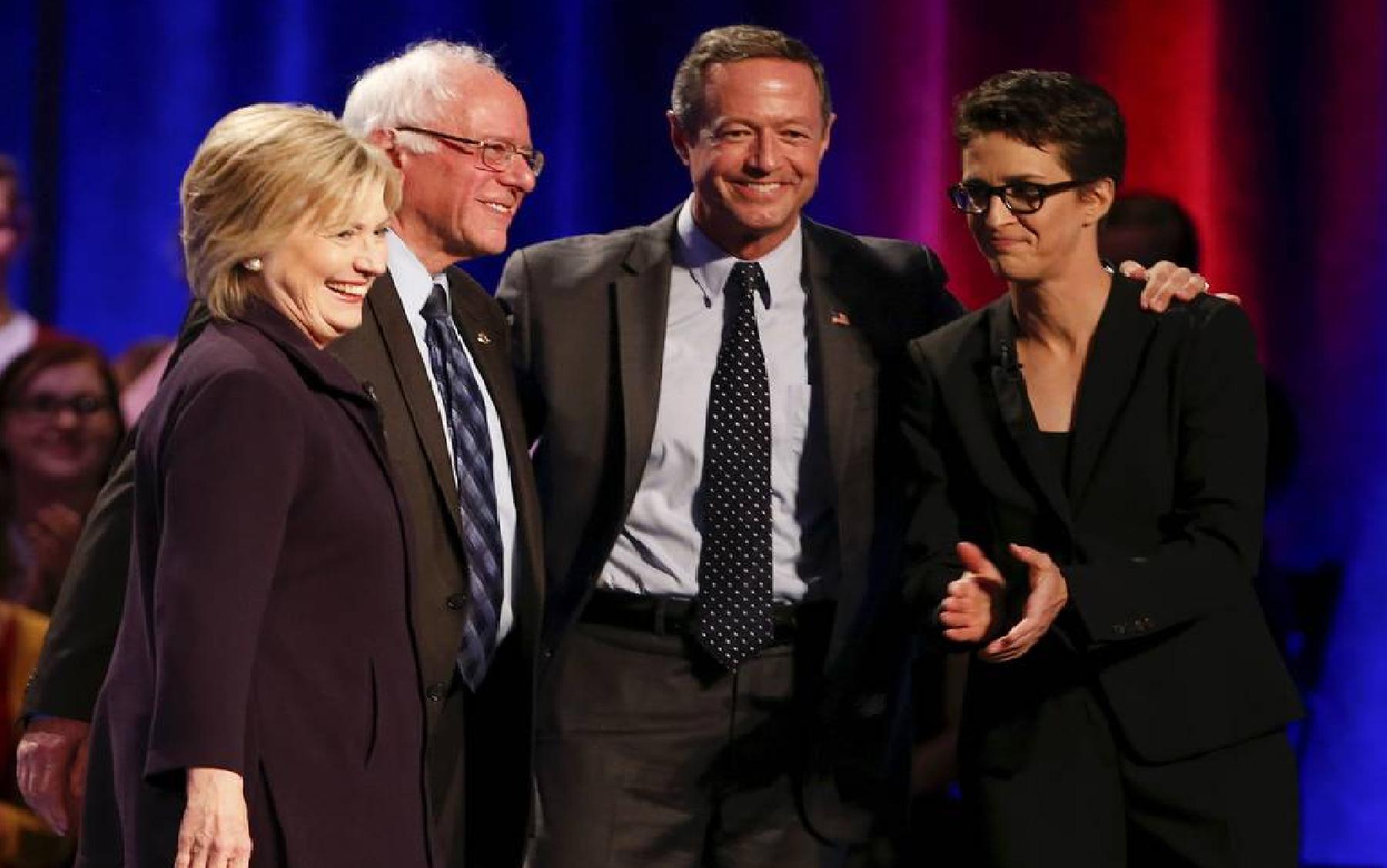
On Friday, November 6, 2015, MSNBC’s Rachel Maddow moderated the latest installment of the presidential candidates’ debates, the First in the South” Democratic Forum, hosted by Winthrop University, in Rock Hill, South Carolina. The forum was not a debate, Maddow told viewers, but was a series of one-on-one interviews of the candidates by Maddow, who generated many of the questions herself. The candidates did not, therefore, engage in any direct conversation or exchange, and the forum differed sharply from the most recent Republican installment, the CNBC debate at the University of Colorado. Maddow’s questioning concentrated on serious questions, but also included some lighter questioning to create a friendly atmosphere (including a “meet the young candidate” segment for each candidate, giving them a chance to talk about their youth and their career). The bulk of the interviews, however, saw Maddow pushing the candidates to justify both their views and their candidacy.

Former Maryland Governor Martin O’Malley was up first. After evading a question about the Democratic Party’s traditional weakness in the South (since the 1970s), the conversation turned to climate change. O’Malley noted that, “We’re the party that believes in science…,” and he talked about the problem as more of a “challenge and opportunity,” denying the traditional view of environmental reform as potentially job-killing. Instead, O’Malley articulated a vision of energy reform as a job creation opportunity, talked about his Clean Energy Jobs Corps proposal, and advocated cities as the best area in which to pursue green energy. O’Malley shrugged aside Maddow’s suggestion that at least some states might lose both jobs and money were his proposal to turn the energy grid completely green by 2050 to be enacted.

Discussing the Black Lives Matter movement, O’Malley asserted that his governorship reduced incarceration and recidivism rates, cleaned the streets of Maryland of drugs, and reduced crime rates, all effects beneficial to African Americans. O’Malley sees the elimination of for-profit prisons as the next step to reduce both prison populations and the legal system’s incarceration mentality.

On foreign affairs, O’Malley sees both the continuing use of the Guantanamo detention facility and the “American boots on the ground” approach to the Middle East as the best “recruiting tools” for ISIL and Al Qaeda, generating by their very existence entire new ranks of extremist, anti-American fighters. The detention of people without due process, O’Malley asserted, was simply “contrary to our principles as a people.”

Maddow’s interview with O’Malley finished with a question about his campaign, still polling in the low single-digits, and a very distant third of the three remaining “viable” Democratic candidates. O’Malley took the moment to attack Sanders as a socialist (unlike himself as a “lifelong Democrat”), and Clinton for being late to the game on numerous issues such as Keystone and gay marriage. O’Malley noted that in races to the governorship, he had also suffered from low polling early on, and that he liked a “tough fight.”

Next up was Bernie Sanders, the formerly independent Senator from Vermont, arguing that his message resonates for all poor and working people, and that despite representing a state that’s 95% white, his civil rights record is unimpeachably progressive. While idealistic, his responses to Maddow’s questions on marketing his Democratic candidacy to southern and black voters spoke less to the realities of lower-class suspicions toward the Democratic Party in the South. Similarly, his responses to her questions about involving the corporations in the reform of the economy and tax structure (especially by moving corporate investment into actual job creation rather than pure wealth concentration) were vague, and centered simply around taxes, suggesting that a Sanders administration might be dangerously confrontational to those powers capable of generating new jobs.

Sanders continued to answer vaguely on other issues, such as Middle East policy. He insisted that the “boots on the ground” needed to be regional rather than American, or that American involvement could take place through a venue of greater international involvement, especially by European powers such as Great Britain, France, and Germany. Sanders refused to consider a unilateral American effort, and seemed to falter at Maddow’s questioning about European and regional reluctance to engage. To be fair, O’Malley’s answers were similarly idealistic and vague, and yet Maddow had not pinned O’Malley into a corner on the issue to the same degree that she did with Sanders.

Sanders pushed his self-image as a candidate for reasonable gun control, arguing that his representation of a rural state gave him a special appreciation of second amendment rights, but that (despite voting against legislation such as the Brady Bill) he also had worked to improve and increase background checks, and to ban assault weapons.

Finally, on the subject of voting rights, Sanders became heated, calling the Republicans “…political cowards, and if they can’t face a free election, then they should get another job.” Sanders saw the loss of Democratic vitality in the South as largely due to defeats on the issue in those states. He saw greater and effective political change as achievable through a renewed fight on that front. “We need to greatly expand voter turnout… We need a political revolution.”

Hillary Rodham Clinton completed the evening, coming out on stage to an explosion of applause. However, the many African American members of the audience looked less than convinced. Maddow’s first serious question asked Clinton about African American reactions to a Democratic stage with only white players, and whether African Americans should feel “left behind” by that reality. Clinton bypassed the question to argue for a “New New Deal,” which would help not only African Americans, but middle-class white voters as well (clearly an answer to speak more to that latter, larger demographic, but which for that very reason cannot be encouraging to the former). Clinton also answered weakly to Maddow’s questioning about Wall Street, repeating her mantra of telling Wall Street to “stop it,” and arguing merely that she is on record as fighting to level the playing field, and that the economy works too much for those at the very top, and too little for everyone else.

Clinton redirected a question about having police in school classrooms (referencing the recent ugly incident in Richland County, South Carolina), to the larger issue of economic change, with over half of students now on lunch programs, a key metric for gauging childhood and family poverty rates. Clinton condemned the school system’s vastly greater expulsion and suspension rates for African-American students in particular.

On foreign affairs, Clinton waved off Maddow’s suggestion that she is more “hawkish” and aggressive than her Democratic competitors. She argued that as Secretary of State, she had pursued diplomatic solutions and saw diplomacy succeed in creating international progress, especially with respect to Iran (with Clinton citing her work in creating a sanction environment that pushed Iran into a peaceful agreement with the West).

Maddow asked few specific questions of any candidate on economic policy and jobs creation, although the candidates were able to get in some vague ideas on the subject. Similarly the three Democratic candidates are all reluctant to use force in the Middle East, and yet they see the area as a key political arena; the forum demonstrated little in the way of clear thinking about alternatives. Another problem area for both parties, the demographics of their own base constituencies, shows an ironic contrast between the Republican Party, fronting both black and Hispanic candidates, and the all-white Democratic candidate pool. With both parties fighting for minority votes, such voters will have to decide whether they are better served by white candidates with more inclusive policies, or by minority candidates breaking key racial barriers but offering little else in the way of overall social inclusion.

In any case, the Forum provided the audience with a stark contrast to the CNBC debate, being more substantial (but still with glaring weaknesses on the issues), less inherently confrontational, less dramatic, and more didactic. The Democratic Party’s candidates therefore are better served by this environment than by the more confrontational atmosphere at Denver, and those viewers considering the Democratic candidates now have better information with which to consider their options as the political fight moves on to the next round.