Category: Commentary

The Hijacking of Morality

Quote of the Week:  “One of the great tragedies of mankind is that morality has been hijacked by religion.”  – Arthur C. Clarke

Arthur Clarke warned us about the tendency of those wearing religious trappings to act immorally, and even to foment deliberately immoral principles and objectives.  Religions like Judaism, Christianity, and Islam are complex structures of thought, filled with self contradictions that allow for these religions to be used for contradictory purposes – to argue, for example, both for and against slavery, for and against war, for and against religious toleration, etc.  However, there is an easy test by which we can determine whether an argument, religious or otherwise, is moral – how, in effect, to determine if morality is on track or has been “hijacked.”  That test is the liberal ethic of building a community of care and welfare, the vision of the City on a Hill.  Morality is ultimately not a question of religion, enshrined as it can be by religious thought.  Morality is not found in God’s House; but in the hearts of people doing the moral work of building a city of love and care and communal responsibility for those around us.

Humans are for the most part essentially moral creatures.  All human civilizations, societies, and cultures have moral systems; and for that matter the gross similarities on moral rules (prohibiting murder, protecting children, etc.) vastly outweigh disparities.  This is even more true of religions, which are virtually universal in their agreement on basic moral questions (disagreeing instead on doctrinal questions, like the number and names of their god(s), the relationship of physical to metaphysical realms, days and times and methods of worship, etc.).  That humans always manage to impose an identical moral order on their religions, and on their societies and cultures (not to mention on agnostic and atheist philosophies) proves that religion gets its morality from people, not the other way around.  Morality is a human quality, not a religious one.

All religions are theories of philosophy.  Philosophy is merely “the study of the general and fundamental nature of reality, existence, knowledge, values, reason, mind, and language.”  Religions are first and foremost theories about the nature, composition, and origin of the universe, questions fundamental to philosophy in general.  All philosophical systems – religions included – are ultimately moral systems, because humans are moral creatures seeking to impose their natural moral standards upon their thoughts, impulses, laws, cultures, etc.  Religions represent natural human curiosity about – and the need to explain – the universe around them; and religious morality derives from both our natural human norms and from social and cultural differentiation.  No religion developed in a vacuum.  All religions grew out of existing moral, philosophical, political, social, and other systems, and kept certain basic standards while imposing certain other new standards.

Political ideals are also philosophies, and they similarly derive from basic moral norms as well as imposing new moral standards.  Furthermore, political and religious ideology are often intimately intertwined.  Human thought remains fixated on systems inherited from the past (systems in which people grow up and which therefore can be central to their conception of the world around them).  Early thinkers sought to explain complex and (at the time) immeasurable phenomena through simple religious statements; and their explanations have been passed down the generations to the religions of today.  Political idealism, often informed by preexisting religious ideals, also interacts with and shapes developments in religious thought (as in such trends like Wahhabism and the Great Awakenings of the nineteenth century; and the twentieth century movements of religious conservatism and extremism).

The interaction between religion and politics has had ramifications both great and terrible.  The American liberal ideal of the City on a Hill exemplifies a civilization informed by Christianity and enshrining a social collective with an imperative to care for all people and to welcome all seeking refuge.  However, despite the essentially liberal ethic that derives from Christianity and the other great religions, religion carries with it a risk that bleeds over onto politics as well.  Religious messages can be confusing, complex, and self-contradictory; and many have perverted religious messages to pursue immoral objectives of greed, selfishness, and intolerance.  In fact, much in the way of religious conservatism (of all colors) falls under this description, including the Religious Right of the US, the settlers’ movement of Israel, and the Islamic theocracy of Iran.  Even more extremist religious conservatives like ISIS, al Qaeda, and terrorist killers like Robert Dear and Dylann Roof pervert religious messages into immorality, denying messages of peace, love, and tolerance; and perpetrating violence and hatred.

Religious conservatism effectively abandons the liberal moral ethic enshrined by religions like Judaism, Christianity, and Islam, and works against the community of the City on a Hill.  Such movements and their sympathizers used religious arguments to support slavery, to rationalize and push forward imperialism and Manifest Destiny, to ignore and even justify the Holocaust, to continue repressive regimes like those of Iran and Saudi Arabia, to fight against the extension of civil rights in the US, and even to argue against basic health care services to the poor like those provided by organizations such as Planned Parenthood.  In all of these cases, religious arguments contradicting the basic liberal ethic of the very religions cited were used to justify oppression, intolerance, and violence.  Values hostile to the major religions of the world, as well as to most human moral norms, are given religious justification by those claiming religious titles and citing religious sources.

Clarke may have misspoken somewhat when he criticized the “hijacking” of morality by religion.  Religion does not “hijack” morality; but it does promote the abandonment of morality (even while being itself an expression of moral principles), by those wearing religious garb and identities.  There is, however, a simple way to tell the difference between religious leaders arguing immorality (the “hijackers”) from those arguing a moral message.  The litmus test is the liberal ethic of community, the construction of the City on the Hill (and the construction in fact, not simply the patriotic lip service to an ethic otherwise ignored).  We find morality ultimately not in God’s House; but in the hearts of those building our City, extending the community of care and welfare to all people.

Headline image via Google Image Search.

Who is at the Helm?

https://i0.wp.com/www.forward-now.com/wp-content/uploads/2012/09/dysfunctional-leadership-row-boat.jpg

The New York Times recently featured a discussion about the political direction of the nation, and various reactions to it.  Having myself answered telephone polls that included the question, “Are you satisfied with the direction in which the nation is moving?”, I am troubled by the failure of polls using this question to address the more fundamental question of who is driving the nation in that direction.  The responses posted by the Times, and the reactions they reveal, also show a problem with both the question and with what American voters think about and respond to.

The main problem which President Obama has had to contend with since even before winning the presidency is the economic situation.  The Bush Recession and the financial meltdown of 2008 pushed President Bush into a corner, and during the 2008 presidential race, Bush asked the two contenders, Senators Obama and McCain, to the White House to discuss it and advise him how to deal with it.  Senator Obama’s plan became the road-map to recovery, used by both Bush and President Obama.  While there was a halt to the meltdown, and while job growth has continued almost unabated since 2009, Republicans and their supporters question the president’s performance and claim that Republicans would have done better.  They of course ignore the fact that the recession and meltdown both happened on their watch; and they ignore the fact that neither Bush nor McCain had an effective plan to deal with them (which is why Obama’s plan was implemented by Bush).  They also ignore the fact that job growth and overall economic performance have generally been better under Democratic presidents than Republicans.  So is the problem “direction,” or “velocity”?  The Republicans have a legitimate concern that Democratic recovery is too slow; but they had no alternative means of achieving a more rapid recovery, with the modern job market globalizing and market shares of foreign nations edging out American manufacturing and other services.  So whom is to blame?  The Republicans who had no ideas and allowed the problems to manifest, or the Democrats who have repaired much of the damage but too slowly from the point of view of their critics?

Robert Reich, Bernie Sanders, and others on the left have also demonstrated significant problems deriving from the increasing concentration of wealth in the US.  Some of the reasons why recovery has been slower than would be liked also derive from this problem.  As wealth has been concentrating (lower-end wages remaining the same over time, but wealth expanding at the top), union and middle-class jobs, which provided much of 20th century America’s income and consumption, have been edged out.  As income and consumption reduce overall, there is less demand for manufactured goods and for the jobs producing them.  There is less money to invest in small businesses (and less consumer support for those businesses).  This allows large corporations to push over smaller ones (itself causing further wealth concentration into the large corporations at the expense of “mom and pop” local businesses).  Congressional leaders like Sanders and Elizabeth Warren have pushed for supports at both consumer levels and business levels to even the playing field; but with foreign competition growing and here to stay, America faces a 21st century economy that will have to be very different from our 20th century hegemony.  Both Democrats (like Bill Clinton) and Republicans have helped to loosen the regulatory environment that creates living spaces for smaller companies and protects them from larger corporations.  And unions have fought to preserve the incomes of their own workers, inciting resentment from others towards their seemingly “overpaid” members, who have traditionally been the nation’s principal consumers and job creators.   So whom is to blame?

A new political environment has evolved with populist movements arising like the petty-fascist reactionaries of Trumpland.  The Republicans bloviate with hate-filled language about homosexuals, abortions, and foreigners to incite actions like the multiple county-based oppositions to the SCOTUS same-sex marriage ruling and the Colorado Springs shooting at the Planned Parenthood facility.  They ignore the calls by Black Lives Matter and other movements for a dialogue on racial discrimination, and their snide remarks about African Americans struggling for their rights helps fuel incidents like the shooting at the Emanuel AME church in Charleston.  They do not even manage to distance themselves from heinous incidents like the Charleston shooting.  The racist group inspiring Dylann Roof’s shooting, Council of Conservative Citizens (the ideological descendant of the Citizens Councils of America , or “White Citizens Councils”), is currently campaigning for Trump in Iowa.  Extremism is looked upon from the right as normal and acceptable.

Are there growing extremes on both sides?  Where is the leftist “extremism” about which the right so often complains?  While Sanders suggests that large corporations will not “like him,” he, Warren, and Reich push not for some communist utopia of “people’s republics” dictating production, consumption, and classless society, but instead for a leveling of the field that allows small companies to co-exist with the large.  They seek a capitalist environment in which workers can achieve personal security and agency while working for profitable companies.  They seek a society in which the police do not target specific groups or races, but instead protect all citizens under their watch.  They seek a society that builds the City on a Hill, the vision for America that has always been and remains the nation’s central, and founding, ideal.  In what way are these goals “extremist”?  So whom is to blame for extremism?  Both parties, or just one – the Republicans?

When poll-takers ask their respondents the question, “Are you satisfied with the direction the nation is taking?” they ignore the question about who is doing the driving.  Both sides of the spectrum have reasons to be fearful about our “direction,” as well as about our “velocity.”  And on the economy at least, both sides are more in agreement about direction, disagreeing more about velocity.  The party in the White House created the plan steering the nation back toward job growth (the desired direction for both parties), while the party in Congress has yet to advocate specific means that would change our velocity.  So which party is to blame?  And where in our course corrections do we find racist and bigoted populist movements of the far-right, like Trump’s movement; or activist movements of the left like Black Lives Matters?  To which direction are they trying to steer us, and is our ship turning toward them?  Economically, where do we find the rocks of foreign competition and increasing globalization, around which we must steer to get to our port?  These questions are far too complex to be enshrined by one simple and myopic question.

Headline image from Forward Now! (posted August 20, 2013), via Google Image Search.

2016’s First Tracking Poll: Voters Expect a Clinton-Trump Race, and a Democratic Win

Less than a month away from the opening of the primaries and caucus season (beginning with the Iowa caucus on February 1, and the New Hampshire primary on February 9), NBC News partnered with Survey Monkey to release their first tracking poll of 2016.  The raw data of the tracking poll reveals a predictable separation of poll respondents from political reality within the Republican camp, and a far more sobering touch of realism from potential Democrats.

Despite Ted Cruz‘s recent surge in Iowa, and Donald Trump‘s continuing inability to get any Republican establishment endorsements (historically a key indicator of success in winning the party nomination), poll respondents leaning towards the Republicans still doled out more support for Trump than for any other candidate (with 33.7%; 39% among men and 29% among women).  Cruz and Marco Rubio were Trump’s principal challengers (with 16.8% and 13.5% respectively).  Those describing themselves as Trump supporters were also largely “absolutely certain” that they would vote for that candidate (51%); whereas Cruz and Rubio’s supporters are less committed, with a “large chance” that they would vote for their candidate (49% of both candidates’ supporters answering so).  Interestingly, despite largely avoiding traditional conservative platform issues and promising substantial increases in government spending, Trump also polled the highest among those considering themselves “very conservative,” with 33% of that group (the far more conservative Cruz got 30%; and all other Republicans polled in the single digits).  As a second choice candidate, Cruz gained the largest share of other candidates’ supporters (with 22%).  Trump and Rubio finished neck and neck as a second choice (with 14% and 13% respectively), while Ben Carson tied at 11% with that old Republican favorite, “Don’t Know.”

The Republican results in the poll clash dramatically with the picture from within the party machinery, where the actual nomination process will largely take place.  While the bulk of the decision will be made through the primary and caucus process, a reliable indicator of nomination potential is endorsement by the “superdelegates” (major Republican leaders in the party, state governments, and Congress).  Trump has yet to gain a single endorsement (out of the sum total of over 180 committed thus far).  Bush, faring meagerly in the polls, is still at the top of the machine’s food chain, with 46 endorsements; Rubio is running second with 38, and Cruz is down in seventh place with 12.  If either Cruz or Rubio pulls out of Iowa in strength, they can leave with both state party delegates and further superdelegate endorsements in their pockets.  Ultimately, tracking polls show who is winning the struggle for the American sitting at home.  The primaries will determine the victor in the struggle for the American going out to vote.

Meanwhile, back in the Democracy, Clinton got 53% of her party’s supporters; with Sanders running at 36% and Martin O’Malley running a consistent 2%.  While overall Republican “certainty” about their candidate for the primary ran 38% (with “large chance” respondents at 40%), Democrats were somewhat more stalwart about their chosen favorite; with 48% “absolutely certain,” and 33% in the “large chance” group.  While Sanders supporters largely looked to Clinton as their second choice (30% of the party seeing her as such), Sanders’s result at 31% (barely beating “Don’t Know,” who so far seems to be running a strong campaign in both parties) indicates that many Clinton supporters are looking to O’Malley as the horse to back at the convention if Clinton flames out.

As with the Republicans, the endorsements picture shows an even simpler reality.  With almost 460 party “superdelegates” having endorsed a candidate, Clinton has a virtual monopoly on the party machine, with 456 endorsements.  Sanders has only two; and O’Malley has but one.

Looking overall at both parties, poll respondents generally favored the Democratic Party over the Republican Party, despite a marginally conservative-leaning respondents pool.  Asked to identify as either “very” conservative or liberal, or conservative or liberal, or moderate, the mean response put the audience at just over the conservative side of the moderate range.  Nonetheless, asked to rate the parties from 0 (worst) to 10 (best), the respondents gave the Democrats an edge with 4.26 over the Republicans’ 3.71.  The Democrats showed further strength in that of the 3,700 respondents, Clinton supporters were the largest group (830, or 22.4%), and Sanders ran a strong second place (558, or 15.1%).  Trump was obviously the top-scoring Republican, with 497 (13.4% of respondents), while Cruz and Rubio together had slightly more (13.6%, with 282 and 221 supporters respectively).  The two main Democratic candidates got 37.5%, to the top three Republicans’ 27%.  This, of course, leaves out the 35.5% who either supported other Republican candidates (and O’Malley’s roughly 2%), or favored the always popular “not sure.”

Ultimately what this poll shows is that, without any endorsements, primaries, or caucus votes being considered (the actual mechanism by which candidates will use to win – or lose – the nomination), the poll respondents at least expect a Clinton-Trump race; with Clinton holding a strong edge over the erstwhile Republican front-runner.

Headline image via Google Image Search

Spark! The Mission for 2016

Happy new year, and welcome to Spark!  For those readers who are new, you should check out our overall mission statement.  In brief, our mission is to heighten the political dialogue in the US with reports and commentaries on themes of political importance (dealing mostly with either national or international events).  Last year, Spark! went online for the first time, and dealt with political events like the presidential debates and the terror attacks in Paris in November.  We looked at individual politicians, like Donald Trump, Ben Carson, and Ted Cruz.  We commented on various general themes, such as the foundational American notion of the City on a Hill, a central theme for this blog; as well as on the meaning of Thanksgiving, and some lesser subjects.  We presented reviews of Hillary Clinton’s book, Hard Choices, and of the film Trumbo.  We ended the year with a “Primer on the Primaries,” and that old media standard, a Year in Review, looking back at some of 2015’s most important political moments.  We also relaxed with some lighter moments, our “Blogs of Lightness,” often seeing what other authors, pundits, and voices are saying.

Now that 2015 is behind us, Spark! is looking forward to an exciting year.  We hope to build the blog into something worthwhile and substantial, something that can capture the interest of readers and commenters, and perhaps even diversify its voice through additional writers and other forms of media presentation.  Spark! will be working with WordPress and other outlets to expand its audience and its outlook.

Nonetheless, Spark! will be just one of millions of inconsequential blogs as long as only a few people read each article.  If you like something, you should “like” it on our blog space, “like” it on Facebook or Twitter, and “share” it with your friends on social media.  Shared links (in emails, etc.) are also good for getting the word out.  Also, if you enjoy reading Spark!, or if you think we got something wrong, you should also comment on anything that captures your interest.  Our slogan is “Fomenting a Political Conversation”; but if we’re just talking to ourselves, no conversation ensues.  You read our words; now let’s have some of yours!  (We would, of course, prefer your comments to be helpful, not insulting; “conversation” implies an exchange of ideas between adults, not just invective and rhetoric.)

Thanks for reading us in 2015, and for coming back (or starting up) in 2016, and welcome to Spark! and to 2016.

2015: The Year in Review

The year 2015 was a busy year.  Some of the most significant political events of the year are reviewed here as a final way to say goodbye to the year about to end.

The SCOTUS ruling on gay marriage.

On June 26, the US Supreme Court delivered a landmark ruling on Obergefell v. Hodges, effectively requiring states to allow same-sex marriages and to recognize such marriages effected in other states.  The case was a consolidation of several cases from different states, including the title case from Ohio, as well as Michigan’s DeBoer v. Snyder, Kentucky’s Bourke v. Beshear, and Tennessee’s Tanco v. Haslam.  The Court ruling overturned federal legislation such as the Defense of Marriage Act (DOMA, 1996), and state laws and constitutional amendments banning or restricting same-sex marriages.  Justice Anthony Kennedy wrote the majority opinion, noting that marriage was “a building block of our national community,” which has itself evolved over time, and that unrestricted rights to marriage ensure the protection of American families and children.  Chief Justice John Roberts dissented by denying that the Court had authority to rule on a right which “has no basis in the Constitution.”

Despite national celebrations of the new-found freedom, some dragged their feet.  Ten counties in Alabama simply refused to issue any more marriage licenses to anyone; while five more counties in Kentucky and Texas took questionable positions (on the even more questionable ground of “religious freedom”).  While the Supreme Court ordered one clerk, Rowan County, Kentucky’s Kim Davis, to begin issuing marriage licenses after her brief campaign to oppose the ruling, other counties still have unchallenged refusals to issue marriage licenses to same-sex couples.

The Papal Encyclical on the Environment

In May, the Vatican released a new papal encyclical, Laudato Si (Praise Be to You), calling for a new human ecology.  The work was both praised and criticized as a “climate change” directive.  Pope Francis worked with both the Vatican’s own scientists, and with noted international scientists, and he criticizes man’s increasing destruction of the Earth.  The Pope cited Biblical verse to contradict the traditional Christian view of man as having domination over the Earth; and instead tied man to his “sister,” the world in which we live.  He called for “a broad, responsible scientific and social debate” to help develop an “integral ecology,” treating ourselves and our environment as one and the same.  The Pope also calls for “an agreement on systems of governance for the whole range of the so-called ‘global commons’.”  But he also endowed all Christians with the responsibility for making ecologically sustainable consumer choices, and for educating both our children and our political leaders on the need for a more integrated and sustainable ecology.  Unsurprisingly, American conservatives reacted negatively, criticizing the Pope (a credentialed chemist) for speaking on scientific matters.  The Pope’s encyclical also was viewed by both the left and the right as a more leftist document than it really is.  The Vatican sees man as “responsible” (empowered to do good), without acknowledging “blame” for increasing warming and extreme weather.  The Pope also defends the Vatican’s continued opposition to birth control and abortion, seeing population increases as beneficial to future human advances and to ecological conditions.

The Iran Nuclear Agreement

On July 14, an agreement on Iran’s nuclear program was finalized in Vienna, between Iran, the European Union, and a group of powers called the P5+1 (the five permanent members of the UN Security Council, plus Germany), after some 20 months of negotiations.  Both before and after the completion of the agreement, conservatives in Iran, the US, and Israel criticized the process (each of them mistrusting the others), as well as the final agreement, the Joint Comprehensive Plan of Action (JCPOA).  Conservatives on all sides viewed the agreement as a surrender to the other side (and ignored the fact that the other side’s conservatives thought the same way).  Nonetheless, the Iranian Parliament passed the JCPOA in October.  In the US, where the JCPOA has the status of a “political agreement” (not a treaty requiring Senatorial ratification), the agreement is subject only to review by Congress due to a 2015 law (the Iranian Nuclear Agreement Review Act).  However, President Obama’s warning to Congress that he would veto any resolution disapproving of the agreement pushed Republicans against the wall as is turned out (amid increasing support for the agreement by professional military and security specialists) that neither house of Congress had the votes to defeat a presidential veto.  Nonetheless, the Republican majorities of both houses remain opposed to the deal; but the agreement is insulated by its legal status for so long as Democrats can retain the White House.

The agreement itself severely restricts Iranian production and enrichment of uranium (placing under IAEA control virtually all of Iran’s enriched uranium, and virtually all of the high-grade centrifuges needed to enrich more).  In return, the US, UN, and EU are obligated to suspend (not to repeal) economic sanctions against Iran; but only after Iranian compliance with IAEA controls is verified.  Iranian conservatives fear that the agreement surrenders Iran’s nuclear program to the West, with no guarantees of Western compliance in sanction relief (which it does).  On the other hand, American conservatives feel that the limits on Iranian production and enrichment are insufficient (with some of the controls eliminated after 8 years, although some controls remain in place for 25 years).  With IAEA inspection to be a permanent reality in Iran, critics fear that Iran can still bypass inspectors at a few key sites.  However, most arms-control experts and nuclear inspection specialists agree that these criticisms are misplaced, and that the JCPOA is a powerful and effective agreement capable of disarming the Iranian nuclear program.

The Syrian Civil War, and the Rise of ISIS

First igniting as part of the Arab Spring in 2011, the Syrian Civil War helped to solidify a group formed in Iraq in the wake of the power vacuum resulting from President Bush’s failure to implement effective post-invasion reconstruction policies.  The Islamic State of Iraq (ISI, itself an offshoot of Al Qaeda in Iraq, a group formed after the US invasion) proclaimed in 2006, and separated formally from Al Qaeda  in 2014, declaring itself a “caliphate,” rejected and condemned immediately by most of the world’s Islamic nations.  In 2015, violence in Syria and Iraq escalated further.  ISIS, formed from a merger between ISI and other extremist groups, acquired the allegiance of groups in Afghanistan (later neutralized by both Taliban and US security operations), Pakistan, and India in January; Nigeria in March; and other groups in the Caucasus and Uzbekistan.  As of December 2015, ISIS controls a large swath of territory in eastern Syria and northwestern Iraq (mostly unoccupied desert; but with some towns and cities, and access to some Iraqi oil fields).

To fight against the group, the US orchestrated the establishment of the Combined Joint Task Force – Operation Inherent Resolve (CJTF-OIR), an international coalition, in October 2014.  In 2015, Russia joined with Iran, Iraq, and the Syrian government to form a combined operations group; and both coalitions have initiated operations not only against ISIS, but to a degree against each other.  However, in late 2015, these nations met in Vienna (without the participation of any Syrian parties, none of whom were invited), and agreed on a tentative transition plan with UN-monitored elections of a new Syrian government.  Despite this agreement, the future status of President Assad’s regime remains in question, with Russia still supporting the regime, and the US insisting that it must go.

In the meantime, the war has spilled over into regions far from the field.  Adding to the over 250,000 dead in Syria and Iraq (as well as over 7 million displaced and 4 million refugees), Paris suffered two separate terror operations in 2015:  January’s shooting at the Charlie Hebdo offices (by a Yemeni Al Qaeda group), and November’s Friday the 13th attack by ISIS-associated European nationals.  November also saw multiple terror attacks throughout the Middle East.  In December, a pair of extremists with apparent sympathies for ISIS perpetrated a mass shooting in San Bernardino, California.  These attacks (and the question of how to respond to them) have widened the political divide in the US, especially as the presidential campaigns move forward into 2016.

Planned Parenthood

Following the release in 2015 of two controversial video clips, the Planned Parenthood Federation (PPFA) came under fierce conservative attack for its involvement with abortion services.  One video, released by anti-choice activists from the Center for Medical Progress (CMP), showed the activists attempting to purchase fetal tissue from Planned Parenthood representatives, while another video showed a vaginal delivery of an early fetus, released by former Pentagon propaganda warfare specialist Gregg Cunningham’s Center for Bio-ethical Reform (CBR).  The CMP clip was used by anti-choice activists to argue that abortions could have some profit incentive (despite existing laws prohibiting this, and which also allow for “reasonable fees” for organizational costs in handling tissues).  The second, CBR clip was completely inaccurately described by Republican presidential candidate Carli Fiorina as showing “…a fully formed fetus on the table, its heart beating, its legs kicking while someone says we have to keep it alive to harvest its brain.”  The video shows a vaginal delivery of an approximately 17 or 18 weeks old fetus (which doctors insist is too young to attempt to keep alive; some doctors having viewed the clip also suggest it may depict a miscarriage rather than an abortion).  There is no sound on the original clip; so no one is recorded as saying anything.  Also, there is no identification of the facility or provider, so it has no established connection with Planned Parenthood.  Nonetheless, the two videos were used to justify efforts by Republican lawmakers to cut off federal and state funding to Planned Parenthood, as a provider of abortion services.  Republicans ignored the fact that by law, Planned Parenthood only uses public funding for non-abortion services (which account for over 90% of their activities), and that abortions are furthermore legal procedures in accordance with Roe v. Wade.  Instead, Republicans exploited public gullibility to bypass Roe v. Wade by shutting down legal medical service providers that had any connection with abortion-related activities or referrals.

As public debate and misinformation developed (with anti-choice activists ignoring the basic facts of their own videos), a terrorist in Colorado incited by this misinformation, Robert Dear, took matters into his own hands in November, opening fire at a Planned Parenthood facility in Colorado Springs.  Three people were killed, and nine injured (including three police officers, one of whom was killed).  Dear refuses counsel, and admits his guilt proudly.  The shooting was just one of many acts of domestic terrorism in the US in 2015.

Terror in the US

The Colorado Springs attack in November and the San Bernardino attack in December were just drops in the bucket of violence and terror in the US, which saw multiple police shootings and multiple “mass shootings” (with definitions of that term confusing both the actual count and the debate about addressing the problem).  Ironically, while overall violent crime in the US continued its two-decades-long drop to an historic low, singular incidents of police violence and public shootings outpaced crime as a growing threat for American citizens.

Roughly 1,200 Americans were killed by police officers in 2015, many in incidents recorded on bystanders’ cell phones, car security cameras, and other digital technology.  Hundreds of victims were unarmed.  Blacks were more than twice as likely to be victims than were whites; and Hispanics and Latinos were marginally more likely than whites to be victims.  The Black Lives Matter movement continued its campaign to educate the public and to help victims and families.  The police, for their part, suffered less than 130 casualties on duty in 2015 (including accidents, “friendly fire,” and medical problems).  While violence against police was up from 2013-4, those two years (and 2015) are part of an overall historic low; 2015 police casualties are still much lower than in any year of the twentieth century.

Mass shootings became a potent threat in 2015; with some estimates including at least one on virtually every day of the year.  However, the definition of “mass shooting” (like the definition of “terrorism,” another term applied to some of these incidents) is debated, with most experts applying such terms to some incidents but not to others (thereby also changing the actual count).  However, many experts agree that mass violence is showing a steady, upward trend.  As such, foreign terror incidents like Charlie Hebdo and the Friday the 13th attacks pale in comparison to the regular gun violence by Americans against each other; some of which was perpetrated by the police, and much of which involved legally acquired firearms.  While President Obama has expressed repeated frustration with Congress’s refusal to discuss the problem, the threat is often sidelined into discussions of mental health and tactical measures like banning assault weapons.  As of yet, however, no measures have been implemented nationally, or been seriously debated in Congress.

Out With Speaker Boehner; In With Speaker Ryan

Following the visit by Pope Francis to the US, in which the Pope addressed Congress, Speaker of the House John Boehner (R-OH) resigned the speakership in October.  The resignation was seen as symbolizing (and resulting from) the progressive take-over of the GOP by the extremist wing of “Tea Party” activists, and the refusal by Congress to enact any legislation or to govern.  The move came after a year of failed attempts to repeal the Affordable Care Act, long a Republican extremist target; and after the refusal of extremists to play by the rules in passing legislation and budgets.  Efforts of those like Senator Mitch McConnell (R-KY) to impede the legislative process also frustrated Boehner and other more mainstream Republicans.  Boehner was ultimately replaced by Representative Paul Ryan (R-WI), Mitt Romney’s 2012 running mate, and since 1999 a rising star among Hill Republicans.

Paris Climate Agreement

On December 12, 195 nations taking part in the Paris Climate Conference (COP 21/CMP 11) agreed in principle on a plan to limit global warming.  The member nations agreed to a previously established target of keeping warming to less than 2 degrees Celsius over the pre-industrial standard, and to “pursue efforts” at limiting warming to under 1.5 degrees.  The agreement was praised by President Obama, French President Hollande, UN Secretary General Ban Ki-moon, former US Vice President Al Gore, and many other leaders; while conservatives in the US and Australia attacked the measure.  The agreement has no formal force until at least 55 nations (representing at least 55% of global GHG emissions) ratify or implement the agreement.  Ratification is scheduled to run from this coming April through April 2017.  Ratifying member nations are required to set their own limits to GHG emissions (ostensibly within limits set by other instruments such as the Kyoto Protocol).  However, there is no specific requirement that any nation must meet, and there are no methods of enforcement or sanction against any nation failing to meet (or enact) its own emissions-reduction requirements.  The agreement does call for an evaluation conference every five years (to review progress and consider additional measures).

Despite the praise by leaders known to be in favor of climate policy, and the criticism by climate-change deniers, some on the left demonstrated in Paris and elsewhere against the weakness of the agreement.  French police reported both legal demonstrations and illegal demonstrations (under security measures implemented after October’s Friday the 13th attacks).  While the agreement does not specifically require US ratification, the 55% GHG emissions target will be far more difficult to reach if the US does not ratify; and the Senate’s Republican majority is highly unlikely to ratify it.

The Presidential Campaigns Warm Up for 2016

This year saw the official kick-off of the 2016 presidential election cycle as the candidates formally announced their candidacy.  As is usually the case (at least when there is not an incumbent president running for re-election), both parties saw a number of candidates stake their claims, as well as more candidates seemingly “considering” running.  While the campaign process often quickly eats up the small fry in favor of more established (or more competent) candidates, and while the Democratic Party saw relatively quick drop-outs of unlikely prospects like Jim Webb and Lincoln Chafee, the Republican Party became and has remained swamped by a multitude of candidates.  Both parties have forceful “insurgent” candidates (Sanders and Trump), as well as establishment candidates (Clinton and Bush).  In addition, the GOP field includes other political hopefuls, like private individuals with no political experience (Trump, Carson, and Fiorina).  While the Democratic Party remains solidly in favor of Clinton (polling at easily twice the favorability of Sanders), the Republican Party is torn between a front-runner (the insurgent Trump) with barely a third of the party behind him (and unlike virtually all of his key opponents, not a single endorsement by a Republican super-delegate, a substantial weakness going into the 2016 primary season), a few lower-polling candidates (Cruz and Rubio, for example) with firmer party endorsements, and a number of establishment candidates each polling in the single digits and waiting for the others to drop out.  Those few Republicans who have dropped out have been some (not all) of those polling less than 1%.  The main establishment Republican who is poised to pick up after Trump’s seemingly inevitable decline is Senator Ted Cruz, representing both Trump’s extreme views and the thinness of Trump’s policy presence.  Cruz, however, is still polling in the teens; barely half that of Trump.  The Republicans end the year, unlike the Democrats, with no apparent standard-bearer that the bulk of the party is willing to follow.

A Primer on the Primaries

With the 2016 election year almost upon us, it is time to review the election process that is about to unfold.  The three major political events of the 2016 election process will be:  the primaries (from February to June); the party conventions (in July), and the general election (in November).  The first two events (primaries and conventions) are party events, with Democratic and Republican party events taking place more or less separately; while the general election will of course be a contest between and involving both parties (and possibly smaller, “third” parties).

The primary process begins on February 1, and actually includes both party caucuses and party primaries, two different forms of decision-making.  Each state’s party engages in only one of the two types, for the purpose of selecting delegates to the conventions (each of whom will then, in turn, support one of the party’s candidates for the party’s nomination for president).  Caucuses are larger, more involved and complex activities than are primaries, and they typically include informal meetings, “town halls,” and other events, as well as formal party votes.  Because of the greater demand on time for participants, caucuses tend to involve smaller numbers of voters, and are therefore oriented more toward party activists and politicians.  Primaries, on the other hand, are generally just basic elections (in regular polling places); the voters come, vote, and leave, and they therefore also turn out in greater numbers than they do for caucuses.  Some states have “open” or “mixed” primaries or caucuses, that allow people to get involved regardless of their party registration status; while others have “closed” primaries or caucuses, in which voters may only participate in party activities if they are registered with that party.  Whichever system a particular state and its parties use, the primaries and caucuses will select delegates (and the delegates’ support to specific candidates) to the party conventions in July.

The two parties use this system slightly differently in allotting delegations and support to the candidates.  The Republican Party employs a more uniform system in assigning numbers of delegates to the states based on their electoral weight.  The Democrats, on the other hand, combine electoral weight with each state’s proportionate support to previous presidential candidates (in past general elections).  Those states that voted more heavily for the Democratic candidates get a greater delegation than those with the same electoral weight but which saw weaker Democratic votes in the previous general election.  In other words, states with strong Democratic parties get proportionally more weight at the conventions than do those with weaker Democratic parties.  Republicans and Democrats also differ in handing state delegations’ support over to the candidates.  Republicans use a combination of “winner takes all” in some states, and proportionate representation in others (so some states can support only a single Republican candidate; while others can support multiple candidates).  The Democrats more uniformly use only proportionate representation; each Democratic state delegation can in theory support multiple candidates.

A greater difference between the parties during the primary season is the Democratic Party’s use of “superdelegates,” a practice used to a much lesser extent by the Republican Party.  The Democratic National Committee (DNC) allots roughly one sixth of the delegates’ voting power at the convention to various individuals of importance within the party.  The superdelegates (selected by the DNC) include certain DNC members themselves; former presidents and vice-presidents; congressional leaders; and certain US Senators, US Congressmen, and state governors.  There are currently (for 2016) over 700 of them.  Unofficially, almost half of them (329) have already endorsed Hillary Clinton, and are therefore expected to vote for her at the convention; while only a handful support either Bernie Sanders (who has 7 endorsements) or Martin O’Malley (with only 3).  Although the entire primary process still lies yet before us, Clinton is already poised to jump out of the gate with an overwhelming advantage.

The first state caucus, on February 1, will be in Iowa, which since 1972 has kicked off every presidential election primary season.  Then, on February 9, New Hampshire will hold the first state primary, also considered a traditional beginning to each primary season.  Later in February, the Nevada state parties will caucus, and then the South Carolina voters will get to vote in their primary.  These first primaries and caucuses can play havoc with campaigns, until then only graded by public telephone polling which tends to record rather different results than do actual electoral events.  Strong campaigns, especially by insurgent candidates (like Trump and Sanders), can deflate rapidly, and be replaced by mainstream candidates (like Bush and Clinton), who are generally stronger in caucuses than in primaries (as the former are more based on career party activists and politicians), and who do much better in electoral events than in public opinion polling.

Then, on Tuesday, March 1, 2016, each party will hold caucuses and primaries in over ten states simultaneously, the largest electoral event of the primary season.  Until that day, called “Super Tuesday,” each state gets its primary or caucus to itself; and candidates usually visit each state during these vital first primaries and caucuses, talk to their voters, and speak on issues of particular importance to the voters of each of those states.  On Super Tuesday, candidates have to make priorities; usually “triaging” the states so that their limited time can be used to reap the greatest rewards.  Candidates may ignore states whose decision is not likely to change if they stay away, and focus on those states where they believe they can make a difference and change the voters’ minds.  They typically also spend more time in states with the most delegates (Texas and Georgia, in particular, among those states voting on Super Tuesday).

Two weeks later, on March 15, after numerous additional primaries and caucuses, comes a smaller version of Super Tuesday with five states voting at the same time, including the typically vital battleground states of Florida and Ohio (which usually see heavy campaign activity).  March 15 is  also a key date because with the states voting on that date, those states which have already voted have collectively, in both parties, over half of the weight of delegates to the conventions; and a good picture may finally have developed of which candidates look strong for the finish, and which candidates no longer have much hope for victory.  As weaker candidates drop out, their resources (remaining campaign funds, activists, and supporters) may be turned over to specific remaining candidates, endorsed by candidates suspending their campaign operations.

The primary process continues until June 7 or so (although some lesser primaries, like the Democratic primary in the District of Columbia, may take place after this date).  On June 7, the last five states (the massive state of California, the dominant New Jersey, as well as Montana, New Mexico, and South Dakota) hold their primaries.  This last, big Tuesday can still breathe life into a foundering campaign with California’s massive party delegations, or kill a campaign barely holding an edge over its competitors.  Once the smoke has cleared, a winner should have emerged; and at the very least only those candidates with strong, national bases and support should have survived.

In the following month, July, the parties will hold their conventions – first the Republicans in Cleveland, Ohio; and then the Democrats in Philadelphia, Pennsylvania.  A party convention can be a formality, if the winner is clear from the primaries, and the losing candidate(s) have conceded victory and endorsed the winner.  If doubt remains within either party whom their nominee will be, the delegates at the convention will have opportunities (possibly multiple such) to cast or recast (and change) their votes.  If a seemingly weaker candidate refuses to concede victory, and can still tie up enough delegates to keep a stronger candidate from getting the nomination, the process can draw out until one side or the other puts the interests of party over their personal ambitions and concedes.  Drawn-out convention fights can also erode independent voter support, and turn party voters against the party’s nominee if the final mud-slinging goes on too long and too far.  Ultimately, whether the nominee is decided before the convention, or during it, the party convention process is intended to finalize the selection within each party of that party’s nominee for the presidential campaign in the general election.  After the nomination, each party works to steer all of its support toward its nominee, including especially the candidates and supporters recently contesting the nomination.

After the party conventions and nominations in July, the two parties and their candidates concentrate on battling each other for the general election on Tuesday, November 8, 2016.  There will be more debates, between the presidential candidates; and between the vice-presidential candidates, generally also selected during the convention process.  Candidates will continue to visit those states seen as strategically vital and/or potentially undecided (the “battleground states”), and other states with something to offer one or both of the candidates.  Finally, in November, comes the general election to decide which candidate (and their party) deserves the chance to steer national policy for the next four years.  And then, we have but a mere two years until the so-called “mid-term” elections (to Congress and various state and local offices), and another two years until the next presidential election; and we begin the process all over again.

Headline image via PBS and Getty Images.

What We Have to Fear From Trump

The internet has in many ways cheapened and vulgarized our definitions of knowledge and dialogue.  Expressions of emotional content, uninformed by facts or logic, abound on all sides of the political scale.  Internet phenomena have even developed rules of their own, such as Godwin’s Law, which suggests that in any uninformed political conversation, comparisons by one side of the other to Adolf Hitler or to Nazism are effectively inevitable.  Hitler is seen (justifiably, of course) as an ultimate evil, and his name is used to denigrate everything opposed by uninformed political amateurs and commenters, from Bush’s war in Iraq to the Affordable Care Act and even Obama himself.  The latest recipient of the comparison is Donald Trump; but for once, critics have finally come close to the truth.  Trump is not Hitler; nor could he ever replicate Hitler’s initial success or the terrors that he unleashed.  But Trump has created a monstrosity of fascist forces beyond his control, forces which themselves now pose a greater threat to our nation than the foreign terrorists of ISIS.  Trump has unleashed forces that threaten the community of our City on a Hill; and to defeat our enemies abroad, we must defeat these forces at home.  But our enemies are not a new Nazi Party or anything like it.  Our enemies are our own hatreds, fears, and paranoia about each other, and about our community and government.

Comparisons of politicians and their philosophies and policies with Nazi Germany and Adolf Hitler have become a part of the political vulgarity, a cheap and generally uninformed criticism of issues beyond the understanding of most of those who make the comparison.  Cheap shots are fired from both sides, by meaner and uneducated critics of the other side, and recent presidents (and other leaders) of both parties have been compared to Hitler by those not understanding either the full meaning of the terms they used or the politicians they wished to criticize.  George W. Bush’s unpopular decision to invade Iraq for reasons later proven to be wrong subjected him to leftist criticism which was cheapened by such comparisons, and his successor, Obama, has also weathered such moronic attacks, which amazingly compared giving uninsured Americans access to health care to genocide policies of the Third Reich.  One problem with the frequency of such attacks is that they are reminiscent of the “Boy Who Cried Wolf.”  They desensitize Americans to the problem of actual fascists among us, such as southern “flaggers,” and other extremists.  It becomes easy not only to compare such icons of bombastic pettiness and hatred like Donald Trump to Adolf Hitler, but to ignore such comparisons as a now too-common cost of doing business in politics.  Trump supporters can deflect such arguments with the same casual superciliousness and nonchalance that Democrats enjoyed when Obama was Hitlerized by right-wing extremists, or that Republicans experienced when Bush suffered such comparisons.  The ease with which both sides can now both fire off and ignore comparisons to Nazism therefore closes our eyes, as in the case of the “Boy Who Cried Wolf,” to real enemies of our City on the Hill when they arise in our midst.  When the real wolf shows up, we treat him as just another prank.

The latest wolf in our midst is Donald Trump; and to a lesser extent the Republican Party’s current field of political leaders.  Trump, who has no political experience at all, and no political legitimacy at all, has managed nonetheless to build a base of rabid supporters from the lowest common denominator of hatred, fear, and self-entitlement.  Tapping into a politically marginalized horde of anti-intellectuals and xenophobes, Trump uses simple facsimiles of public oratory such as his slogan “Make America Great Again.”  There is an easy parallel to find with Hitler’s promise to put Germany “back” as the centerpiece of European civilization, and with Hitler’s promise of an innate and genetic German greatness that had been oppressed by a conspiracy of foreign powers and subhumans.  Trump’s argument is not nearly as thought out (however ahistorically) as was Hitler’s message.  Trump merely pushes his base into seeing that at one time, America was “great”; but that now – due to the actions of “stupid” politicians – we have lost that greatness.  Trump claims also to have the solution:  close the borders, build a wall, keep out Mexicans and Muslims, deport or intern and publicly mark such untermenschen; and, of course, believe in the essential greatness of our new Leader.  Trump ignores essential constitutional principles (which at any rate lie above his educational and intellectual pay grade), and he cares less about the basic history behind the challenges the US currently faces, challenges with which our next presidents will have to contend.

An even scarier comparison to Hitler can be found in those following Trump.  Trump’s supporters have attacked, openly and violently, those opposing or questioning his candidacy, a frightening parallel to the Nazi Party’s use of the Sturmabteilung (SA) in fomenting street violence and providing “security” at Nazi Party events.  Trump has encouraged such violence from his supporters by applauding the rough treatment of anti-Trump protesters.  However, Trump demonstrates himself to be less a leader than an impotent follower unsure of how to handle the violent base he has crafted from the dregs of our polity.  Unlike the Nazis, who deliberately created an organized political street army (with uniforms, ranks, and all), Trump manifests more as a Dr. Frankenstein, unable to control the monster he’s created.  The monster is real; and the evil behind the monster’s creation is also just as real.  But it is getting out of the control of its depraved and alienated creator.

It is with Trump’s metamorphosis from Hitler to Frankenstein that some of the problems of Hitler analogies begin to manifest.  Other problems with the analogy arise, such as Hitler’s acquisition of power through the collapse of a weak and inflexible political structure.  Hitler never faced an electoral situation like that provided for by the US Constitution; and the US has never had a small party take power without developing substantial electoral strength throughout the nation.  With even his own new-found Republican Party fleeing from him in droves, his front-runner status may still be strong in the polls in comparison with his rivals, but only a small portion of Americans (or even of Republicans) actually support him.  The prospect of Trump facing a Democratic candidate (Clinton or Sanders) is both exciting and nerve-wracking to Democrats; exciting because it virtually guarantees a Democratic victory, but nerve-wracking because of the small but frightening prospect that he might actually win anyway.

Another problem in comparing Trump with Hitler is in their relative political and oratorical skills.  Hitler demonstrated much political acumen in his earlier years (later becoming ever more unable to grasp basic political realities); and his skill at using public oratory to move the crowds remains legendary.  He brought even well-educated people over to his side, and powered them with a thirst for greatness and a belief in their rights to it.  Trump, on the other hand, is an oratorical buffoon, able to move with xenophobic rhetoric those weak-minded enough to enlist in his mob army, but easily dismissed and laughed at by comedians, pundits, and real politicians.  Trump’s few proposals for action on problems faced by our country earn a similar reception, as the creations of a simple-minded child unable to cognize the world around him.  Trump is unable to master even conservative politics as he has attempted to do, earning not only the front-runner position in public polling (a position not backed up yet by any state primaries), but also a firmly entrenched opposition to him from the very party he claims to be leading.

As with any political phenomenon, the two American parties of course have different responses to Trump’s “campaign.”  Usually, most candidates in the pre-primary struggle for relevance defend their partisan comrades from the other side, but point out the great differences between themselves and their rivals.  While the Democrats have very cohesively defended each other against external attacks (e.g., Sanders’ defense against Clinton’s critics on the email investigation and the obviously partisan Benghazi committee), and the mainstream Republican field has done much the same among themselves, the GOP has become increasingly hostile to Trump, with House Speaker Paul Ryan, Carli Fiorina, Jeb Bush, Dick Cheney, and others objecting to Trump’s anti-Islamic rhetoric.  If there’s anything the nation can seem to get together on, it is that Trump’s core political values are a betrayal of our City on a Hill.  Nonetheless, as Clinton, Obama, and others have pointed out, while the GOP mainstream is opposed to Trump’s cheap invective, they still collude with Trump on the party’s basic message, including their mutual xenophobia.  What the GOP fear in Trump is not so much a transformation of the country, as that a political outsider and neophyte would be at the helm of that transformation.  They do not fear the developing paranoia or nationalism; but they fear their own loss of power as the traditional helmsmen of such forces, and they fear that Trump’s political incompetence will make the transformation superficial and ephemeral, risking the future of the conservative revolution.

Donald Trump’s campaign, and the many trending comparisons of Trump to Hitler, teach us that we have many demons yet to fight before we can achieve our City on a Hill, and that those demons, our greatest threats, are here at home.  Trump is not Hitler, nor could he ever be, for a variety of individual and political reasons.  But he is unleashing, deliberately, forces which threaten the core values of our nation.  He is unleashing, deliberately, forces of hatred, fear, xenophobia, and mutual suspicion.  He is unleashing, deliberately, forces opposed to the formation of a community of care, a value that forms the center of the American promise.  That promise is what our enemies, both foreign and domestic, hope to destroy:  the promise to build a community of all people, of all faiths, of all races and nationalities, of all classes, working together and caring for each other.  To defeat our foreign enemies, and defeat those here at home, we must respond not in fear but with strength and confidence in our mission, welcoming those wanting to join us, and caring for those in need.  Those fearful of others, those frightened of their neighbors, are the ones threatening our City on a Hill, and strengthening our enemies abroad.  Just as Franklin Delano Roosevelt observed that such forces threatened America in the 1930s, just as he saw not foreign enemies but Americans’ own fears of each other as itself the greatest threat to our security, we must once again be warned that, “…the only thing we have to fear is fear itself.”

Headline image via Google Image Search

The American Cultural Divide: Freedom for One, or Freedom for All?

When candidates for political office debate or make short public statements, they sometimes wax on vague notions such as their vision of America and the nature of freedom.  They try to connect with voters by referencing what many Americans think are basic national virtues.  However, the cultural divide between Right and Left has widened over the last half century, and the very definitions of essential American virtues have themselves been changed with this divide, as the two sides redefine these virtues through increasingly divergent perspectives.  The most essential divergence between Right and Left is on the definition of that most seemingly American value: that of freedom itself.

While both the Right and Left view themselves as fighters for freedom, the two view freedom through substantially different perspectives.  The Right views freedom from within the context of a zero-sum game, in which freedom and personal rights are finite and competitive.  One person’s freedom limits another’s, and the expansion of one’s freedom means a contraction of another’s.  The Left, on the other hand, views freedom as inherently indefinite and communal; the extension of freedom for any member of the community expands overall communal freedom, benefiting all other members.  This cultural divide informs both sides’ views on the nature of the American community, with the Right portraying the community as a Darwinian survivalist competition, a dog-eat-dog collection of individuals each seeking to survive at the expense of the others, while the Left sees the American community as a shared environment which itself strengthens the community’s individual members, each member gaining from the extension of freedom to any of their own.

The cultural divide, and the differing perspectives on American community, plays out through both large-scale approaches and specific issue positions.  Both sides, alike, recognize that the American culture largely evolved from the social dominance in Europe, colonial America, and the post-revolutionary United States, of rich, white, European, Christian men.  However, while the Right sees any movement to extend rights, freedom, opportunity, and wealth to other classes and identities, as an effective attack on the rights of existing dominant groups (in effect, a “culture war”), the Left sees the expansion of freedom not as a “war” upon some within society, but as a strengthening of freedom for all in society including the existing dominant groups (especially considering that those dominant groups themselves are often core supporters of both the Right and Left).  To the Left, freedom is not a war between groups for power over the others, but a bounty which any can access, and which itself grows with the size of the population able to access it.  The Left therefore champions multiculturalism, to extend freedom as much as possible, to grant access to freedom to as many as possible, to better improve and increase the freedom of all.  The more freedom we share, the more allies we have against groups trying to take that freedom away; and the more freedom we share, the harder it is for the courts to legitimize restrictions on those freedoms.  The Right, however, sees multiculturalism as a “culture war” or “class war” against the existing freedom of prevailing dominant groups.  The Right sees society as “one against all, and all against one,” (in essence an “army of one” against oppression), while the Left sees society as “one for all, and all for one” (effectively a mutual defense treaty against oppression).

We can see these large-scale approaches in specific issue platforms.  For example, on the same-sex marriage issue the Right sees the expansion of rights to marriage as an “attack on marriage” (thereby necessitating the now overturned Defense of Marriage Act), whereas the Left sees any expansion of access to the legal rights extended to married couples as effectively strengthening the institution of marriage and the freedoms and benefits accruing to it.  The Right does not care that more kinds of people getting married takes nothing away from those already allowed that right; the expansion of freedom must, they feel, somehow decrease their own agency and freedom whatever the reality might be.  There is, of course, a greater cultural war by the Right to delegitimize those not like them, and restricting access to traditional institutions is a part of that cultural war to keep freedom from being shared or expanded.  Meanwhile, the Left cannot fathom any kind of logical basis for conservative reaction against same-sex marriage, as those on the Left come from the perspective that more people getting married can only create a greater social push toward providing protections and benefits to all married couples, regardless of what groups they represent.  The Right sees marriage as a zero-sum game; the Left sees it as a freedom shared by and strengthening the community.

Other issue positions are similarly determined by the large-scale approaches of the zero-sum competition and the shared-rights community.  For example, the Right exploits racism and xenophobia by directing national urges to fix our problems toward hatred against immigrants seeking to join our City on a Hill, while the Left reaches out to those communities.  Although the Right, when in power, never actually pursues any “solution” to “immigration problems” (because they are ultimately dependent on exactly those population groups that would be affected by such “solutions”), they fan the flames (especially when not in power) to gain political points by speaking about freedom and opportunity within the framework of a competitive zero-sum, in which “they” are coming to take “our” freedom and jobs.  The Left is informed and supported by ethnic groups who have themselves created jobs and expanded American freedoms by their very arrival and work here, making our nation ever greater, stronger, and richer.

Other lesser examples can be found in cultural symbols like the conservative myth of a so-called “War on Christmas,” seeing multiculturalism as somehow taking away Christmas or Christ from those celebrating such images.  The majority of Leftists who are themselves Christians obviously see things differently, understanding that the expression “Happy Holidays” is not an attack on their faith, or a restriction of what they can believe or celebrate, but merely an inclusion of others into the national merriment that the dominant Christian majority has always vocalized and expected everyone to join.  Another lesser example can be found in the recent “flagger” debate between some southerners (who generally gained the sympathies of the Right) feeling that the Confederate battle flag represents southern history and culture; and those (north and south, and generally gaining the sympathies of the Left) who feel that the South has plenty of legitimate, non-racist symbols of pride, and that the selection of a symbol with an obvious racist legacy therefore also demonstrates what image of the South pro-flag advocates want to portray:  a white-dominated, racially ordered and enforced community of racially selective freedom.  The “flaggers” prefer a symbol of the zero-sum approach (where blacks fighting to secure their freedoms have to fight against whites for those freedoms, and take away white freedoms in the process), whereas other southerners prefer other symbols of the South that portray its greater, diverse community and the South’s many champions for freedom for all races and peoples.

The Right also prefers some issues precisely because they do show a tendency toward zero-sum competition for rights.  The right to bear arms (under the ambiguous language of the Second Amendment) is an excellent example.  The Right believes that the Second Amendment rights of those Americans seeking to use them trump the rights to life, liberty, and the pursuit of happiness recognized by the Constitution’s preamble as the cornerstone for all American rights.  Second Amendment rights are to the Right more important than the basic rights of the 40,000 Americans killed by gun-fire each year to life, liberty, and the pursuit of happiness; and those deaths (roughly equivalent to losing the Vietnam War all over again every single year) are an acceptable “cost of doing business” for those demanding the justice of an overarmed populace.  Of course, with violent crime in the US at an all-time historic low, the Second Amendment is itself a greater threat to our freedom than those threats seemingly recommending a nation-in-arms.  Such an argument relegates the protection of individuals and families to police and communal law enforcement (taking rights to such away from gun-owners, and confirming the zero-sum nature of this particular issue); but also recognizes the greater rights of the greater American community to the most essential freedom, that of life itself.

While both those on the Right and those on the Left claim to believe in and defend the American promise of freedom, their vision about what that promise holds has diverged into conflicting perspectives on the nature of community in America.  The Right insists on, and fights to preserve, an anarchic collation of competing individuals and forces, living in an environment of restricted and finite freedoms, which cannot be shared or realized communally (at least not without taking away such freedoms from the individual).  The Left insists on, and fights to preserve, a vision of a community of shared rights, with every individual’s own rights extending the rights of others in the community, and of the community as a whole.  The Left’s vision is far more compatible with the earliest vision of American community, John Winthrop’s “City on a Hill” vision of an America acting as a greater, cohesive community to foster greater agency, greater responsibility, and greater morality at both individual and communal levels.  The Right’s vision, on the other hand, is effectively a failure of faith in the expansive nature of freedom, in the nature of the American community, and in the nature of the religious faith to which American conservatives often pretend to defer.  The Left’s vision is more compatible with the traditional American vision, with the argument on American exceptionalism, and with the Christian faith upon which that vision and that argument were originally based.  Whether the core of American conservatism will find its way back from the great divide, and embrace an expansive vision of American freedom, shall remain to be seen.

Of Refugees, Welfare, and Thanksgiving

On Thanksgiving, Americans traditionally have family dinners, typically with turkey and lavish side dishes and desserts.  We watch parades and football games.  We remember times gone by.  We talk, or argue, about politics, culture, and values.  We say that we do all this as a means of somehow giving thanks.  But how do lavish feasts and parties in the wealthiest, most overfed nation on Earth give thanks to anyone?  Whom are we thanking, and for what?

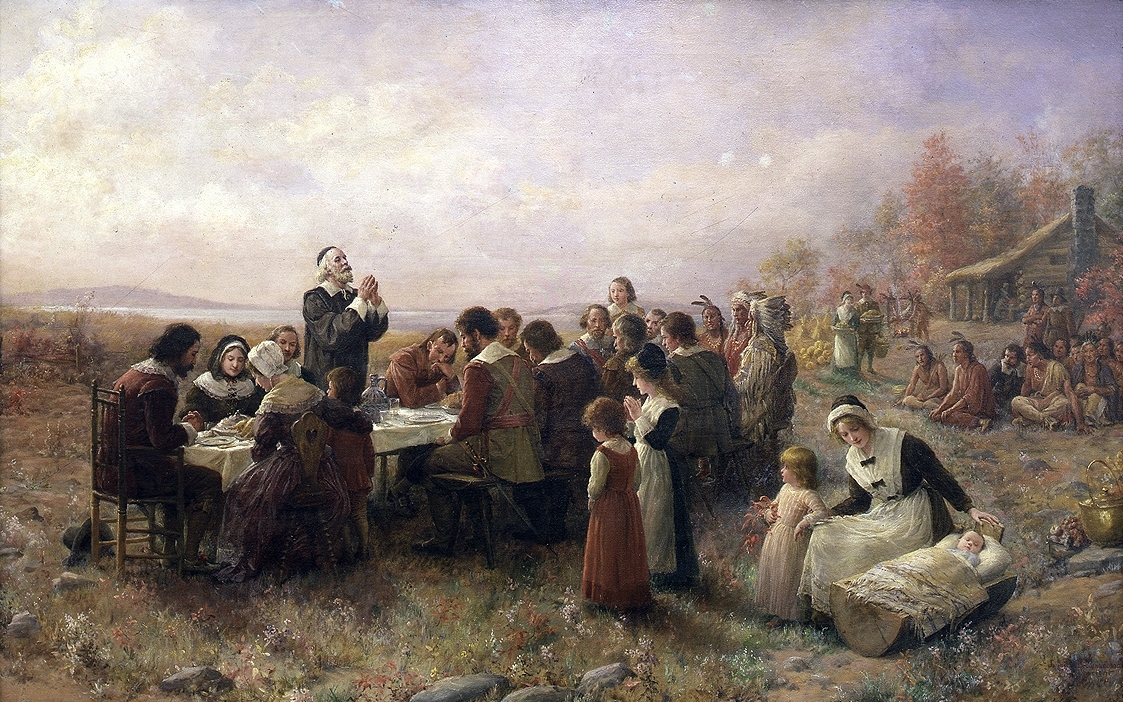
Thanksgivings are a normal part of Christian societies, and while not legislated into permanent existence in the United States until 1863, America had seen countless Thanksgivings before that, whereby Americans gave thanks to their God for the bounties of the earth and of their work.  The traditional “First Thanksgiving” was held by English Dissenters of the Plymouth Colony in 1621.  Those colonists who had lived through the first winter celebrated their survival and the success of their first harvest.  Their survival and their harvest success were both due in part to help from the local Wampanoags under under Massasoit, who provided food and helped teach corn cultivation.  The English Dissenters were refugees from the violent religious warfare that ripped through Europe in the 16th and 17th centuries; and these refugees with a completely alien religion, language, ethnicity, and political values were nonetheless welcomed and given welfare by the Americans already here.  For that, and for their survival of the first year’s trial in their newly adopted home, the colonists gave thanks to their God.

A decade later, John Winthrop (later the governor of the Massachusetts Bay Colony) delivered his “Modell of Christian Charitie.”  Winthrop articulated a vision of a new America to come.  He expresses essentially the sentiment of “there but for the grace of God,” arguing that we are all born into circumstances at God’s pleasure.  The rich and poor alike, Winthrop asserts, have God to credit with their status (not their own labors or failures); and those born into – and escaping from – areas of terror and violence are likewise responsible only for their own agency in escaping their condition, not for the violence from which they strive to escape.  This argument played successfully with the various schools of English Christian immigrants in America, who sought refuge from the horrific religious and political turbulence tearing Europe apart.  However, those surviving the journey (itself a dangerous ordeal), and those fewer who survived their first hungry winters, gave thanks for making it through the trials of their odyssey.  Winthrop’s City on a Hill was built by the refugees who were wise enough to save themselves, strong enough to survive cold and hunger, and humble enough to accept a helping hand from an alien people.

Since the founding of our City on a Hill, the United States has been a nation of refugees and immigrants, and of people brought here in chains.  All of these people were taken into an alien land, society, and culture.  Refugees, immigrants, slaves, and servants are who we are, and are who built this country.  Refugees seeking to escape violence, and immigrants seeking a better life created the new America; and the new America was built into a giant through slavery and forced labor.  While slaves built a massive cotton economy in the south, northern free workers (many of them recently arrived immigrants and refugees from famines and revolutions and turbulence in Europe and elsewhere) built mills, factories, roads, bridges, and railroads.  Slave-masters and company bosses both fought to keep their labor forces in chains, with blood spilt south and north alike by their efforts.  Banks and corporations were built by a government providing public resources and revenues to men of wealth, many of them going bankrupt despite these gifts and despite underpaying their workers, through sheer mismanagement.  Slave labor, and immigrants and refugees, built our cities and our farms; our infrastructure and institutions; our massive economy, our social system, and our political values.  Slaves, immigrants, and refugees are what we Americans are.

It is for the labor of those who came before us that we owe our wealth, our education, our security, and all else that we have.  It is for their labors we must give thanks, and it is for the gifts enabled by their labors that we owe a great debt.  We cannot repay that debt to slaves whipped to death, or to workers cut down by strikebreakers.  We cannot repay the debt to Native Americans killed by diseases brought to them by Europeans, or pushed off their lands later by Europeans or white Americans.  We cannot repay the debt to those no longer with us.  But the debt remains, and must be repaid, as a cost of maintaining our City on a Hill.  Our thanks is a beginning, but is not enough.  The debt can only be paid, and our thanks can only be truly given, by continuing to build the City our predecessors created.  The debt is paid, our thanks given, by welcoming new refugees into our land as new Americans, just as our Native American forebearers did – taking in a people looking, sounding, and thinking differently, because they need our help.  The debt is paid, our thanks given, by opening our borders to immigrants.  The debt is paid, our thanks given, by helping the sick and poor and hungry.  The debt is paid, our thanks given, by honoring descendants of slaves and free workers alike, making sure these people whose ancestors died building our nation have every opportunity to reap from the seeds sown by their fathers and mothers.  It is for the sacrifice and labor and strength; for the blood, sweat and tears; for both the liberties and personal agency as well as for the sacrifice and suffering of those who built this nation that we give thanks.  But just cutting a turkey, or watching the Lions lose, does not give thanks.  Building the City on a Hill, welcoming strangers and foreigners, using our wealth to fulfill the City’s mission by caring for our needy, and eradicating poverty and social inequality, are the only means our nation has, to give thanks and repay the debts incurred for our fortunes.

On Thanksgiving, enjoy your bounties, and enjoy your friends and family.  These have been given to us by those gone before us.  But remember that our bounties came at a cost which must be repaid.  And the repayment of that debt is simple to understand – we must fight to maintain and to build our City on a Hill, and welcome those coming to our nation as newfound builders and new celebrants of our freedoms and our wealth.  This is a positive feature of our nation; that we can move forward and achieve even more, but only if we repay those debts from the past.  Repay them, give thanks, and have a Happy Thanksgiving.

[image used, The First Thanksgiving at Plymouth, oil on canvas by Jennie Augusta Brownscombe (1914), found on Wikipedia.]

Why the Democrats are the New National Security Party

Gopper

Following a series of terrorist attacks in the Middle East and France, national security has become a vital issue in the continuing contest between the Democratic and Republican parties for the hearts and minds of the American voters.  Americans were particularly shocked by the Paris attacks, in a city seemingly far removed from the conflict zone of the Middle East, and especially considering the long and close relationship between the US and France.  Reacting with an almost post-911 frenzy, American pundits and social media commentators ratcheted up the panic level to maximum.  Seemingly reading the temperature of frightened Americans, the US House of Representatives pushed through House bill 4038, restricting the entry of Syrian and Iraqi refugees to the US.  Numerous state governments also issued arguably illegal restrictions of refugees to their own states as well, ignoring increasing evidence that refugees in France were not involved in the attacks (perpetrated by French and Belgian nationals), and contradicting France’s own immediate response of welcoming even more refugees.  As the election year draws ever closer, American voters will consider the two major parties’ (and their candidates’) responses to terror and their positions on national security policy.

First on the radar screen at the moment is Daesh (or the Islamic State; the author prefers the former term particularly as the group finds that term to be offensive to their image), the group behind last week’s terror.  Sadly, neither party has a cohesive plan (let alone an exit strategy) for pursuing war, with both parties apparently employing a “one-piece-at-a-time” chess-game strategy.  Candidates from both parties are reluctant to engage in another seemingly indefinite ground war, and the complexities of the Syrian civil war perplex the candidates on all sides.  Trump, Cruz, Bush and Christie (and Clinton on the Democratic stage) all urge a greater use of US airpower (most unrealistic is Trump’s focus on destroying oil facilities, which are of only minimal value in petroleum-poor Syria).  Trump and Carson both urge a greater ground effort in Iraq (containing Daesh to Syria, though neither candidate is willing to use the term “containment” to describe their strategy).  Bush has, since the latest wave of attacks, begun to favor the use of ground forces, but has not specified where or how, or how many, or with what objectives.  Paul wavers indecisively between calling the use of ground forces “unconstitutional,” and stating that he would use “…overwhelming force.  I wouldn’t mess around.”  He is as devoid of details as Bush, however.  Kasich favors invoking Article V of the NATO agreement, to “take care of business and come home,” but also has not said how either the deployment or the coming home would actually work.  Finally, Sanders, still trying to maintain relevance against Clinton’s rising popularity among Democrats, calls for a new, greater coalition (including Russia as well as the Muslim states of the Middle East).  Sanders, however, has not been able to explain how to defuse the increasing hostility and suspicion between the US and Russia.  With Russia bombing anti-Assad groups who have been aided by the US, there is much to do if Russia and the US are to work together instead of seeing the war as a zero-sum conflict between themselves.  No one on either side of the partisan divide has successfully addressed that issue.

Another issue of the Syrian war is the status of refugees seeking to escape the war zone.  On this issue, the parties have spelt out their differences far more prominently.  Republicans pushed through the House bill, and most of the state efforts to restrict refugees have come from Republican governors.  Republican candidates have said little to oppose restrictions, and have even called for “religious tests” denying Muslims refuge in favor of Christians.  Trump has even echoed Nazi racial programs by calling for the “registration” of Muslim refugees.  Sanders and Clinton have both (in league with President Obama) attacked such as un-American and un-Christian; and that argument has resonated with the evangelical community (normally a Republican stronghold).  Various commentators have linked Republican language of restrictions to Daesh’s specific goal of dividing America from the Muslim community, calling the Republicans out for surrendering in one fell swoop the terrorists’ most immediate political objective.

Taking the bipartisan confusion about the Syrian war together with the clear partisan divergence on the greater philosophy of conflict and engagement, we can define a reluctant tendency of a few Republican hotheads to push for a greater “imperial overreach,” while most candidates agree that a new war may simply not be in our national interest.  The Democrats, while being only slightly more (but questionably) reasoned and willing to lean on allies and other powers, see a clear link between the pursuit of war policy in the Middle East and maintaining our “shining City on a Hill” through one of our most American and liberal values, the compassion for refugees seeking a better life in a civil society.  Republicans are more willing to sink to the lowest common denominator of popular suspicion and resentment of the “Other,” and choose to empower themselves in a confusing conflict by taking power from those seeking asylum.  As with so many other issues, the Democrats’ approach seeks to build the City on a Hill; whereas the Republicans want only to wave the flag while denying its true meaning and value.  The Democrats’ approach also de-emphasizes the military aspect of the conflict in favor of the greater political conflict, while the Republicans confusedly wallow in the mud over tactical military problems without a greater appreciation of the politics driving the issue.

Iran is another issue more cohesively dividing the parties, both as an actor in the Syrian war, and as a power seeking a greater role in regional affairs.  All candidates recognize that Iran and Daesh are inherently opposed to each other, but they also fear what an increased role for Iran in Syria would mean for Israel, Lebanon, Iraq, and other regional states and issues.  Clearly as the US looks to regional states to step up and defeat Daesh, Iran’s massive and well-equipped military poses as a major potential ally; but a sudden US-Iran relationship could not be formed from that foundation alone, particularly as long as Iran and Israel both remain inherently hostile to each other.  As with Russia, Iran shows something of a zero-sum game approach to the conflict, with an Iranian defeat of Daesh as not necessarily in the strategic interest of the US (and with Iran viewing a potential US defeat of Daesh through a similar lens).  Neither US political party has developed a viable pathway to a US-Iran partnership on Syria.

Iran’s search for greater regional power and relevance further conflicts with American security policy on the nuclear weapons issue.  Flanked by  a hostile, nuclear-armed Israel to one side, and a hostile, nuclear-armed Pakistan to the other, and faced continuously by US naval forces in the Persian Gulf (themselves obviously backed by a massive nuclear deterrent), Iran has obvious motivations for acquiring a nuclear weapon.  Such a capability would force the US to use greater reflection before employing its military forces against Iran, and could theoretically increase Iranian prestige in the region (albeit also triggering a regional arms race, as Iran’s other regional rivals would seek to acquire their own nuclear deterrents).  The US, wishing to keep its military options on the table (and also fearing a potential Israeli-Iranian nuclear exchange), wishes also to keep Iran from getting a nuclear weapon.  This issue has driven the past year’s antagonistic partisan debate over the Joint Comprehensive Plan of Action (JCPOA) and related agreements, by which Iran has agreed to surrender the vast majority of its nuclear weapons production potential (in both its on-hand materials and its processing capacity).  Republicans responded to their growing irrelevance in international politics with alarmist misrepresentations of the agreement (relying on their supporters’ reluctance to read 160-page technical agreements).  The Democrats, on the other hand, were able to brush aside Republican arguments, although they did face some difficulties over Republican accusations regarding “secret language” in the Additional Protocols.  Nevertheless, the Democrats secured a victory both internationally as well as domestically, in first pushing Iran to the peace table (through Clinton’s construction, as Secretary of State, of a rigid international sanctions environment), and second in getting the agreement approved over the opposition of the conservatives of both nations.

Another major security problem for the US is Russian expansionism.  Republicans have scored points by recalling Obama’s 2012 criticism of Mitt Romney, telling the governor that US-Russian conflict was a thing of the past.  Sanders hopes in effect to prove Obama right by developing a more productive relationship with Russia; but has not indicated how he would make that happen.  The Republicans dither between Trump and Fiorina imagining themselves using their corporate boardroom experience to build a better relationship (disregarding the historic lack of success that American business leaders have had in using business strategy in international politics), and Carson’s details-free “position of strength” exhortations.  Clinton is the only candidate with actual experience in negotiating with Russia and Putin; although her track record there is a combination of both successes and failures.  Otherwise, Republicans do not actually say what they would do differently from each other, or from Obama.  They attack Obama as somehow impotent in the face of Russian expansion into the Ukraine and Syria; but they ignore their own party’s failure in preventing or halting an actual outbreak of war between Russia and Georgia in 2008.  They have offered no actual solutions not already explored or implemented, only insisting that their sheer Republicanness would somehow force Putin to back down (despite the fact that that did not work the last time they tried it).  The Democrats, with Sanders’ vague intent to partner with Russia, and Clinton’s actual experience in doing so, therefore show a modest superiority over the Republicans, who seem more confused and torn over what to do (and over how to frame a campaign statement about it).

Finally, the Democrats claim a right to a major national security interest that the Republicans have traditionally denied en masse: the threat posed by climate change.  A few of the current flock of “clown car” candidates, however, see the issue as an arena in which to grab moderate American voters, and so the GOP’s diversity on that issue has grown.  Trump, Huckabee, Cruz, and Carson are still flatly in denial; while Fiorina, Rubio, and Paul are willing to concede that something freaky is happening, but all demonstrably oppose any  government action to limit or reverse the process.  Kasich, Christie, and Bush all recognize climate change as the real result of human actions; but they only see the need for the most limited of government action to curtail the problem.  Clinton can also be shown as having only limited commitment, having (while serving as Secretary of State) pushed fossil-fuels development as a key to foreign states’ overall energy independence; but her language is far more hawkish and she supports the president’s Clean Power Plan.  She may well have been steered to the left by Sanders’ more inflammatory language (describing climate change, at least before the recent wave of attacks, as the greatest threat to the US).  Martin O’Malley has fought for relevance from his single-digit approval ratings by in part pushing a far more detailed and comprehensive Clean Energy plan than have either of his Democratic rivals.  Both parties have therefore used the issue not merely to hammer the other party, but as an in-party arena to attract different political constituencies.  However, across the board, the Democrats have called unapologetically for greater action, while the Republicans’ most “radical” elements call simply for limited action at best, preferring to rely on private corporations’ good will to accomplish energy transformation and ecological protections.  The most popular Republican candidates fall on the flat denial side (although collectively those “most popular candidates” still poll at less than half among total Republican supporters).  Overall, the Democrats continue to be the party most willing to pursue actual reform on environmental and energy policy.

The Democrats can lay claim, therefore to being the US’s “National Security Party,” having by far the more coherent view of American security interests, as well as potential solutions to current problems.  Neither party really has much of a vision for Syria; but the Republican “fire and forget” military strategy applied in Iraq (and which created the Daesh problem in the first place) still remains their preferred alternative.  The Democrats see the need for a more philosophically consistent political conflict, between the American City on a Hill and an extremist, deliberately antidemocratic way of life, using our nation’s greatest assets and the power of modern information systems to push Daesh into irrelevance while using limited military efforts to neutralize physical targets as they manifest themselves.  The Democrats also have a far better plan (and history) of dealing with Iran, although there, too, both parties suffer from strategic myopia.  Even more short-sightedness is evident on the Russian front; but the Democrats have the greater experience and willingness not just to talk but also to listen, a fundamental step to repairing relationships.  Finally, on climate change, the Democrats have a much clearer vision of both the scope of the problem and the venue for solutions, a vision far more consistent with the actual data acquired by climate scientists.  As we near the start of the election year, the Democrats have demonstrated themselves as the party most capable of facing and solving our most vital national security problems.