The Discomfort of Thoughtful Politics

Quote of the Week:  Too often we enjoy the comfort of opinion without the discomfort of thought. –John F. Kennedy

When I saw this quote of Kennedy’s recently, obviously the first thing I thought about was the Trump trainwreck – er, sorry; “campaign,” I think we are calling it now.  However, I realized that as a Thinker-American (we are a small but vibrant community), it is just too easy to pick on the intellectually weak.  Furthermore, none of the trumpenproletariat are likely to be reading this and to be pushed to test their synapses for electrical power.  I realized that my picking on Trump would be simply another voice in the echo chamber; and echo chambers are themselves a part of the problem that has let the bottom-feeders of our polity out into the air to claim legitimacy.  Instead, it is more fruitful to test my own political faith and my claims to intellect, as well as those reading this blog, by reminding all of us (myself most definitely included) that in politics, and in so many other areas, we participate in too many activities that reinforce beliefs and emotions, without adding data or requiring thought.  Sanders supporters and Clinton supporters yell at each other without even stopping to listen, as if they were Democrats and Republicans (and that latter pairing itself is more incapable of working together or listening to each other than in the past).  They each then go back to their echo chambers, hear the same combination of facts, arguments, and opinions, and go back reinforced to refuse to listen once again to the other side.  Supporters of the various Republican candidates do the same to each other.  This nation has no real political discourse between opponents.

The internet has helped mightily to create and reinforce these echo chambers.  Individual claims become “facts” on the internet to those readers who do not take the time to test claims that fit nicely into their view of the world.  Figures and charts and other seemingly legitimate data are coddled together without real research from vetted sources or any attempt at peer review before publishing. On the other hand, facts that do not fit are simply, conveniently, discarded.  We use an impossibly rigid system of looking at facts and arguments from the other side (that creates a virtually impenetrable barrier); but take as already given, vetted, and proven the slightest claim or remotely “fact-esque” opinion that agrees with our own.  In doing so, we claim to be “thinking”; but we are really only engaging in the comfort of opinion without risking the discomfort of thought.

The next time you hear an opponent – even one with the obvious logical and factual flaws of Trump – argue their side, check your own motivations to dismiss them, and your own factual basis.  And the next time you hear someone on your side present their stump speech, check your motivations to agree, and the factual basis of your own argument.  Then re-check them.  Then do it again.  Think about why your politics are “better” than those of someone else; and think about why your opponents may also have a legitimate viewpoint worthy of consideration.

Are you ready to believe six impossible things before breakfast?  (Just ask Alice.)  Then you may be ready for the discomfort of thought.  If not, then leave your echo chamber, lock the door behind you, drink some more coffee, and try to do it by the close of business.

Headline image via Google Image Search.

The Timing of Political Revolution

Presidential candidate Senator Bernie Sanders says that now is the time for “political revolution.”  As a campaign slogan, it is catchy, and the evidence from the only two (and disproportionately white) states to vote in the primaries thus far is that it is catching on.  Young people especially are flocking to Sanders and to his message of “political revolution.”  But are the Sanders supporters (and the Senator himself) correct about the timing?  Is it, indeed, really time for a “political revolution”?

I myself am a socialist, of the variety referred to within the large and diverse leftist community as a “trade union socialist.”  We believe in the formation and use of democratic union organizations as a foundation of pushing through a greater democratization of both our economy and our government.  In the United States, trade-union socialists generally vote Democrat (or for the Green Party in local elections); as have I specifically.  Trade-union socialists are the primary constituency of the Democratic Socialists of America, an organization that has had a long and friendly relationship with Senator Sanders (a contributor to DSA newsletters, and of DSA values).  Sanders has for years been our spearhead.  He has pushed moderate socialist ideals into the legislative conversation.  Despite being an independent (still so listed in the Senate), he has also pushed actual Democrats into remembering and representing their leftist values.  Sanders has had a bountiful impact on American politics.

However, I disagree with the Senator about the timing of political revolution.  I have historical reasons, as well as concerns after viewing the past few years of politics.  Over a century ago, from 1904 to 1905, the Russian Empire was at war with Japan.  The war did not go well for Russia, despite having an overwhelmingly larger army and navy.  The new Japanese military operated on far more modern theories of war, and emphasized much greater modernized training than was found in the Russian military.  After repeated military setbacks, in January of 1905, a revolution began in Russia, mostly spontaneously.  The peasants (who formed the bulk of the personnel in the military, as well as the country’s population) rose up against the regime in protest against the great bloodshed among their own.

The organization that became the Communist Party (at the time called the Russian Socialist Democratic Labor Party, or RSDLP) had already fragmented into a small, radical “Bolshevik” group (led by Lenin); and a larger, more moderate “Menshevik” group (of whom Trotsky was a prominent spokesperson).  With a revolution apparently happening all by itself, the socialists considered what to do about it.  Trotsky saw that the rising was the people’s way of telling the socialists that now was the time.  He also saw it necessary to take the reins and lead the rising so that it ended not in defeat, bloodshed, and more repression; but instead with some measure of democratization of Russian society and government.

Lenin disagreed.  He looked at the rising, by traditionally conservative peasants (the Russian Orthodox Church itself had many clergy acting as leaders of the rising), not as a good sign but as an omen that the people were not ready, and now was not the time to agitate.  He saw a peasant revolution in 1905 as likely to take Russia backwards rather than forward.  The RSDLP largely agreed, regardless of the factional split.  Their concept of revolution was based on modernized, urban industrial workers, not the peasants; and the workers were still a relatively tiny sector of the population.  They feared that conservative peasants would oppose educational reforms, modernization of the economy and infrastructure, and the development of a more inclusive culture (all of which were key platforms for the RSDLP).  Ultimately, the RSDLP stood aside, while a smaller faction followed Trotsky into the revolution and into the new Russian government.  In little time, the Revolution of 1905 was unmade as the Tsar showed himself disinterested in working with a more democratic government.  Finally, World War I erased almost all of what little good the revolution accomplished; and a new revolution (two, in fact) took place in 1917.

The Russian Revolution of 1905 has great relevance to Sanders’s idea of “political revolution.”  Many Americans are, like the Russian peasants of 1905, very conservative; distrusting of outsiders, and of new ideas.  Consider the past few years, as Democrats have used the power of the White House, of the Congress before 2014, and of new social media venues, to try building a greater City on a Hill.  In the meantime, we have seen great push-back.  How much does the Black Lives Matter movement resonate among white voters?  The movement argues only that blacks should not be needlessly targeted for violent reactions by the police.  Is that a “radical” suggestion?  How many Americans, after the BLM campaign, clung ever more tightly to the Confederate Battle Flag as a symbol of the racist America they wanted to maintain?  How hard has Planned Parenthood and other women’s health organizations had to fight – not for an expansion of services, but only to continue those services legally guaranteed by Roe v. Wade?  Furthermore, it took the US Supreme Court to overturn “marriage amendments” across the nation; and when a Kentucky county clerk told the Court they could go stuff it, a massive upswelling of support stood behind her.  There is still a discouraging proportion of Americans who hate Obama for no other reason than that they still see his color, and political power, as indicative that he is not even American, or Christian (and we will move past the further point of why his being Christian should even matter in a nation that pretends to value “religious freedom”).  These people will all be voting in 2016; and in the mid-terms in 2018.  How much “political revolution” can we expect from these voters?  And what kind of revolution do you expect to see from frightened, and frighteningly well armed, white men?

Sanders is not the only candidate promising political revolution.  Donald Trump has created a movement of trumpenproletariat from whole cloth, from segments of the population that rarely vote.  By moving increasingly conservative and xenophobic people to the polls, his promise to “make America great again” promises precisely to undo everything that has made our nation great already.  Each victory we have enjoyed – and we have had many – is seen as a “defeat” by this anti-American who wants to tear down the City on a Hill and build a parking structure in its place.  If we have a political revolution in 2016, Trump and his petty-fascist followers are promising to be the leaders of that revolution.  It takes a certain naive optimism to presume that “political revolution” is going to go the way Sanders proposes.  Even presuming Trump loses, his fascist army will still be fighting out there in the streets of the information superhighway, on Facebook and Twitter and Snapchat.  They will vote locally while voting for the president, and keep pushing Congress ever more to a radical right extremism that undoes everything we have accomplished over the last half century.

This is not the time for a political revolution.  This is not the time to radicalize heavily armed Americans already suspicious of their government, of new ideas, of people with different skin colors and accents and clothes and religions.  This is a time to consolidate those gains we have made, and to prevent the Right from making further inroads to our rights and our prosperity.  This is the time to build the City on a Hill by speaking to those values most Americans hold dear.  The last half a century has seen progress, and the promise of a new America that is more inclusive and more prosperous than ever before; that builds and shares more wealth than we have ever seen.  But that progress is at risk.  And promises of political revolution threaten to undo that progress, to destroy the foundations of a more inclusive, more productive, more secure America that we have barely begun constructing.

In the 1930s, there was another moment when political revolution was advocated.  Germany had a much larger and better organized socialist movement, and a century previously had led the world in creating what today we think of as modern liberalism.  That very state did see a revolution in the 1930s – a revolution of exactly the type of people that Karl Marx feared would undo all of our leftist values, and exactly the type of people that Donald Trump is bringing together.  With even stronger leftist assets and credentials than the US has today, Germany pushed over into a radical right-wing nightmare that makes today’s Republican party look democratic, inclusive, and reasonable in comparison.  This happened in the home of modern liberalism, and the home of a strong socialist movement.  Political revolution was argued by both left and right.  And when revolution came, those voices who had first advocated it were not its leaders, but its victims.

The last few years of conservative retraction demonstrates that the United States does not possess the capabilities needed for moving a leftist, or even just liberal, political revolution past the trumpenproletariat and past our own conservative peasants.  We have not one, but two candidates who are arguing for a political revolution.  Unlike Trump, Bernie Sanders is a great, principled, and honest leader.  But his promise to light the flame of political revolution is naive and dangerous.  Before you light the flame, be sure you know who is going to be carrying the torch.

Headline image by Ben Sarle, via Sanders campaign on Facebook.

Growing a Family with Water in Flint

The Guys from Texas

While the city of Flint, Michigan waits for a long-term resolution for its beleaguered water system, as its citizens struggle from day to day for the most basic of needs, that of water, the people of Flint look eagerly to any support they can get.  For now, at least, the city is blessed with the limelight and the attention of our fickle media.  Help is coming in from across the state and across the nation; at least for now.  This is the story of four amazing men who joined in that drive, and built new family connections in the process.

After my recent volunteer experience, I went back to Flint on Saturday with my wife Tonya and our young friend Joshua.  This time, we ended up getting sent by the Red Cross to Crossing Water, operating out of St. Michael’s Catholic Church.  We spoke with Michael Hood, program director, who is sending support teams to Flint households to determine families’ needs and provide for them as best they can (Crossing Water was also the subject of another writer’s experience, which I re-blogged here). The group is currently working very hard to find people with the most urgent circumstances and get them some relief: disabled people unable to lift and carry cases of water, mothers of young babies that require clean water for mixing formula, undocumented people lacking the proper identification to show the National Guard workers checking residents through the water pick-up stations, home-bound elderly folks without access to the pick-up stations, etc.

While talking with Michael (in a room filled with eager volunteers, many also sent from the Red Cross), we met four young men (see photo above; from left to right):  Samah Haider, Wajahat Zaidi, Daniyal Taqvi, and Mohammed Bhayani.  These four men had arrived in the room through a very different path from the rest of us.  They had just arrived in a U-Haul truck filled with 12,000 bottles of water (300 cases, in six pallets), and they had driven up from Texas to help get water to the needy families of Flint.  I spoke later with Daniyal Taqvi, and learned how they had made their way to Michigan.

Earlier in the week, Daniyal had been watching TV, and he saw news reports of Flint children suffering from lead poisoning and going to the hospital with tragic complications.  That image truly brought the reality of Flint’s crisis home to him.  Daniyal is a board member of the Houston chapter of the “Who is Hussain” organization (an Islamic organization whose Michigan chapter has already contributed directly to Flint, with over 30,000 bottles).  As Daniyal explained to me, Hussain ibn Ali, the martyr honored by the group, died while suffering from thirst.  “Water is something that touches a bond with us,” Daniyal said.  “All people need water, and as a human being, it is my responsibility to be able to provide water to them.”

Already experienced in working together on food and water drives in Houston, Dallas, and Austin (for the homeless, and to help build the Muslim community), these four young men were able to use the Who is Hussain structure and other elements of Houston’s Muslim community to collect some $1,500 for Flint in three days.  But they did not just want to send money.  Daniyal explained that maintaining a human connection with the care that these men were providing, and with the community they were aiding, was for them a key part of that care.  During our conversation, Daniyal was close to tears as he described the love and human closeness that he felt with those of us who joined his team, and with those to whom he gave water.

As the four men made their way up north in a rented car, they had little idea of what was to happen on arrival.  Their way was eased by compassionate souls in the rental company, and in a bank helping with the trip’s finances.  Daniyal tells me that in both places, the companies waived various fees when they learned of the group’s mission, to help them get aid to the north.  However, despite this aid, and the money raised in Houston, the group wanted to dedicate the donations entirely for water; so all actual costs of the trip itself were borne by the four men as part of their own donation to the cause.

Never having been to Michigan in the winter, the team expected a frozen winter wasteland, and they were bemused by the unseasonably mild temperatures and the lack of snow on the ground.  They arrived in Dearborn, rented a U-Haul, bought 6 pallets of water from Sam’s Club, and drove to Flint.  After using Google to locate aid centers in Flint, the men got the email of an organizer at St. Michael’s church at 609 E 5th Ave; and the men finally found themselves in a room with Crossing Water’s Michael Hood, and with about 15 Red Cross volunteers, including my own little team, Jason Garcia and his family, and others.

Michael Hood’s phased operation (mapping out needs, and then getting water to those specific people needing it) was a longer-term and broad-based system of care, and our Texan friends wanted to get water into the hands of those needing it rather more quickly, and more personally.  They did, however, donate about a third of their supply to Crossing Water (two pallets; about 4,000 bottles in 100 cases).  As they began unloading cases onto the ground, we formed a daisy chain together to get the cases from the truck to the church, and into a storage area inside.  As we unloaded, cars driving by inquired about getting water, and we gave some of them cases of water as well.

Water Truck

Samah and Daniyal getting ready to unload the last of the two pallets for Crossing Water.  Photo by Jason Garcia.

Once the church’s storage room was full, Daniyal and his team-mates wanted to go into Flint neighborhoods to deliver water personally, their main motivation in coming all the way to Michigan from Texas.  We met a Flint woman who needed water; and she told us that her whole neighborhood needed water.  Soon a convoy was formed, headed by the Flint native’s car, followed by myself, the water truck, and a couple of other cars of Red Cross volunteers.  Other volunteers remained with Crossing Water to help with their canvassing campaign.  Meanwhile, our watering convoy descended on northwest Flint, in the area of Dupont Street and Martin Luther King, Jr. Ave.  We went door-to-door; some of us contacting residents to find out who needed water, while others did the heavy lifting and moved cases to those homes needing it.  The volunteers’ cars all had water as well (which we had all brought to donate), and we emptied out our car stashes while also taking cases from the truck.

In that first neighborhood, a resident told us about another nearby neighborhood needing water, and we found our way to a building with many elderly residents (many without cars and unable to get to the drive-through pick-up locations).  We formed another daisy chain, and unloaded a pallet’s worth or so into a central holding area that a building resident had identified as the best place to leave water where everyone could get to it.  While we were there, an elderly lady began crying when she talked to Daniyal, learning that help had come to her all the way from Texas.

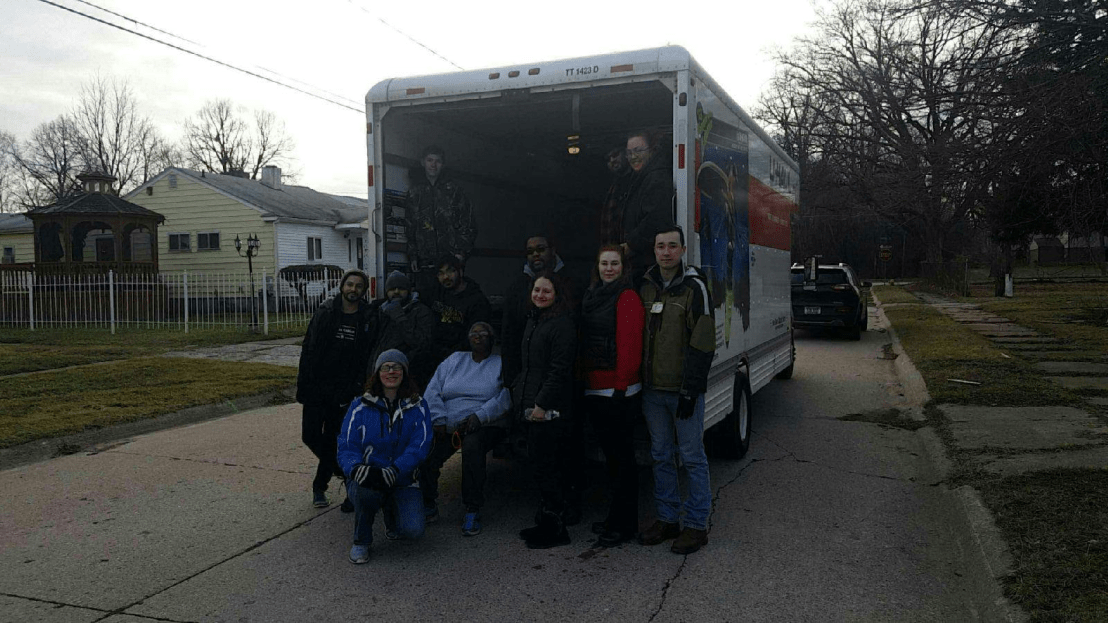
Another resident told us about a government housing project, Aldridge Place, that was very large and very needy.  She agreed to show us the way, and our mobile watering army followed her there.  It was indeed a large complex, with numerous buildings and cul-de-sacs.  We simply dropped off a case at each door, knocking to alert residents, many of whom came out and thanked us as we worked.  As one resident saw Daniyal moving a case of water, she also began crying, hugged him, and said, “Everything’s getting better.”  Finally, with only a little water left in the truck, the Flint native who had led us to the project showed us to a last nearby neighborhood where we unloaded cases at each house that showed signs of occupancy.  At last the truck was empty.  We all thanked each other, hugged or shook hands, took pictures of the truck with our tired little army, and then called it a day.  (My family met up with our new Texan friends for dinner in Dearborn later in the evening, but that’s another story.)
Tired Relief Crew.png

A tired relief crew at the end of the day.

When I asked Daniyal what motivated them all to do such charitable work, he reminded me that we are all human beings, first and foremost, whatever else we may be.  He also felt it important that, with so much of the media’s attention focused on bad examples of Muslims, Americans should see the positive impact that Muslims and their faith can play in our society, with Islam’s own unique imperatives of charity and brotherhood.  His own organization, Who is Hussain, has organized other water drives in Flint, as well as peace rallies in the wake of last year’s darkest moments of terrorism.

Daniyal has come away from this experience with a deep sense of family connection with us in Michigan.  He feels new, profound connections with those like myself who followed the lead of these men and helped them fulfill their mission of mercy.  And he also feels a profound connection to those needy to whom he gave water, a meaningful and spiritual experience for him.  These men came to give; but they got back something that they felt distanced from in the north – family.  Daniyal was touched by the realization that “humanity still exists,” that while not everyone is equally blessed, those with more can share their blessings with those who have less.  Daniyal wishes now that everyone could do something like this at least once; to realize we are all part of a greater human family.  He, Samah, Mohammed, and Wajahat are proud to have given water to their family.

Flint is only one place in the US that needs help, as much as it lies on the headlines of today’s papers and internet sites.  My city in Michigan, or their cities in Texas, could be among the next places that need outside assistance, that need good people like these to come from other towns to help.  These men did not come here to help people that looked or dressed or worshiped like them.  They came here as people, to help other people in need, members of the same community of mankind regardless of petty differences.  They came here in the best tradition of their faith, and of the nation we all share, traditions that call for all people with extra resources to help those without.  This is the ultimate meaning of our City on a Hill, the building of a community of care and welfare.

Those politicians and extremists who call for restricting entry to our City of people in need of shelter (some of whom look precisely like these four amazing men from Texas) are not building our City, or defending our nation or what it stands for.  And they threaten the ties that build our nation – the ties between the diverse communities and cultures of our City.  Such ties will be needed more than ever as our nation’s infrastructure ages, as political rhetoric demonizes and marginalizes the poor and the different, as some Americans refuse to accept others as members of the same human race.  Instead of such politicians and pundits, we need more men like these four.  We need more men like Daniyal Taqvi, like Mohammed Bhayani, like Samah Haider, and like Wajahat Zaidi – they are the true builders of our City, examples of our best traditions, and leaders who give real meaning to our values.

With special thanks to Jason Garcia, Michael Hood, John Gleason; and of course our new brothers in Texas.

Whom Are We Allowed to Criticize?

Quote of the Week:  To learn who rules over you, simply find out whom you are not allowed to criticize. –Voltaire

As an American citizen, I have a strong appreciation for the First Amendment to the US Constitution, guaranteeing our rights to free speech, and the freedoms of religion, press, and assembly; as well as the less-cited right to petition the government for redress of grievances.  All of these rights work together in harmony to allow us the right to criticize whomever we please – in theory.  Obviously, the Constitution was never purported to be a perfect document; and there are glaring omissions from the point of view of modern society.  For example, major corporations were beyond the imagination of the framers of the Constitution; and so corporate powers over individuals, communities, and even our government specifically are completely unrestrained by any line of the Constitution.

In fact, every grouping of people outside of the government proper has the power to restrict rights of all people joining those groups (besides often working to limit rights of others outside the group).  Churches can require members to follow religious rules; families, companies, and other groups can control speech as rigidly as they please; and so forth.  While the Constitution protects rights to criticize other groups, we are losing the fight within groups.  This becomes evident as political divisiveness and the vitriol of rhetoric separate factions within political parties as deeply as they separate the parties themselves.  As Democratic and Republican campaigns for the nomination to the presidency heat up, invective not only between but also within the campaigns is also heating up.  There is an ever-increasing expectation of ideological conformity within the campaigns.  Trump supporters (the trumpenproletariat) become ever more shrill in favor of their candidate, and eat each other alive when any of them expresses doubt or recognizes a flaw in their candidate.  The supporters of other campaigns do the same.  As a Clinton supporter myself, I have received the most vicious criticisms on Facebook from fellow Clinton supporters (whenever reflecting on weaknesses, like her Wall Street connections and her Iraq vote), while Sanders supporters and Republicans have been far less nasty.  While some members of both parties’ campaigns complain about attacks by other candidates from the same party, I have seen fierce expectations of conformity within the members of several individual campaigns.

This bipartisan expectation of conformity is troubling indeed.  It demonstrates that whatever the Constitution says, we are not allowed to criticize those very individuals asking us for our vote and purporting to represent our interests and views.  That is not a foundation of democracy; that is a weakness that can potentially undermine our democracy.  None of our candidates are perfect (if you will excuse the understatement); and we must express our doubts not only about those we are fighting against, but of those for whom we are fighting.  If we do not, the very point of this fighting is lost.

Headline image via Google Image Search

Helping Out in Flint

Helping in Flint.png

On Friday, February 5, 2016, Spark! joined with the Michigan Democratic Party and other groups in supporting the relief drive in Flint, Michigan.  The Red Cross Blood Donation Center (1401 S Grand Traverse Street) has been dispatching volunteers to various local charities, churches, and other organizations to provide water and other supports to residents affected by the water crisis.  They provide water directly to houses, and also maintain drive-through water pick-up locations, where drivers can simply pull up and have cases of water, and/or gallon jugs, packed into their car.

I participated in one such activity for several hours at one of Flint’s Center of Hope locations (at 517 E 5th Avenue), along with various people volunteering from other organizations (in the picture above, for example, a couple of the volunteers are US Navy recruiters).  We unloaded pallets of water from a truck brought to the site; and packed cases into cars, vans, and trucks as they rolled up (four cases per adult in each vehicle).  We also received a large number of water donations (sort of a “take some water, leave some water” activity).  Many of the volunteers (myself included) also brought some of their own water donations as well.

The Red Cross in Flint can be reached at (810) 232-1401.  They operate volunteer support teams seven days a week, mostly from 9:00am – 4:00pm.  Please come and help them.

You can read more about how this crisis occurred in Part I of my “Special Report: Flint in Crisis”; and about what Flint needs (and how to help) in Part II.  You can also read a touching story about the human impact of these events that I re-blogged from another writer.

Headline image © 2016, Sparkpolitical.  All rights reserved.

Genius, Mediocrity, and the Perception of Victory

Quote of the Week:  Only mediocrity can be trusted to be always at its best. Genius must always have lapses proportionate to its triumphs. –Max Beerbohm

As a political writer, I take these words to heart.  They are especially relevant to the risks that a writer must take as a natural part of the process.  Not everything I do ever ends up being perfect; and it is astounding how completely different something I have in my head looks once I start putting it into words.  Even outlines and drafts change radically as I enter words here, and often the transformation can be not only astounding but disheartening.  Sometimes I have ideas that work just fine in theory but come out looking more like something I would have written in high school.  At any rate, Beerbohm’s words indicate that as a writer I should be prepared to face a possible disaster (a “lapse of genius,” if you will) in order to strive for the higher goal of a well-constructed and delivered argument.

Looking past my own concerns, Beerbohm’s words are also relevant to the recent Iowa Caucus.  Two candidates in particular (Clinton and Trump), as well as the media, made their results out to be more than what they really are.  Clinton’s “virtual tie” (to use Bernie Sanders’s description) is painted instead as a “victory” (in a state she was expected to win, and by a good margin); at least in part because she is also expected to lose New Hampshire to Sanders, and needs to prevent a perception building up of an unstoppable Sanders momentum.  However, Clinton does have hope on the horizon, in the shape of Nevada (possibly), South Carolina, and Super Tuesday.  South Carolina in particular should be a big win for Clinton, and it is difficult to see how Sanders will keep up in the multiple-front onslaught of Super Tuesday.  But to get her there, Clinton strives to shape perceptions of her campaign as the unbeatable juggernaut.  She simply changed expectations at the last minute by having it appear that any win, even by the tiniest margin, was a “great victory,” regardless of the omens portended by Iowa.  But Clinton is a genius of political organizing, and that includes being married to another great political organizer.  Mediocrity is not a problem that Clinton suffers; and the campaign need not fear its lapse.  The genius of organization behind the Clinton machine should be allowed to consider soberly the reality of Iowa and find a way to connect to the new, young voter (who is overwhelmingly in favor of Sanders, and who well may play a vital role, as young voters did in 2008).  The genius of Clinton should be allowed its lapse; and it should be allowed to see and portray that lapse as what it is – not a fatal weakness, but a problem that needs to be fixed as the campaign moves on to its next objective.

Similarly, Donald Trump brought in a much lower percentage of Iowans than his pre-caucus poll numbers indicated.  Those numbers gave him a second place not far from the first, held by Ted Cruz, but also even closer (by a single percentage point) to Marco Rubio’s third place.  Trump is underplaying the result, treating it as if it had been expected.  Yet Trump had more campaign stops in Iowa than any other GOP candidate.  He clearly invested far more resources in, and expected far greater results from, the people of Iowa (despite at one point insulting them by asking, “How stupid are the people of Iowa?”).  He also moves on to New Hampshire, a state where he is expected to do much better – a likely win.  And yet, the New Hampshire primary is basically “small time,” and like Iowa allows for much time and preparation, neither of which will be available for subsequent steps like Super Tuesday.  Trump’s failure to understand the voters, to understand the campaign process, and to understand his own rivals for the nomination (Rubio especially, whom Trump simply never saw coming) indicates not so much a “genius” showing an inevitable lapse, but the expected results of mediocrity trying to compete with its betters.

With Trump in Iowa, we see mediocrity at its best; unable to look past his own nose, or hear past the crowd of those around him.  Whereas with Clinton, we see political genius afraid to allow itself the comfort of a clear lapse.  For the good of the American political process, Trump’s mediocrity would best continue to “be always at its best,” but Clinton’s genius should be allowed to experience both its first lapse as well as its potential future triumphs.

Headline image via Google Image Search

No words….

This post delivers a far more personal touch on the Flint Water Crisis than what many bloggers and reporters (myself included) have provided. It’s well worth the read.

Beverly Davidson, LMSW's avatarVoices from the Infant, Toddler and Family Field

Yesterday two of my friends and I had the honor of volunteering in Flint, MI for a small NGO called Crossing Water.   This is a volunteer organization started by some members of the National Association of Social Workers-MI chapter.  The goal of this group is to create connections among community groups in Flint to help serve impoverished communities who are deeply affected by the current water crisis.  What I saw was heart-breaking beyond words.  And it was only one day there.  I am trying to imagine living this way and I can’t.

We came to a low-income housing complex run by the Flint Housing Commission.  I saw a case of water on people’s doorsteps that had been delivered earlier in the day by volunteers.  There was no governmental system in the complex to test water, distribute water, or provide lead-testing to the children.  This is a complex managed essentially…

View original post 1,885 more words

Flint in Crisis, Part II: Friends in Need

With the city of Flint, Michigan, still deeply in need of aid and support in its continuing water emergency, we move from the basic causal events leading up to this January (detailed in Part I of this report earlier in the week), to a fuller examination of the problem at hand, and what needs to be done to fix the problem.

Flint is no longer using its contaminated river; and is back on Detroit’s water supply, having hooked back up last October.  However, as MSNBC’s Rachel Maddow stated recently in a televised town hall visit to the town, “the damage is done.”  Flint’s older lead pipes are corroded, and some of Flint’s galvanized pipes have also been damaged by the corrosives (chloride in particular), and by lead eaten off of connecting pipes by those corrosives.  While the entire system has not been compromised, fixing those parts that are is proving to be a complicated, expensive, and long-term operation for a variety of reasons.  Until the system is fixed, many residents are living day-to-day by depending on bottled water supplies, for cooking, washing, and of course drinking.  For a large city in a modern nation to be denied access to safe running water is simply unthinkable.  Others are more fortunate, and have water filters for at least some of their fixtures; but they are still dependent on external support for regular replacement cartridges.  Cartridges need to be regularly replaced due to continuing high lead levels in the water, and are obviously in very high demand.  There are also test results showing that in some homes the lead levels in the water are too high even for filters to handle safely, in some cases by an order of magnitude.

Lead will continue to leach into the water in all parts of the system using the old lead pipes which have been compromised, until those pipes are either repaired or replaced.  In those parts of the system that are damaged, it is no longer a question of the source of the water in the pipes.  The cleanest water will still be contaminated with lead leaching out of the damaged pipes.  Those parts of the system where the pipes have not been damaged can now use the water coming through from Detroit since last October (although consumer confidence in the system will be another issue entirely).  But what parts of the system are damaged, where is the damage, and how extensive is that damage?  One big problem, identified by University of Michigan-Flint professor Martin Kaufman, is that Flint’s records on its own water system are questionable at best.  With little money for modern resources, Flint still uses an index card system for tracking work done on its pipes.  The cards are not even organized properly, and some of the records are out-dated and incorrect.  The city’s own water officials are in many cases unsure where some of the pipes are, in what condition, and of what construction.  So fixing the system requires much more than looking up where the lead pipes are and replacing those.

One potential solution would be to run anti-corrosives and a sealant through the pipes.  Phosphates, highly toxic chemicals, are useful in sealing corrosion on old pipes.  The problem still remains as to where those chemicals need to be applied.  But with phosphates, there are additional problems.  Unlike regular anti-corrosives that most municipal water systems use (which are only used for preventing corrosion, not for sealing already damaged pipes), phosphates are highly toxic and would need to be flushed out of the system (and the system tested for water safety).  They are also only a temporary fix.  The pipes would begin corroding again; and so would need continuous monitoring and testing (for lead to begin leaching back into the water; not a good way to convince consumers of the system’s safety), as well as repeated resealing for as long as those parts of the system were not replaced.

Furthermore, there is the problem of home damage beyond the damage to the city’s water system itself.  Flint master plumber and plumber’s union manager Harold Harrington, featured by Maddow and MSNBC’s Stephanie Gosk in an interview segment, suggests that homes damaged by the corrosives and/or experiencing high lead levels in the water may require from $3,000 to $10,000 of repairs each (pipes, fixtures, water heaters, etc.).  There are an estimated 15-20,000 homes that need water service repairs.  Harrington suggests that some 1,000 plumbers could do that part of the job relatively quickly; but no one in the government has allotted any funding or authorized any work toward that goal.  Obviously, expecting poor home-owners who were not at fault for the failure of the system to pay for these repairs themselves would be both financially unrealistic and morally bankrupt.

Senators Peters and Stabenow (both Democrats representing Michigan in Washington) are attempting to attach an amendment to the Energy Policy and Modernization Act under review in the Senate’s Energy Committee, which would provide as much as $400 million in federal EPA funding for fixing Flint’s water system, and require the state to match all federal funds with an equal appropriation.  The $800 million total, if approved and funded, would meet Governor Snyder’s January 14 estimate of $767 million for repairs (Flint’s mayor, Karen Weaver, estimates repair costs about twice as high; $1.5 billion).  Senator Lisa Murkowski (R-AK), chair of the committee, has not indicated any support for the measure, either for herself or her Republican colleagues, long opposed to federal infrastructural expenditures and oversight.  Sen. Murkowski has at least expressed support for a provision of the amendment enabling Michigan to use $21 million of an existing federal Drinking Water Revolving Loan for forgiving Flint for already incurred debts for its water acquisition.

In the meantime, beyond fixing the water system, Flint has many new problems to fix resulting from the damage already done.  Lead poisoning is irreversible; and whatever damage was done (especially to young children, who are especially vulnerable to lead poisoning) cannot be undone.  Parents, teachers, doctors, and counselors need to observe the children under their care for cognitive and physical indicators of lead poisoning, and provide supports to those children as needed.  Many of these children’s blood lead levels are now going back to normal, as they are back on clean water; so those levels will not indicate who will suffer from lead poisoning, or how extensive the damage will prove.  With Flint already under economic hardship, Flint’s schools (lacking medical personnel, for the most part – they only have “health navigators” to help find external medical supports) need vastly more money for more support programs and for on-site medical staff.  This money will have to come from external sources – the state and/or the federal government, both largely run by Republicans clinging tightly to the purse-strings.  State representative Sheldon Neeley (D-Flint) has asked the governor to forgive Flint’s public school system for its existing debts, as a way to help the schools create better programs and hire essential personnel.

Flint also needs other infrastructural development and investment.  There are virtually no major grocery stores easily accessible to poor residents (the Kroger stores there are on the outskirts, difficult to get to for poor residents).  Dr. Mona Hanna-Atisha, one of the principal doctors involved in alerting Flint to its lead problem and in pushing the local and state governments on the issue, insists that fresh vegetables and unprocessed foods are key needs for developing children.  Such needs will be especially important to families with children suffering from lead poisoning; and they are difficult to come by outside of larger grocery stores.  Such needs can also be expensive, and require greater preparation time.  These factors tend to steer poor families toward unhealthy, high-carb, high-calorie, processed foods (part of the so-called “ghetto tax” suffered by the poor).  Flint is merely the tip of the iceberg in the nation’s problem in providing opportunities and a healthy standard of living for its poor.  These problems plague all poor communities, rural and urban alike.

In the meantime, as Flint struggles to survive this calamity, some support is coming to the city from across the state and across the nation.  Celebrities, organizations, and private individuals are all chipping in with donations of money, water, and other supplies.  The most immediately pressing needs are bottled water and water filters (as well as cartridges for those filters), all of which are being consumed about as fast as they come in.  These needs will continue to be daily requirements for a great number of households until the infrastructural repair work is well underway, a process that has not even begun.  Most large-scale celebrity and corporate donations, while expressing great charity and solidarity, provide less than a day’s water for the city’s population of 100,000.  Flint needs everything it can get, and immediately.  Flint also needs volunteers to help with water distribution, and with blood-lead testing and other services.

While deeper ramifications of the crisis will be examined in Part III of this report (still to come), readers can help Flint now, by volunteering time, and/or donating funds and/or supplies.  For Michigan residents wishing to come in person to help, one of the principal centers of support is the Red Cross in Flint:

Red Cross Blood Donation Center, 1401 S Grand Traverse Street, Flint MI 48503.           (810) 232-1401

The United Way of Genesee County has set up a donations page for contributions to the Flint Water Fund:

http://www.unitedwaygenesee.org/civicrm/contribute/transact?reset=1&id=5

For other ideas on supporting Flint during this crisis, see the following:

MSNBC: How to help Flint, MI

CNN: How to help with the water crisis in Flint

Flint Water Response Team

Come back to Spark! later this week for Part III of this Special Report.

Headline image, volunteer for Who is Hussain preparing water donation to Flint, via Google Image Search.

The First Round of the Primaries

With all pundits’ attention riveted to the Iowa Caucus, the first real electoral event in the 2016 election cycle, it is worthwhile to step back and peruse what in vague terms the first month of the primaries and caucuses is going to involve.  For more information on the general process involved, check out Spark!‘s Primer on the Primaries.  Note that with one exception, all of the events below allot delegates by proportionate representation, so multiple candidates can (and will) come out of them with delegates to the conventions.

Timeline of events for the first month (Feb 1 – March 1):

Monday, Feb 1: Iowa Caucus (both parties)
Tuesday, Feb 9: New Hampshire Primary (both parties)
Saturday, Feb 20: Nevada Democratic Caucus (closed to GOP)
– also, South Carolina Republican Primary (open to all voters; and “winner takes all”)
Tuesday, Feb 23: Nevada Republican Caucus (closed to Democrats)
Saturday, Feb 27: South Carolina Democratic Primary (open)

Then (wait for it): Tuesday, March 1, Super Tuesday: 10 states will have primaries or caucuses for both parties simultaneously (AL, AR, GA, MA, MN, OK, TN, TX, VT, and VA); plus 6 more single-party primaries and caucuses (American Samoa D, Alaska R, Colorado D, Democrats abroad, North Dakota R, Wyoming R).

More events obviously will happen in March after Super Tuesday.  We have another article describing the second round of primaries (up through March 15, and including further discussion of Super Tuesday).  Spark! will bring you further updates as we get closer.

While Iowa is an exciting event for politicians, pundits, and anyone following electoral politics, it is nothing more than the symbolic beginning of the election cycle.  Only three candidates have ever gone from winning their party’s Iowa caucus to gaining the presidency in the same year:  Jimmy Carter in 1976 (who only had 27% of the Iowa Democrats in 1976; there were 37% “uncommitted” that year), George W. Bush in 2000, and Barack Obama in 2008.  Many candidates have emerged from Iowa in strength and were never heard from again; whereas the opposite has also been common. Bill Clinton, for example, seized a massive 2.8% of the Iowa Democratic Caucus in 1992 (losing overwhelmingly to Tom Harkin’s 76%; remember him? Yep, thought so).  Clinton went on to win both the nomination and the presidency.  Iowa is therefore not a predictable indicator of who will win in the end.

However, as the first electoral event, Iowa provides the opportunity and time for candidates to prepare offices, staffs, and support; and to get their message out.  It is a battle for a strong “out of the gate” position in the horse race to the nomination.  The results of Iowa are merely the bell clang of that race.  After Iowa, candidates have relatively short periods of time in which to prepare for state primaries and caucuses; and then Super Tuesday comes along, and the campaigns have to battle it out in multiple states simultaneously.  On Super Tuesday, they triage their resources as best they can, to win those states considered to be both in contest and winnable (as well as losable).  After Iowa, there is little chance for candidates and campaigns to take a breath.  Ultimately, therefore, what Iowa represents is not so much the strongest candidates or campaigns, or the ultimate likely victors; but rather just the beginning of the real test for how the candidates have prepared for the four month slug-fest of the primaries phase of the nomination process.

As you prepare for and then watch the Iowa caucus and its results, remember the British wartime advice:  Keep Calm, and Carry On.  This is just step one, of a long and complex process.

Headline image via Google Image Search

Flint in Crisis, Part I: A Tale of Two Cities

Lansing Protest 3

The following constitutes Part I of a multi-part Special Report on the current water crisis in Flint, Michigan.  Part II was published several days later.

The Flint water crisis begins with the decline of the manufacturing cities of Detroit and Flint; and with the “water war” between those cities over Flint’s water supply.  That “war” was escalated by the Republican administration of Governor Rick Snyder, whose entire tenure has been powered by corporate financiers.  Snyder’s administration has been a long, sordid tale of privatization of public goods such as education, municipal services, and utilities.  Taking advantage of poor cities like Detroit, Plymouth, and Flint, Snyder has appointed “emergency managers” empowered to overrun elected municipal governments across the state (some, like Flint and Detroit, with large Democratic majorities and therefore hostile to the governor), and to transfer public services to private profiteers.

Both Flint and Detroit have suffered from the loss of automotive and other manufacturing jobs to non-union southern states and to low-wage foreign markets.  The cities have therefore also lost their principal revenue source: middle-class manufacturing workers.  Snyder has pushed these cities and others into selling off their public services to the private sector that has backed his elections (including his re-election in 2014, with less than 21% of the voting-age public supporting Snyder).  In both 2014 and 2015, Detroit was plagued by its own water crises, which were financial problems involving tens of millions of dollars of unpaid water bills.  Detroit’s response was to cut off water to delinquent accounts.  However, with a major portion of delinquent accounts being owned by about 40 major businesses (including major Detroit sports arenas like Joe Louis Ice Arena and the Comerica Park baseball stadium), Detroit left intact its services to the major debt holders and instead targeted the small-debt holders, the poor families of Detroit.

Detroit’s Water and Sewerage Department (DWSD) also sought to reduce its deficits by raising the price of water sold to other municipalities, such as Flint, whose water costs almost doubled between 2004 and 2013.  The DWSD had been the principal supplier of water to the city of Flint, a smaller city even harder hit by globalization.  In November 2011, Snyder began appointing “emergency managers” to run Flint’s financial affairs.  The managers often overruled the decisions of the elected city council.  Snyder’s managers in Detroit and Flint began working in parallel to privatize city services in both cities, with the DWSD a major target.  Too big to be sold outright, Snyder’s corporate appointees worked to parcel out the DWSD into more easily digestible portions.  After Flint ceased acquiring water through Detroit, Snyder’s administration and managers broke up the DWSD into a smaller version of itself (keeping its old name), and a new semi-private, autonomous corporate entity, the Great Lakes Water Authority (GLWA).

The Republicans’ desire to break-up the DWSD, and the city of Flint’s need to cut their growing costs for water, pushed the two into a search for alternate means of supplying the city’s water needs.  A consortium of city and county water officials, the Karegnondi Water Authority (KWA), was created from drain and water authorities in Genessee and Lapeer counties.  The KWA proposed to build a pipeline to bring water from Lake Huron to Flint, with construction to be completed around the end of 2016.

With a major source of its revenue threatened, the DWSD and the city of Detroit argued that Flint was initiating its own “water war” against them.  They also argued that construction costs and risks would make the new pipeline water more expensive than the costs of Detroit’s water.  In several attempts by the two cities to come to terms, and with Snyder’s office running interference, the DWSD apparently offered to cut costs back.  Detroit proposed to cut prices by as much as half, which would have made Detroit water cost 20% less than the construction and operation of a new pipeline system; but Snyder’s office killed the deal.  Finally, in March 2013, the city council approved the plan for the KWA pipeline.  The DWSD retaliated, issuing a cut-off notice to take effect the following April.

With the cut-off to take place at least two years before the completion of Karegnondi pipeline, Snyder’s emergency manager for Flint, Ed Kurtz, pushed the city council into tapping the Flint River, according to reports by both Time Magazine and the Wall Street Journal.  Both the WSJ and Michigan blog Bridge MI deny that the city council were given any choice in the process.  Both organizations cite sources within Flint’s city council saying that the decision was made solely by the state (the emergency managers and the State Treasurer, Andy Dillon).

The Flint River, once contaminated by factory waste disposals into the 1950s, continues to suffer pollution problems from winter-time run-off of road salts and other ground contaminants.  Road salts themselves are heavily corrosive, containing chloride and other corrosive chemicals which have bled into the Flint River, the principal drainage system of the region.  In April, 2014, Flint disconnected its municipal water supply from the DWSD.  Almost immediately after the shut-off of Detroit water, in the spring of 2014, Flint residents noticed a change in the taste, odor, and color of their municipal water.  That summer, Flint doctors recorded unusually high incidences of rashes, hair loss, and other ailments.  In the fall, Flint schools began bulk purchases of bottled water.  In October the GM plant in Flint ceased using municipal water after corrosion damage was detected in parts exposed to water from the municipal system.

The corrosion at GM was caused by high levels of chloride in the municipal water (having some eight times that found in Detroit water).  While most municipalities add safe corrosion inhibitors, Flint water was not treated.  The chloride corroded the old lead pipes of the city’s water system, leaching lead into the water coming out of the pipes.  The lead quickly reached extremely hazardous levels.  While federal law considers 15 parts per billion (15 ppb) as a minimum “action level,” requiring responsive action, EPA tests of Flint residential water reached levels as high as 13,200 ppb, almost 900 times the minimum action level.

Further problems in the river water were detected by researchers called in to investigate increasing medical concerns.  The water had untreated biological issues, with both E. coli and Legionnaires’ virus detected shortly after the water switch.  While the city quickly recommended the boiling of water to combat E. coli, the Snyder administration still refuses to accept a connection between two independent medical reports of Legionnaires in the water, and some 87 recorded cases of Legionnaires in Flint after the water switch.  So far, ten of the Flint Legionnaires patients have died from their ailments.

While the EPA essentially kept quiet on the issue, instead pressuring the Michigan Department for Environmental Quality (MDEQ) and other state authorities to take action, the MDEQ refused to accept the validity of the increasing evidence of large-scale problems in the water supply.  Both city and state governments largely treated the greatest problem cases as isolated local incidents not demonstrating a greater problem. Meanwhile, medical institutions in the Flint area recorded the average level of lead in the blood of local children as doubling since 2013, and in some areas tripling.  In January, 2015, Genesee county declared a public health emergency, and urged Flint residents not to drink the water.

Almost a year later, in December, 2015, a Snyder-appointed task force to look into the problem finally criticized the MDEQ for failing to “properly interpret” federal guidelines on water lead levels, and for failing to require corrosion-control treatment for Flint river water.  Following this criticism, MDEQ director Dan Wyant resigned from his post.  His successor, Kevin Creagh admits to his agency’s “tone-deafness” to the problems.

With ten residents dead, numerous children showing cognitive and physical impairments indicative of excessive lead poisoning, and various rashes and infections plaguing many more residents, public activists attempted to reach the voters and motivate public officials of the state to take responsibility for their actions and fix the problems they caused.  Protesters from across the state marched in Flint on January 8; and then again in front of the governor’s condominium in downtown Ann Arbor on January 18.  The next day, hundreds more protesters poured into Lansing, marching to the steps of the capital building as Snyder delivered his annual “State of the State” address inside.  The United Auto Workers union (UAW) was there in force, representing the aggrieved auto workers whose loss of jobs and income has served as an economic trigger for these events.  Protesters from Flint and other Michigan towns called for justice; for the resignation, impeachment, or even arrest of the governor; as well as for a substantive solution to the Flint water crisis.

In his address on the 19th, Governor Snyder finally apologized for the crisis, saying, “I’m sorry and I will fix it… You did not create this crisis, and you do not deserve this.”  Two weeks before, the governor had declared a state of emergency in Flint and in Genesee County.  On January 12, he also mobilized small units of the Michigan Army National Guard, to provide water supplies and security.  On January 16, in response to the governor’s request for federal support, President Obama declared Flint to be a federal emergency area.  Although the Federal Emergency Management Administration (FEMA) requires that federal “states of emergencies” be for natural catastrophes, FEMA has funding for lesser “emergency areas” such as the Flint crisis.  The federal government allotted an initial relief package of $5 million, with FEMA coordinating relief with multiple agencies.  In his address on the 19th, Governor Snyder requested $28 million from Michigan’s state budget for emergency relief.

A full year after Genesee County declared an emergency and told residents not to drink the water, the governor’s office finally noticed and also declared an emergency.  That was almost a full year of tens of thousands of poor families knowing that their water was poisoning them and their children, but lacking the resources to buy enough bottled water for their daily household needs.  Only after a year of repeated complaints by dozens of residents at city council meetings and with bottles of poisoned, discolored, and foul-smelling water from their homes, did the governor finally declare an emergency.

For more information, come read Part II.  Also read our re-blog of “No Words“; our story on “Helping Out in Flint,” and our most widely read story, “Growing a Family With Water in Flint.”

Headline image © 2016, Sparkpolitical.  All rights reserved.