Tag: government

Three Reasons Why I’m Buying a Cup of Starbucks Coffee Tomorrow

Starbucks

Normally, I’m not that big a fan of Starbucks.  It’s not so much a political or moral thing; I mostly just don’t like their coffee that much.  However, tomorrow, I’m looking past all this and buying a cup of Starbucks.  Why?

  1.  The dark side of Christian conservatism, that wants to see a “war on Christmas” in everything they see, thinks red Christmas cups without dancing snowflakes make the Baby Jesus cry.  I’m going to enjoy a warm cup of Jesus tears; maybe a latte.
  2. Starbucks has just announced a program to provide a gay-friendly safety environment for victims of hate crime.
  3. Starbucks has also just announced it is increasing substantially its program to provide educational funding for dependents of veterans (if those vets are company employees).

Today (November 10, 2015), there is a strike against companies not paying a living wage (which Starbucks vowed to do last year, effective this past January); so I’ll wait to make Jesus cry until tomorrow.  But tomorrow, I’m going to give Starbucks some money.

While the Parties Continue to Fight, MSNBC’s “First in the South” Forum Beats Out CNBC’s Debate By a Wide Margin

Dem Forum

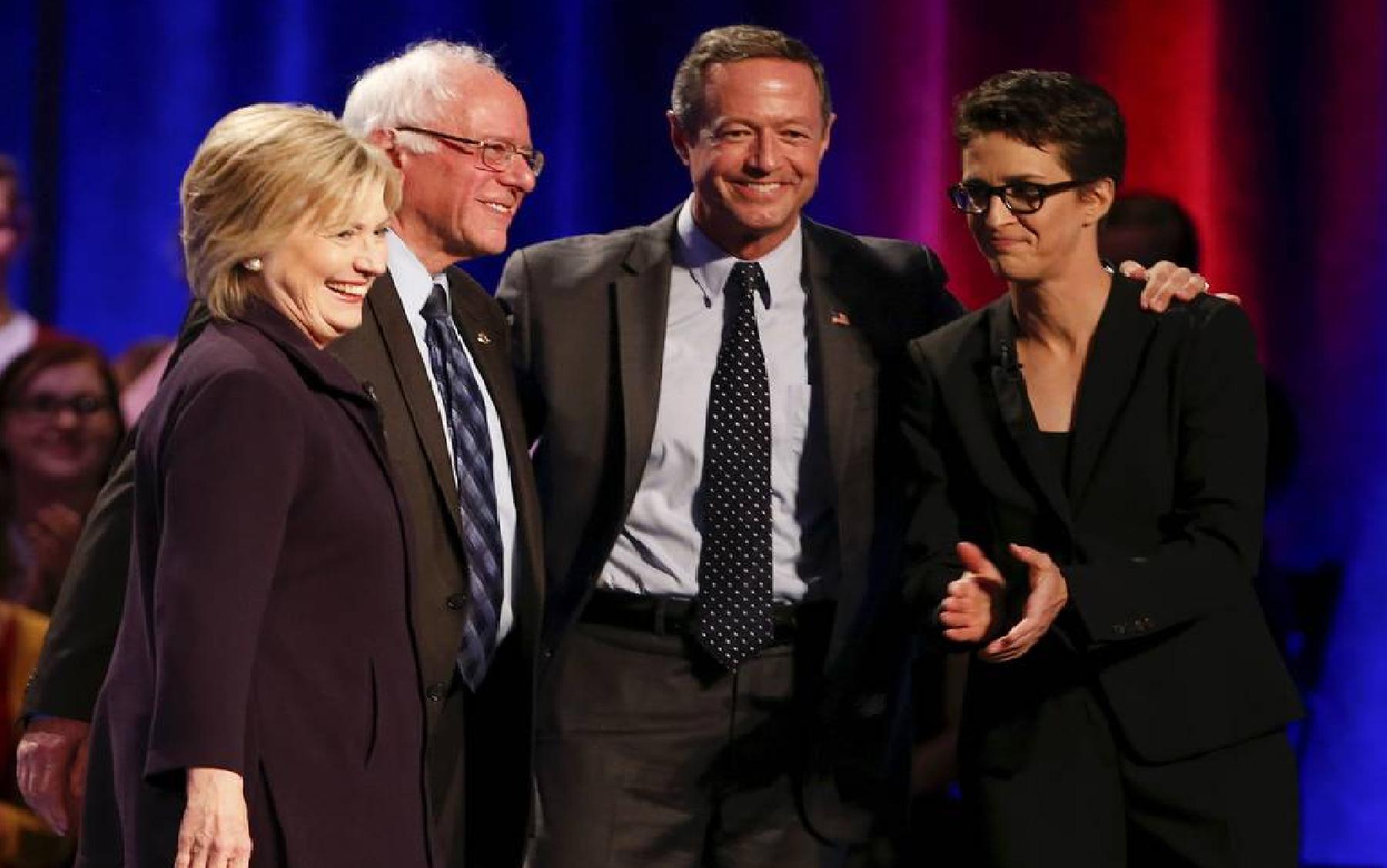
On Friday, November 6, 2015, MSNBC’s Rachel Maddow moderated the latest installment of the presidential candidates’ debates, the First in the South” Democratic Forum, hosted by Winthrop University, in Rock Hill, South Carolina. The forum was not a debate, Maddow told viewers, but was a series of one-on-one interviews of the candidates by Maddow, who generated many of the questions herself. The candidates did not, therefore, engage in any direct conversation or exchange, and the forum differed sharply from the most recent Republican installment, the CNBC debate at the University of Colorado. Maddow’s questioning concentrated on serious questions, but also included some lighter questioning to create a friendly atmosphere (including a “meet the young candidate” segment for each candidate, giving them a chance to talk about their youth and their career). The bulk of the interviews, however, saw Maddow pushing the candidates to justify both their views and their candidacy.

Former Maryland Governor Martin O’Malley was up first. After evading a question about the Democratic Party’s traditional weakness in the South (since the 1970s), the conversation turned to climate change. O’Malley noted that, “We’re the party that believes in science…,” and he talked about the problem as more of a “challenge and opportunity,” denying the traditional view of environmental reform as potentially job-killing. Instead, O’Malley articulated a vision of energy reform as a job creation opportunity, talked about his Clean Energy Jobs Corps proposal, and advocated cities as the best area in which to pursue green energy. O’Malley shrugged aside Maddow’s suggestion that at least some states might lose both jobs and money were his proposal to turn the energy grid completely green by 2050 to be enacted.

Discussing the Black Lives Matter movement, O’Malley asserted that his governorship reduced incarceration and recidivism rates, cleaned the streets of Maryland of drugs, and reduced crime rates, all effects beneficial to African Americans. O’Malley sees the elimination of for-profit prisons as the next step to reduce both prison populations and the legal system’s incarceration mentality.

On foreign affairs, O’Malley sees both the continuing use of the Guantanamo detention facility and the “American boots on the ground” approach to the Middle East as the best “recruiting tools” for ISIL and Al Qaeda, generating by their very existence entire new ranks of extremist, anti-American fighters. The detention of people without due process, O’Malley asserted, was simply “contrary to our principles as a people.”

Maddow’s interview with O’Malley finished with a question about his campaign, still polling in the low single-digits, and a very distant third of the three remaining “viable” Democratic candidates. O’Malley took the moment to attack Sanders as a socialist (unlike himself as a “lifelong Democrat”), and Clinton for being late to the game on numerous issues such as Keystone and gay marriage. O’Malley noted that in races to the governorship, he had also suffered from low polling early on, and that he liked a “tough fight.”

Next up was Bernie Sanders, the formerly independent Senator from Vermont, arguing that his message resonates for all poor and working people, and that despite representing a state that’s 95% white, his civil rights record is unimpeachably progressive. While idealistic, his responses to Maddow’s questions on marketing his Democratic candidacy to southern and black voters spoke less to the realities of lower-class suspicions toward the Democratic Party in the South. Similarly, his responses to her questions about involving the corporations in the reform of the economy and tax structure (especially by moving corporate investment into actual job creation rather than pure wealth concentration) were vague, and centered simply around taxes, suggesting that a Sanders administration might be dangerously confrontational to those powers capable of generating new jobs.

Sanders continued to answer vaguely on other issues, such as Middle East policy. He insisted that the “boots on the ground” needed to be regional rather than American, or that American involvement could take place through a venue of greater international involvement, especially by European powers such as Great Britain, France, and Germany. Sanders refused to consider a unilateral American effort, and seemed to falter at Maddow’s questioning about European and regional reluctance to engage. To be fair, O’Malley’s answers were similarly idealistic and vague, and yet Maddow had not pinned O’Malley into a corner on the issue to the same degree that she did with Sanders.

Sanders pushed his self-image as a candidate for reasonable gun control, arguing that his representation of a rural state gave him a special appreciation of second amendment rights, but that (despite voting against legislation such as the Brady Bill) he also had worked to improve and increase background checks, and to ban assault weapons.

Finally, on the subject of voting rights, Sanders became heated, calling the Republicans “…political cowards, and if they can’t face a free election, then they should get another job.” Sanders saw the loss of Democratic vitality in the South as largely due to defeats on the issue in those states. He saw greater and effective political change as achievable through a renewed fight on that front. “We need to greatly expand voter turnout… We need a political revolution.”

Hillary Rodham Clinton completed the evening, coming out on stage to an explosion of applause. However, the many African American members of the audience looked less than convinced. Maddow’s first serious question asked Clinton about African American reactions to a Democratic stage with only white players, and whether African Americans should feel “left behind” by that reality. Clinton bypassed the question to argue for a “New New Deal,” which would help not only African Americans, but middle-class white voters as well (clearly an answer to speak more to that latter, larger demographic, but which for that very reason cannot be encouraging to the former). Clinton also answered weakly to Maddow’s questioning about Wall Street, repeating her mantra of telling Wall Street to “stop it,” and arguing merely that she is on record as fighting to level the playing field, and that the economy works too much for those at the very top, and too little for everyone else.

Clinton redirected a question about having police in school classrooms (referencing the recent ugly incident in Richland County, South Carolina), to the larger issue of economic change, with over half of students now on lunch programs, a key metric for gauging childhood and family poverty rates. Clinton condemned the school system’s vastly greater expulsion and suspension rates for African-American students in particular.

On foreign affairs, Clinton waved off Maddow’s suggestion that she is more “hawkish” and aggressive than her Democratic competitors. She argued that as Secretary of State, she had pursued diplomatic solutions and saw diplomacy succeed in creating international progress, especially with respect to Iran (with Clinton citing her work in creating a sanction environment that pushed Iran into a peaceful agreement with the West).

Maddow asked few specific questions of any candidate on economic policy and jobs creation, although the candidates were able to get in some vague ideas on the subject. Similarly the three Democratic candidates are all reluctant to use force in the Middle East, and yet they see the area as a key political arena; the forum demonstrated little in the way of clear thinking about alternatives. Another problem area for both parties, the demographics of their own base constituencies, shows an ironic contrast between the Republican Party, fronting both black and Hispanic candidates, and the all-white Democratic candidate pool. With both parties fighting for minority votes, such voters will have to decide whether they are better served by white candidates with more inclusive policies, or by minority candidates breaking key racial barriers but offering little else in the way of overall social inclusion.

In any case, the Forum provided the audience with a stark contrast to the CNBC debate, being more substantial (but still with glaring weaknesses on the issues), less inherently confrontational, less dramatic, and more didactic. The Democratic Party’s candidates therefore are better served by this environment than by the more confrontational atmosphere at Denver, and those viewers considering the Democratic candidates now have better information with which to consider their options as the political fight moves on to the next round.

Ben Carson: What is he for, and Who is for him?

Ben Carson

The day after the CNBC broadcast of the third Republican Party candidates’ debate, the Wall Street Journal and NBC conducted a series of polls to take the voters’ temperature across the partisan field.  Looking at both major parties, the poll demonstrated that Democratic respondents became less enamored of Bernie Sanders, and more favorable to Hillary Clinton (except in New England, especially New Hampshire, which in February will host the second state Democratic primary).  A blog article published on WSJ‘s website attributes much of Clinton’s resurgence to her success in shrugging off the Benghazi committee attacks. Among Republicans, numbers showed a sudden spiking of support for Ben Carson, and a noticeable loss of support for Trump, with Carson now the front-runner of the moment.  The polls further demonstrated that, were Clinton to have run at the time of the polls against a Republican opponent, only Carson could potentially have taken the election (although both Clinton and Carson had the same rating: 47% of the respondents).  All other Republicans would have lost the popular vote to Clinton (although these numbers leave aside the question of state electoral votes that would have actually decided the question).  Trump was, of the potential opponents posed against Clinton, the most likely to lose to Clinton.  Rubio and Bush both lose in a popular race, but by less of a margin than Trump.  So, for the moment, Ben Carson is the new golden child of the Republican clown car, running neck and neck with Clinton.

At the CNBC debate, Carson was soft-spoken and said little about his platform (and, indeed, the questioning was often more aimed at candidates’ personal histories and views, rather than being truly centered around potential policies).  One might be tempted to think that his quiescence bespoke more on the debate procedures than on his own thoughts about how the nation should move forward.  However, his campaign website says little more about his positions on major national issues than what he was able to articulate at the debate.  Carson remains a man whose thoughts, if any, on issues of substance remain known only to himself.  The position statements on his website, such as they are, are tuned not to the voter who wants actual answers, but to the voter who wants simple, unsupported platitudes.

Carson lists ten issues of importance to him (and presumably to those choosing to support him):  opposition to abortion, passing a balanced budget amendment to the Constitution, de-federalizing government controls on public education, keeping the Guantanamo detention facility open, replacing the ACA with health savings accounts, using the power of government to protect religion, maintaining strength against Russia, preventing further work on gun control, supporting Israel, and simplifying the federal tax code.  Carson avoids discussion of any kind about the economy and jobs, about peace and security in the Middle East (other than our need to support Israel), about climate change, about banking reform, about energy policy, about law enforcement and incarceration, or about any other substantive national issue.  His issue statements, such as they are, pose few actual policy suggestions and indicate a childishly simplistic ideation (to use that word loosely) of modern political realities.

For example, rather than indicate that he himself would cut any spending, he merely calls for the ratification of a constitutional amendment mandating the balancing of a budget (he is unsurprisingly short of actual details of how that would work).  His education policy is limited solely to de-federalizing government oversight over public education; he avoids any discussion of higher education, or of actual educational goals beyond making education more subject to local controls.  Yet, reinforcing the modern American conservative contradiction between wanting less government in some areas but desiring more government in others, Carson advocates (again without any specifics) using the powers of government to “jealously protect” religious practices.  And finally, he seems to agree with Carly Fiorina’s hope to simplify the tax code as the solution to American fiscal issues.

On foreign issues, Carson’s website is virtually silent.  Carson does see Russia as a rising threat, and that opposition must be led by America “from a position of strength,” and of course he fails to identify any mistakes made by Obama’s administration or anything he would do differently.  He also neglects to consider any other forces of opposition (such as ISIL, Iran, Al Qaeda, North Korea, China, etc.), or any allies or other forces with which we should pursue relations, beyond the state of Israel.  There, too, while advocating the continuing support of Israel (an issue never actually in question), Carson neglects to state what his administration would do differently from the current one, past administrations, or those of any of the other prospective candidates of either party.

This is the sole website presence of “Ben on the Issues” (as his website pretends to portray), and having read it, the reader is challenged to find a single thing a Carson administration would do about most of these issues.  We learn simply, and vaguely, that Carson seems to oppose using the government to provide basic social supports, but is eager to see religious practice protected by government power.  He wants a balanced budget, but does not want to have to do it himself.  He doesn’t have a better idea on how to improve the revenue stream other than by simplifying the tax code to something that would fit on a cereal box.  And he has no ideas of any kind as to how to pursue American interests abroad.  Yet this very ambiguity, as well as his sanctification of unborn life and his use of the government to protect religion, are tuned to the low-information voter who feels entitled and threatened by a modern, complex, tolerant society that expects them to act like adults.  While Carson speaks less to the angry (who are, the WSJ/NBC polls indicate, more defiantly pro-Trump than Carson’s supporters are pro-Carson), Carson is the “bleed-through” candidate best positioned to benefit from the inevitable weariness of conservatives with the Trump “comic-book candidacy.”

While it is far too early to predict that the ultimate race will be one between Clinton and Carson, the current polling demonstrates that Clinton can potentially gain yardage through a clear, but simple, articulation of actual policy proposals and a greater diversity of issues capability and relevance.  Such yardage will never attract the low-information voter; but those voters are harder to move from party to party.  The 2016 race will have to be fought and won, and can at the moment be won, on more intellectual grounds.

Clown Car 3: The Moderators Strike Back (The CNBC GOP Debate in Synopsis)

The third Republican Party debate of 2015 (titled with an astonishing lack of irony, “Your Money, Your Vote“), moderated and broadcast by CNBC on Wednesday, October 28, 2015, and hosted by the University of Colorado, proved to be very predictable in most respects, but also played to the modern television audience through elements of drama and confrontationalism. The moderators (John Harwood, Becky Quick, and Carl Quintanilla) get the credit or blame for the content of the questions, for the environment of the debate, and for keeping the candidates on track. While conservatives may applaud their candidates for continuing their basic platitudes, and liberals may denigrate them for the same reason, the audience of the debate also must consider the job of the moderators in getting the candidates to answer tough, relevant, and expository questions, fulfilling the role of the debates (as one of the moderators noted) as the candidates’ “job interview.” After this “interview,” there was a substantial (admittedly mostly conservative) backlash against CNBC for failing in their part of the process. The candidates failed to speak much on relevant issues, but the moderators failed to ask the right questions and failed to earn the candidates’ cooperation.

The debate began with a “job interview” question, asking the candidates to describe their greatest weakness. The candidates, used to beginning with opening statements (omitted from this debate), generally refused to even acknowledge the question, and used the time to make opening statements. Trump was then asked about his “comic-book candidacy,” to which he responded with predictable indignation, but he also reiterated his baseless platitudes about building a “wall” and getting Mexico to pay for it. Carson and Cruz both said little about their similar flat tax plans (and Rubio would also later get into a fierce argument with Harwood over criticisms of his plan), while Fiorina argued for a simplified plan (reducing the tax code from her alleged 73,000 pages to three pages). Kasich argued that both Carson’s and Trump’s tax plans in particular were unrealistic and irresponsible, and would explode the budget deficit. As the moderators interrupted the candidates, ran over other candidates’ own interruptions and responses, and denied the veracity of the candidates’ claims and statements, Cruz criticized the moderators for asking tough questions, but also for ignoring substantive issues, and for attempting to incite fighting between the candidates (especially between Bush and Trump, Huckabee and Christie, etc.).

After the first commercial break, the debate environment settled down a little, with less open interruption and confrontation by the moderators, but still aggressive questioning. However, through the rest of the debate, the moderators asked the candidates more about their personal differences and disagreements, and about minutia of their views and statements, while avoiding completely major current issues such as gun control, education reform, banking reform, foreign affairs and national security, police culture and law enforcement (and incarceration) issues, etc. Carson, Trump, and Fiorina were questioned about their personal business interests and failures. Fiorina used the moment to blame government for all social and economic problems. She steadfastly refused to acknowledge that failures, weaknesses, corruption, and concentration of wealth create problems in the corporate sector. Cruz, in answering (or avoiding) a question on working women’s issues, focused solely on “single mothers,” thereby ignoring the possibility that single career women without children (or with adult children) and married women might also be a part of the labor force worth considering. He and Fiorina, to the surprise of no one, both blamed women’s poverty on the Democrats, and also unsurprisingly failed to cite any facts or argument behind their assertions.

Trump was asked about the rights of his employees to come to work armed, and about whether he himself carried, rather than about gun control or rights as a national issue. He played to his base in responding that he “sometimes” carries, just to be unpredictable. Christie claimed Obama does not support the police; and of course he did not bother to cite any actual examples, let alone facts. As the topic moved to retirement, with only modest mentions of Social Security (notwithstanding some mutual sniping between Huckabee and Christie), Fiorina predictably called for the government to get out of the retirement business.

In the final segment of the debate, as the topic moved to Medicare, Huckabee said, “We don’t have a health care crisis, we have a health crisis.” He claimed that only a few maladies, particularly cancer and Alzheimer’s, cause most of the spending on Medicare, and that the solution to funding Medicare (or defunding it) would be “simply” to cure these maladies (ignoring the fact that medical science has been working towards those goals, and that we do not yet have a road map toward those objectives).

A major dramatic moment occurred when Jeb Bush was asked about whether fantasy football constitutes gambling, and if such ramifications necessitated a greater role for the federal government. While Bush shrugged the question aside (admitting to participating himself and bragging about the success of his team), Christie exploded about the pettiness of the moderators in ignoring substantive issues and asking about a stupid issue like federal involvement in fantasy football. Christie also called John Harwood (and the panel in general) rude even by New Jersey standards, particularly when Harwood interrupted one of Christie’s responses on climate change (one of the few moments substantive issues were even brought up).

Ultimately none of the candidates either were asked, or found the moment, to present their “vision” of America and the federal government, beyond simple soundbites like Fiorino’s vapid antifederalism and Trump’s childish and unelaborated “I will do so much better.” Rand Paul had few moments worth remembering, Kasich played the reasonable Republican criticizing his colleagues’ unreasonable and irresponsible approaches, Bush played up his affability (aside from criticizing Rubio’s absenteeism), Rubio attacked the Florida press for also criticizing him for not doing his job, Carson remained quiet and sleepy and devoid of actual facts and arguments, Christie played up his aggressive New Jersey attitude, and Huckabee echoed Jim Webb’s complaints at the Democratic debate about not getting a fair share of mic time.

After the debate, the conservative press (and the RNC) lambasted CNBC for the confrontationalism and for preferring the incitement of infighting to a greater conversation about substance. As the third debate of the “clown car,” little else could really have been expected. The GOP has yet to whittle its candidate army down to a few likely leaders, and until it does, substance is effectively beyond the expectations of a two-hour debate with commercials. While the “clown car” makes for entertaining television, it minimizes the possibilities of substantive debate and fuller policy proposals. As the Democrats have already culled their candidates to two likelies and one not so much, America awaits the conservatives’ response to the constraints of their own selection process.

First Blog of Lightness: Aaron Sorkin’s Impact on Burmese Political Reforms

Hillary Clinton tells us in her book, Hard Choices:  “The Speaker of the Lower House of [the Burmese] Parliament, Shwe Mann, another former general, met with me in another gigantic room, beneath a painting of a lush Burmese landscape that seemed to stretch for miles.  He was chatty and good-natured.  ‘We’ve been studying your country trying to understand how to run a Parliament,’ he told me.  I asked if he’d read books or consulted with experts.  ‘Oh no,’ he said.  ‘We’ve been watching The West Wing.’  I laughed and promised that we would provide even more information.”

  • Hillary Clinton, Hard Choices (New York:  Simon & Schuster, 2014), p. 117.