Once again, McCain’s Folly, Sarah Palin (the reality-TV star from Seward’s Folly), makes a mess of the English language (presuming that was, in fact, what she thought she was speaking). The best experts in political cryptography believe that she was attempting to endorse Donald Trump. She likely was also attempting to grab a scrap of relevance from her seat on the ash-heap of history. Tina Fey, long a favorite alternate version of Palin (both for her comedic effect as well as for being able to make sense of the blithering Alaskan), returned to SNL to parody Palin’s embarrassing moment. Enjoy Palin’s – er, uh, Fey’s delivery.
Moonlight and Madness, Or Moderation?

Quote of the Week: “Follow your inner moonlight; don’t hide the madness.” – Allen Ginsberg
Ginsberg was certainly not afraid to live by these words, leading the beat generation and counterculture, expressing his homosexuality openly, confronting the government on drug policies and on war issues, and creating poetry anew in his own image. However, as a political writer (and an avid watcher of the political horse-race, elections) I am somewhat intimidated by these words. I do not live, and also do not write, as if I were Ginsberg, or a follower of him (which I am not, much as I am inspired by some of his work). I write as a liberal, but one trying to converse politely with the Right; in case they happen to stop by. But most, or all, of my readership thus far seems to be on my side of the spectrum. I began my blog under the tagline “Fomenting a Political Conversation,” and that remains for the moment my mission – to get people talking if I can, not just with their individual echo chambers, but with people on the opposite sides of the aisle.
In that spirit, I often tone down my language. I edit out some of my anger at the injustices of the world, at what I think are not just wrong but stupid positions or arguments. I hide the madness, and stray from my inner moonlight in pursuit of what is likely a futile goal. And I expect the politicians on center stage to do the same.
As a liberal, I love the stances and proposals of both Hillary Clinton and Bernie Sanders. I have been a follower of both for years, and have been a past contributor to Clinton’s 2008 campaign, and to Sanders’ involvement in the Democratic Socialists of America. Still, when Sanders shouts like the angry old man on the porch (in effect, living Ginsberg’s advice in ways that I cannot), I cringe. I see Sanders as the great legislator (giving a voice to Congress that even as a Senator, Clinton never could); and Clinton as the great executive with deep personal experience and relationships with the leaders of the world. But I also see Clinton as reserved (like myself) in ways that Sanders is not. What would she promote as a candidate if she followed her own inner moonlight? She was a leftist in 2008, before Sanders was there to push her; so that does not just come from the current dynamic. Is Clinton “realistic” and Sanders “radical”? Is Clinton “political” and Sanders “real”? In part, I hope to answer these questions through this blog as I investigate these actors in greater detail. For now, I find myself torn – between the “moonlight and madness” of Sanders’s more “revolutionary” proposals (which energize my instinctive leftism), and the “moderation” of Clinton, and her “establishment” positions (which I internalize as reasonable compromises). And I am torn as a political writer, between writing my fury and delivering fiery oratory; and my desire to talk to the other side in a way that welcomes dialogue.
When So Few Words Cause So Much Harm to So Many

“A well regulated Militia, being necessary to the security of a free State, the right of the people to keep and bear Arms, shall not be infringed.” – the Second Amendment to the US Constitution.
And there lies the heart of the problem – or one of them, at least. Today that poorly constructed sentence, with no connective phrasing indicating the relationship between the “well regulated Militia,” the “security of a free State,” or the “right of the people to keep and bear Arms,” would be edited until it actually made sense (unless, of course, it were posted as a meme on Facebook). Is the right of Americans to own weapons seated solely, or largely, upon the intent of maintaining a people in arms against a foreign invader or domestic oppressor? Or, as Justice Antonin Scalia argued in District of Columbia v. Heller, 554 U.S. 570 (2008), is there no necessary relationship, and does the Second Amendment simply promise unfettered rights to arms regardless of the “militia,” or the “security of a free State”?
While this is an interesting constitutional argument, over 30,000 lives are taken each year by firearms in the United States. Roughly a third of those lives are victims of apparently deliberate violence; while suicides account for the largest share of gun deaths each year. The many Americans lost each year (equivalent to losing the entire Vietnam War all over again every 21 months) deserve much more than an “interesting constitutional argument.” Furthermore, as national fears ramp up over an increasing wave of violence (the rise of mass shootings, the rise of police violence against civilians, and the fears of foreign terrorism), gun-rights advocates opposing further regulations and gun-control advocates seeking further regulations both cater to fears of those around us. The gun lobby and those gun-owners who oppose regulation portray a multitude of apparent threats to themselves, and to their families and homes. They also ally with more extremist elements expressing fears of the “Other,” and with an increasingly publicly acceptable bigotry against non-whites. The gun-control advocates fear that they may be next to die to some crazed, Christian “holier than thou” shooter in their church, school, or shopping mall; or that their nephew with problems may be the next to use a weapon to end his life.
President Obama, tired of more than a year of almost weekly “thoughts and prayers” consolations to the nation for the latest shootings du jour, finally moved past a catatonic Congress to enact changes to gun sales regulation via the few powers available to his office. Immediately, the predictable firestorm of reaction was raised against the President by those in the gun lobby who had eagerly awaited such action for seven years without satisfaction. The tightening of existing regulations on the sale of firearms now seemed to them to be inaugurating the president’s long-awaited crusade to take away their guns. Quickly the president rose up to the challenge of national dialogue, in a time when we Americans do not bother to actually listen to each other any more. At a “town hall” meeting hosted by CNN in Fairfax, VA, the president took questions from representatives from both sides of the gun issue. Although the NRA’s headquarters is located just down the road from the site of the “town hall,” that organization refused to contribute to the dialogue, preferring instead to steer the issue silently through campaign contributions.
The president attempted to connect with gun-owners and sellers, reminding them that each of them probably had to pass background checks themselves. His executive order focuses on ensuring that everyone purchasing a firearm passes through the same process. There was not a lot of listening in the hall that night, however; and the president had to repeat his insistence that new regulations would not result in anyone’s guns being taken away, or even make it more difficult for law-abiding citizens to acquire firearms. When George Lakoff wrote about “framing” political dialogue, this was precisely what he was talking about. People (on all sides of political and moral questions) create “frameworks” within which new information coming in must either fit, or be discarded. New facts and arguments which do not connect with existing views of reality are simply discarded; not accepted or even noticed as facts or as being relevant, however well reasoned or argued. Therefore, it does not matter how much the president reassures conservative gun-owners that he is not “coming for their guns”; since the NRA has spent millions of dollars convincing them that he is, that is their reality regardless of what the new executive order actually spells out, or what the president says to explain the language or intent of the order.
Unlike the gun lobby, however, the president made it clear that at least he was listening to the other side. He recognized that the Second Amendment (ambiguity notwithstanding) guarantees the right to own weapons, and that the right to do so is not going to go away. Those of us who are not killed each year by gun violence are simply going to have to live with the most heavily armed national population in the world. But, as the president noted, there are ways we can work to ensure safety, to keep weapons out of the hands of criminals and terrorists as much as possible. At the “town hall,” at least, one side (the gun lobby) was “framing” the president’s words into an intent to take away their guns; while the other side (the president) was in fact listening and responding to their fears, even accounting for them into his executive order and his message.
There were more stalwart opponents of gun rights at the town hall, however. Father Michael Pfleger of Chicago (a longtime acquaintance of the president) argued that in Chicago, it is easier for kids to get guns than it is to get computers. He asked the president why gun ownership and control could not be handled like that of cars (legal, accessible, but heavily regulated, insured, etc.). The president reminded the father of the public’s paranoia about the government, citing last year’s Texas freak-out over military maneuvers in a state proud to house some of the largest military bases in the country. Were the government to take firmer steps, especially without Congressional support, the public outcry would simply escalate past the administration’s ability to get anything done. The president’s executive orders and arguments now positioned him in the center, rather than on the left or right; with the left arguing for greater controls, and the right arguing for fewer controls (or at least against more controls). The president showed a willingness to listen to both sides. Nonetheless, in our divisive political culture, the conservatives view the president’s words and actions as being on the left rather than in the center, as those of an activist and opponent rather than as a mediator between two opposing forces.
There is a simple explanation as to why one side in particular, the conservatives fearing a gun-seizing federalist tyranny, wears greater blinders than the other. As lawyer and blogger Jack D’Aurora noted, the answer is easy: “follow the money.” There’s gold in them thar frames. There is money and power to be made by keeping people afraid and “clinging to their guns.” And until we work harder to push corporate contributions and moneyed political interest groups out of our representatives’ pockets, they will continue to sell us their products and their consequences. Until we push the NRA and the gun manufacturers (some of whom have also been attacked by the NRA for attempting to improve gun safety, as the president noted at the town hall) out of congressional offices, we will have to live – or die – with an overarmed and under-listening population.
Headline image from a posting by Odyssey, via Google Image Search.
A good read from other bloggers: The Box that Built the Modern World

In 2013, Andrew Curry posted this blog: “The Box that Built the Modern World: How Shipping Containers Made Distance Irrelevant.”
This was a fascinating (if now slightly dated) article. As a poster noted a couple of years ago (around when this was first posted), containerization explains a little of how globalization works (in the sense of off-shoring). But it also explains a foundation of the 21st century “economy without workers,” in which wealth is generated without a great part of that wealth distributing to the middle class through wages and salaries. With much greater volumes of cargo moving through much smaller numbers of manual workers and their managers, wealth is created, but kept at the upper levels, producing greater inequality, and putting out of work the dock-worker and his manager without providing them with any measure of a replacement job. Wal-Mart, Amazon, and others have joined this network of producing cheap, slave-labor products in poor nations, and transporting them virtually free of movement costs to the US, where the unemployed and under-employed workers have little choice to maintain a standard of living but to buy the cheap products that are all they can afford.
Image posted from Curry (illustrations by Peter & Maria Hoey) in the article cited.
A Friendly Guide to Coexistence
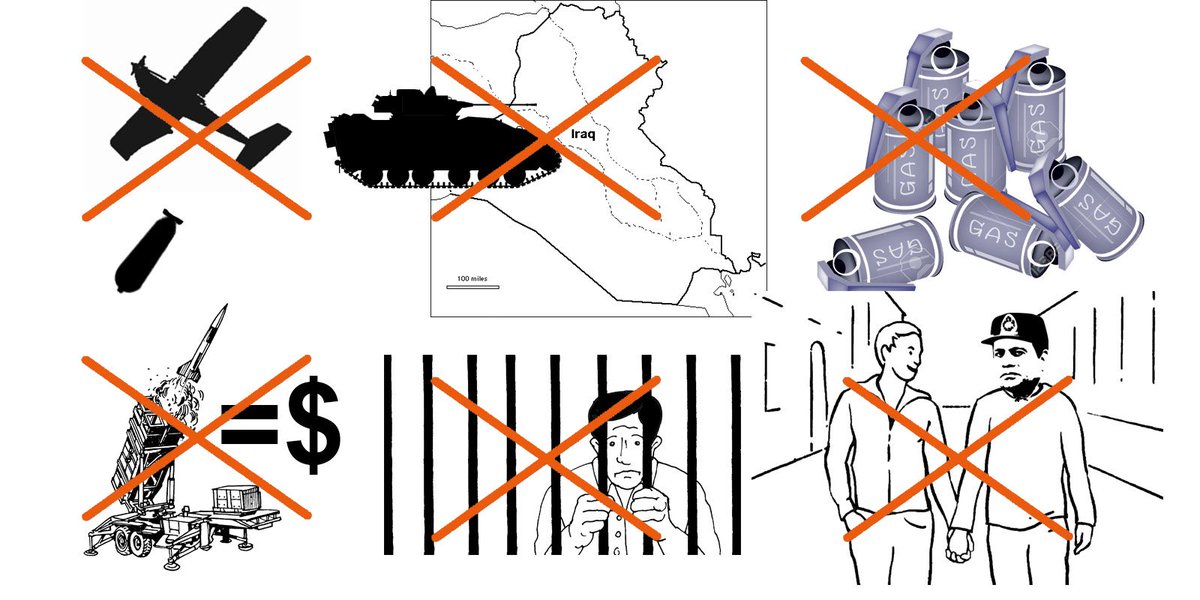
After the Germans published a quickly parodied “guide to refugees’ behavior” in Europe, Twitter user Karl Sharro @KarlreMarks posted this guide to “how the West should behave in the Middle East.“
Long Live the King

In honor of Martin Luther King, Jr., and of the work he did to make our nation into a center of freedom and democracy, Spark! wishes all our readers a happy and safe Martin Luther King Day. Keep fighting the good fight, and thank you for your service to our nation.
Thanks to the Democratic Senators of the Michigan state legislature for posting the image on Facebook.
The Hijacking of Morality

Quote of the Week: “One of the great tragedies of mankind is that morality has been hijacked by religion.” – Arthur C. Clarke
Arthur Clarke warned us about the tendency of those wearing religious trappings to act immorally, and even to foment deliberately immoral principles and objectives. Religions like Judaism, Christianity, and Islam are complex structures of thought, filled with self contradictions that allow for these religions to be used for contradictory purposes – to argue, for example, both for and against slavery, for and against war, for and against religious toleration, etc. However, there is an easy test by which we can determine whether an argument, religious or otherwise, is moral – how, in effect, to determine if morality is on track or has been “hijacked.” That test is the liberal ethic of building a community of care and welfare, the vision of the City on a Hill. Morality is ultimately not a question of religion, enshrined as it can be by religious thought. Morality is not found in God’s House; but in the hearts of people doing the moral work of building a city of love and care and communal responsibility for those around us.
Humans are for the most part essentially moral creatures. All human civilizations, societies, and cultures have moral systems; and for that matter the gross similarities on moral rules (prohibiting murder, protecting children, etc.) vastly outweigh disparities. This is even more true of religions, which are virtually universal in their agreement on basic moral questions (disagreeing instead on doctrinal questions, like the number and names of their god(s), the relationship of physical to metaphysical realms, days and times and methods of worship, etc.). That humans always manage to impose an identical moral order on their religions, and on their societies and cultures (not to mention on agnostic and atheist philosophies) proves that religion gets its morality from people, not the other way around. Morality is a human quality, not a religious one.
All religions are theories of philosophy. Philosophy is merely “the study of the general and fundamental nature of reality, existence, knowledge, values, reason, mind, and language.” Religions are first and foremost theories about the nature, composition, and origin of the universe, questions fundamental to philosophy in general. All philosophical systems – religions included – are ultimately moral systems, because humans are moral creatures seeking to impose their natural moral standards upon their thoughts, impulses, laws, cultures, etc. Religions represent natural human curiosity about – and the need to explain – the universe around them; and religious morality derives from both our natural human norms and from social and cultural differentiation. No religion developed in a vacuum. All religions grew out of existing moral, philosophical, political, social, and other systems, and kept certain basic standards while imposing certain other new standards.
Political ideals are also philosophies, and they similarly derive from basic moral norms as well as imposing new moral standards. Furthermore, political and religious ideology are often intimately intertwined. Human thought remains fixated on systems inherited from the past (systems in which people grow up and which therefore can be central to their conception of the world around them). Early thinkers sought to explain complex and (at the time) immeasurable phenomena through simple religious statements; and their explanations have been passed down the generations to the religions of today. Political idealism, often informed by preexisting religious ideals, also interacts with and shapes developments in religious thought (as in such trends like Wahhabism and the Great Awakenings of the nineteenth century; and the twentieth century movements of religious conservatism and extremism).
The interaction between religion and politics has had ramifications both great and terrible. The American liberal ideal of the City on a Hill exemplifies a civilization informed by Christianity and enshrining a social collective with an imperative to care for all people and to welcome all seeking refuge. However, despite the essentially liberal ethic that derives from Christianity and the other great religions, religion carries with it a risk that bleeds over onto politics as well. Religious messages can be confusing, complex, and self-contradictory; and many have perverted religious messages to pursue immoral objectives of greed, selfishness, and intolerance. In fact, much in the way of religious conservatism (of all colors) falls under this description, including the Religious Right of the US, the settlers’ movement of Israel, and the Islamic theocracy of Iran. Even more extremist religious conservatives like ISIS, al Qaeda, and terrorist killers like Robert Dear and Dylann Roof pervert religious messages into immorality, denying messages of peace, love, and tolerance; and perpetrating violence and hatred.
Religious conservatism effectively abandons the liberal moral ethic enshrined by religions like Judaism, Christianity, and Islam, and works against the community of the City on a Hill. Such movements and their sympathizers used religious arguments to support slavery, to rationalize and push forward imperialism and Manifest Destiny, to ignore and even justify the Holocaust, to continue repressive regimes like those of Iran and Saudi Arabia, to fight against the extension of civil rights in the US, and even to argue against basic health care services to the poor like those provided by organizations such as Planned Parenthood. In all of these cases, religious arguments contradicting the basic liberal ethic of the very religions cited were used to justify oppression, intolerance, and violence. Values hostile to the major religions of the world, as well as to most human moral norms, are given religious justification by those claiming religious titles and citing religious sources.
Clarke may have misspoken somewhat when he criticized the “hijacking” of morality by religion. Religion does not “hijack” morality; but it does promote the abandonment of morality (even while being itself an expression of moral principles), by those wearing religious garb and identities. There is, however, a simple way to tell the difference between religious leaders arguing immorality (the “hijackers”) from those arguing a moral message. The litmus test is the liberal ethic of community, the construction of the City on the Hill (and the construction in fact, not simply the patriotic lip service to an ethic otherwise ignored). We find morality ultimately not in God’s House; but in the hearts of those building our City, extending the community of care and welfare to all people.
Headline image via Google Image Search.
Traversing the Thin Line Between War and Peace

This week, in accordance with plans announced last year, the United States Army is deploying roughly 1,300 personnel from the 101st Airborne Division (Air Assault) to Iraq, in what is characterized as a regular rotation. The division headquarters is replacing the division headquarters of the 82nd Airborne Division as the command component of a DMCU (Division Multi-Component Unit). The DMCU is a joint coalition force responsible in part for training and supporting Iraqi military and security personnel, as part of the Operation Inherent Resolve mission to combat ISIS. The 101st Airborne’s headquarters elements will include about 65 personnel from the Wisconsin National Guard. The division headquarters has been home-deployed since February 2015, when it returned from a five-month deployment to Liberia as part of the relief effort to stop the spread of the Ebola virus.
In addition to the headquarters rotation, the division’s 2nd “Strike” Brigade will be replacing the 10th Mountain Division’s 1st Brigade as that formation returns to its home base in Ft. Drum, New York. The combat elements of the 2nd Brigade trained recently at the Joint Readiness Training Center in Fort Polk, Louisiana. Major General Gary J. Volesky, commander of the 101st Airborne, expressed great confidence in the brigade’s ability to perform its mission. The troop rotation is ultimately going to leave approximately the same US troop strength in Iraq (currently around 3,000) as before.
The USN and Iran Face Off in the Gulf? (Or Not)
Meanwhile, on January 12, two USN patrol boats with ten sailors aboard (nine men and one woman) were detained by naval elements of the Iranian Revolutionary Guards (IRGN) for “snooping around” (the Iranian accusation), or for “mechanical issues… leading to both boats inadvertently drifting into Iranian waters” (the American response, paraphrased from the Reuters feed on the incident). The Iranian government assured the US State Department that the Americans would be returned to US custody very shortly.
Headline image of 101st Airborne helicopters via Google Image Search.
Image of USN riverine patrol boat released by Reuters, courtesy of the US Navy.
Who is at the Helm?

The New York Times recently featured a discussion about the political direction of the nation, and various reactions to it. Having myself answered telephone polls that included the question, “Are you satisfied with the direction in which the nation is moving?”, I am troubled by the failure of polls using this question to address the more fundamental question of who is driving the nation in that direction. The responses posted by the Times, and the reactions they reveal, also show a problem with both the question and with what American voters think about and respond to.
The main problem which President Obama has had to contend with since even before winning the presidency is the economic situation. The Bush Recession and the financial meltdown of 2008 pushed President Bush into a corner, and during the 2008 presidential race, Bush asked the two contenders, Senators Obama and McCain, to the White House to discuss it and advise him how to deal with it. Senator Obama’s plan became the road-map to recovery, used by both Bush and President Obama. While there was a halt to the meltdown, and while job growth has continued almost unabated since 2009, Republicans and their supporters question the president’s performance and claim that Republicans would have done better. They of course ignore the fact that the recession and meltdown both happened on their watch; and they ignore the fact that neither Bush nor McCain had an effective plan to deal with them (which is why Obama’s plan was implemented by Bush). They also ignore the fact that job growth and overall economic performance have generally been better under Democratic presidents than Republicans. So is the problem “direction,” or “velocity”? The Republicans have a legitimate concern that Democratic recovery is too slow; but they had no alternative means of achieving a more rapid recovery, with the modern job market globalizing and market shares of foreign nations edging out American manufacturing and other services. So whom is to blame? The Republicans who had no ideas and allowed the problems to manifest, or the Democrats who have repaired much of the damage but too slowly from the point of view of their critics?
Robert Reich, Bernie Sanders, and others on the left have also demonstrated significant problems deriving from the increasing concentration of wealth in the US. Some of the reasons why recovery has been slower than would be liked also derive from this problem. As wealth has been concentrating (lower-end wages remaining the same over time, but wealth expanding at the top), union and middle-class jobs, which provided much of 20th century America’s income and consumption, have been edged out. As income and consumption reduce overall, there is less demand for manufactured goods and for the jobs producing them. There is less money to invest in small businesses (and less consumer support for those businesses). This allows large corporations to push over smaller ones (itself causing further wealth concentration into the large corporations at the expense of “mom and pop” local businesses). Congressional leaders like Sanders and Elizabeth Warren have pushed for supports at both consumer levels and business levels to even the playing field; but with foreign competition growing and here to stay, America faces a 21st century economy that will have to be very different from our 20th century hegemony. Both Democrats (like Bill Clinton) and Republicans have helped to loosen the regulatory environment that creates living spaces for smaller companies and protects them from larger corporations. And unions have fought to preserve the incomes of their own workers, inciting resentment from others towards their seemingly “overpaid” members, who have traditionally been the nation’s principal consumers and job creators. So whom is to blame?
A new political environment has evolved with populist movements arising like the petty-fascist reactionaries of Trumpland. The Republicans bloviate with hate-filled language about homosexuals, abortions, and foreigners to incite actions like the multiple county-based oppositions to the SCOTUS same-sex marriage ruling and the Colorado Springs shooting at the Planned Parenthood facility. They ignore the calls by Black Lives Matter and other movements for a dialogue on racial discrimination, and their snide remarks about African Americans struggling for their rights helps fuel incidents like the shooting at the Emanuel AME church in Charleston. They do not even manage to distance themselves from heinous incidents like the Charleston shooting. The racist group inspiring Dylann Roof’s shooting, Council of Conservative Citizens (the ideological descendant of the Citizens Councils of America , or “White Citizens Councils”), is currently campaigning for Trump in Iowa. Extremism is looked upon from the right as normal and acceptable.
Are there growing extremes on both sides? Where is the leftist “extremism” about which the right so often complains? While Sanders suggests that large corporations will not “like him,” he, Warren, and Reich push not for some communist utopia of “people’s republics” dictating production, consumption, and classless society, but instead for a leveling of the field that allows small companies to co-exist with the large. They seek a capitalist environment in which workers can achieve personal security and agency while working for profitable companies. They seek a society in which the police do not target specific groups or races, but instead protect all citizens under their watch. They seek a society that builds the City on a Hill, the vision for America that has always been and remains the nation’s central, and founding, ideal. In what way are these goals “extremist”? So whom is to blame for extremism? Both parties, or just one – the Republicans?
When poll-takers ask their respondents the question, “Are you satisfied with the direction the nation is taking?” they ignore the question about who is doing the driving. Both sides of the spectrum have reasons to be fearful about our “direction,” as well as about our “velocity.” And on the economy at least, both sides are more in agreement about direction, disagreeing more about velocity. The party in the White House created the plan steering the nation back toward job growth (the desired direction for both parties), while the party in Congress has yet to advocate specific means that would change our velocity. So which party is to blame? And where in our course corrections do we find racist and bigoted populist movements of the far-right, like Trump’s movement; or activist movements of the left like Black Lives Matters? To which direction are they trying to steer us, and is our ship turning toward them? Economically, where do we find the rocks of foreign competition and increasing globalization, around which we must steer to get to our port? These questions are far too complex to be enshrined by one simple and myopic question.
Headline image from Forward Now! (posted August 20, 2013), via Google Image Search.
On Science and Ignorance
Quote of the Week: The greatest obstacle to discovering the shape of the earth, the continents, and the oceans was not ignorance but the illusion of knowledge. –Daniel J. Boorstin
These words by University of Chicago historian and Congress Librarian Daniel Boorstin bring to mind the consistent rejection of science by the Republican Party, and the “debate” on science that takes place in the party divide. Republicans attacked former chemist and current Pope Francis, after issuing his Laudato Si’ encyclical on global ecology last year. They also lampooned President Obama during their most recent debates for his involvement with the Paris Climate conference. Yet Republicans do not merely deny science; they pretend to a knowledge of a “different” science. For example, Senator Cruz used satellite data to attempt to disprove global climate change. The scientist whose work Cruz was citing later distanced himself from Cruz’s argument, saying the senator had misunderstood his data and the conclusion. Cruz has also shown a fatal misunderstanding of science in general, fatal in particular because he is the chairman of the Senate’s subcommittee on Space, Science, and Competitiveness. When Republicans complain about the inefficiency of the federal government, it is lamentable that they never think to include, as an argument, that the US Government should not have legislators untrained in science telling the scientists themselves what science is or is not. That is not merely ignorance; but the “illusion of knowledge.”
 Spark!