The 2016 Primaries, Round Three

Now that we are past Semi-Super Tuesday (March 15, that is; not its official designation, of course), it is time again to look ahead to the next round of the primaries, and to consider the greater context into which the primaries are playing out.  First of all, if you are new to this process, and have not read Spark!‘s earlier posts on the subject, you can see all of our blogs on the primaries (three so far) by going to the Elections 2016 Category.  We have covered thus far the process in general (in “Primer on the Primaries“); the “First Round of the Primaries” (covering the beginning of the primaries, up through Super Tuesday, March 1); and the “Second Round of the Primaries” (from late February, through March 15).

The primaries will continue into June, and of course are intended to select delegates for both parties’ conventions in July (the Republicans in Cleveland, July 18-21; and the Democrats in Philadelphia, July 25-28).  For the purpose of this blog, we are designating “Round Three” as taking us through the end of April.  May and June will constitute at least “Round Four;” and possibly more if needed to cover events as we move forward.

As of this writing (March 18), there are still some delegates yet to be apportioned from states that have voted, but which have not completed counting the votes.  Delegate counts are still somewhat unofficial, and are projections based on reports from states and voting districts.  As a result of confusion between the various state parties’ rules and other irregularities, various reporting agencies have minor differences in their delegate counts.  Real Clear Politics‘ projections of March 18 allot the following:

Democratic Race: 2,382 delegates needed to win [out of 4,763]

Hillary Clinton: 1,614 delegates (needs 33.5% of remaining delegates to win)

Bernie Sanders:  856 delegates (needs 66.6% of remaining delegates to win)

Republican Race: 1,237 delegates needed to win [out of 2,472]

Donald Trump:  673 delegates (needs 52.5% of remaining delegates to win)

Ted Cruz:  413  delegates (needs 76.7% of remaining delegates to win)

John Kasich:  143  delegates (needs more delegates to win than are uncommitted)

Marco Rubio:  169 delegates, and out.

Before moving forward, we can see, then that both Democratic candidates still have a viable path to the nomination; but that Clinton’s path is a far easier one than is Sanders’s.  On the Republican side, no candidate has yet a decisive edge for the first ballot in July.  Trump is by far the closest; but he still needs a greater percentage of the remaining delegates than he has shown himself able to secure thus far.  There is good news and bad news ahead for the Trump campaign.  The good news for Trump (and the bad news for the GOP and for the rest of the nation) is that the “winner takes all” states have now started voting.  In those states, Trump only needs to secure a plurality to get all of their delegates; and he has shown himself clearly able to accomplish that.  The bad news for Trump (and the good news for the rest of us) is that the Republicans are becoming increasingly hostile to him, and may manage to pull out enough key victories in states where Trump is weak to keep him from achieving the delegates threshold for the first ballot at the convention.  From there, things get a lot more interesting – and Trump may yet manage to secure a victory in Cleveland, so a brokered convention is not necessarily a Trump defeat.

None of the other Republican candidates has a viable path to first-ballot nomination.  Cruz needs an impossibly high percentage (over 76%) of the remaining delegates, and has nowhere been able to come anywhere close to such a victory, let alone achieving that nationally.  He would basically have to win many major winner-takes-all states to achieve that.  John Kasich, earning recently his first state victory in his home state of Ohio (a “winner takes all” state giving him the entire Ohio delegation), has so few delegates to his name that even if he were to win every single remaining delegate at this point – a 100% victory in every state, requiring nothing short of divine intervention – he would still come in 18 delegates short of a first-ballot win.  Marco Rubio, of course, has suspended his campaign, although his ghost may resurrect at the convention for second or subsequent ballots.

The next round of primary events include:

Thursday, March 10: Virgin Islands (R).  The caucus has already taken place; but no results have been announced yet.  9 Republican delegates will be apportioned, on a winner-takes-all basis.

Tuesday, March 22: Arizona and Utah will both hold dual-party events (primaries in AZ, and caucuses in UT).  The Republicans in American Samoa will hold an open convention; and the Democrats in Idaho will caucus.

Arizona is a winner-takes-all state for the Republicans.  Polls on Tuesday (March 15) showed Trump leading Cruz, 31% to 19%; but there were also 30% undecided respondents among the Republicans.  Clinton had a decisive edge on Sanders, 50% to 24; but that also puts 26% of Arizona Democrats into the undecided category and up for play.  Arizona could be a huge Clinton win; or a marginal Sanders victory.  Arizona has 58 Republican delegates to offer; and 75 Democratic delegates (plus ten super-delegates).

Utah has not been polled recently; but back in February both Cruz and Rubio had slight edges over Trump.  Bush, Carson, and Fiorina were still in play back then; and while Bush voters are unlikely to reach for Trump, Carson voters are more likely.  With Rubio gone, it may be easy to suggest that his voters support Cruz; but the two are widely different species of the Republican order, and Rubio supporters may go for Kasich or even Trump instead.  Some 42% of February’s respondents supported candidates no longer running; and so Utah has the chance to offer some nasty surprises.  February polls also showed Clinton leading Sanders 50% to 44 (with Sanders up a few points from January); and Sanders’s viability may well have been strengthened by his recent performance, so Utah is going to be a big fight for the Democrats as well.  Utah has 40 Republican delegates, 33 Democratic delegates, and 4 Democratic super-delegates.

Idaho’s caucus is currently presumed to be a modest Sanders win, giving both candidates roughly half of its 23 delegates.  Idaho and the other primaries and caucuses that day will give the Republican candidates a total of 107 more delegates; and the Democrats a total of 131 more, not including 18 super-delegates.

Saturday, March 26:  Democratic caucuses in Alaska, Hawaii, and Washington state.  Polling on these states is meager at best, and not up to date.  Together, they will allot to the candidates some 142 delegates, and 30 super-delegates.

April 1-3:  Republican state convention in North Dakota, which will nominate delegates to the July convention in Cleveland.  28 Republican delegates will ultimately be sent to Cleveland from North Dakota.

Tuesday, April 5Wisconsin open primary for both parties.  Wisconsin has no recent polling, but Trump held a significant advantage in February, when the field had more players.  Although the “middle states” have been forming a strong Cruz bastion, it seems unlikely that Trump’s advantage will have lessened; and it is a winner-takes-all state offering Trump (or whichever Republican wins it) all of its 42 delegates.  On the blue side, Clinton and Sanders were running neck and neck at the beginning of the year; so its 86 Democratic delegates make it a significant battleground state.

Saturday, April 9: Wyoming‘s Democratic caucus for its 14 delegates. Following this caucus, from April 14 through the 16th, Wyoming Republicans will hold a state convention to select the 15 remaining delegates selected by the party (there was a caucus on March 12; but it only had 11 delegates selected by that process). Three more Republican delegates from the state are super-delegates, as every Republican state party is allotted three such slots.  Polling data on Wyoming is lacking; but Ted Cruz blasted Rubio and Trump out of the water there last Saturday, taking 9 of the 11 selected delegates.

Tuesday, April 19: New York‘s closed primary for both parties.  The most recent polls showed Clinton with a whopping advantage (71% to Sanders’s 23) for its massive allotment of 247 Democratic delegates; however previous polls showed far less of an advantage (55% to 34 at the end of February), so either the recent Emerson poll is skewed, or Clinton’s success on March 12 has helped to shift New York more substantially in her favor.  Trump has a similar advantage there by the same polling firm (64% to Cruz’s 12; Kasich has a mere 1%), but previous polls by other firms had his numbers in the mid-40s.  The Republican party allots New York’s delegates as “winner takes most”; so as long as he has the plurality, he gets the bulk of delegates, but Cruz could still come out with delegates.  The trick to New York, however, is that it also has a 20% inclusion threshold; only candidates gaining at least 20% of district votes get any delegates from them.  Neither Cruz nor Kasich have been approaching those numbers in New York, so it is looking like an almost automatic Trump victory.  Cruz will likely rue the day he criticized “New York values” on April 19.

Tuesday, April 26: “Mini-mini-Super Tuesday” (I presume that only I am calling it that). Connecticut, Delaware, Maryland, Pennsylvania, and Rhode Island will all hold dual-party closed primaries, a huge battle for the Old Colonies.  Some 172 Republican delegates and 384 Democratic delegates are up for grabs.  While there is useful polling data  for Maryland and Pennsylvania, the other three states have not been adequately polled since November, 2015 (when almost all of the original 17 Republican candidates were still running).  A lot of voters have shifted to Sanders from Democratic undecided respondents since then, so only relatively recent polls are useful.  However, the entire region has been continually found to be more favorable to Trump than to other Republicans; and is largely more favorable to Clinton.  Delaware and Maryland have winner-takes-all Republican primaries; and Connecticut has (like New York) a 20% inclusion threshold as well as a 50% winner-takes-all threshold, so it may be a full Trump victory as well.

Total delegates, Round Three:  444 Republicans; and 1,004 Democrats (plus 184 super-delegates to be decided separately).

Based on the polling data available, Spark! projects the following for Round Three:

Hillary Clinton will gain another 520 delegates, giving her 2,134.  At that point, Clinton will need only 18.3% of the remaining uncommitted delegates to win the nomination.

Bernie Sanders will gain 417 delegates, giving him 1,273.  He would then need 82% of the remaining uncommitted delegates to win the nomination.  If our projections come anywhere close to the events, then by the end of Round Three, while Sanders will have come even closer to Clinton’s numbers, Clinton will have achieved enough superiority to take the nomination at the first ballot of the convention with ease.

In the meantime, Donald Trump will gain another 346 delegates, for a total of 1,019.  He would need to get 34.1% of the remaining delegates to win the first ballot in July.

Ted Cruz will gain 71 delegates, bringing his total to 484.  He would need more additional delegates than are available; and therefore could not get a first-ballot nomination.

John Kasich will get another 18 delegates, bringing him up to 161.  He already has no chance for a first-ballot nomination.

The key states to watch during this process are Arizona (for both parties), Washington (for the Democrats), Wisconsin (for both parties), and New York (for both parties).  Collectively, the statistically uninformative Old Colonies battling it out on April 26 will also host a major contest for substantial delegates and for new numbers.
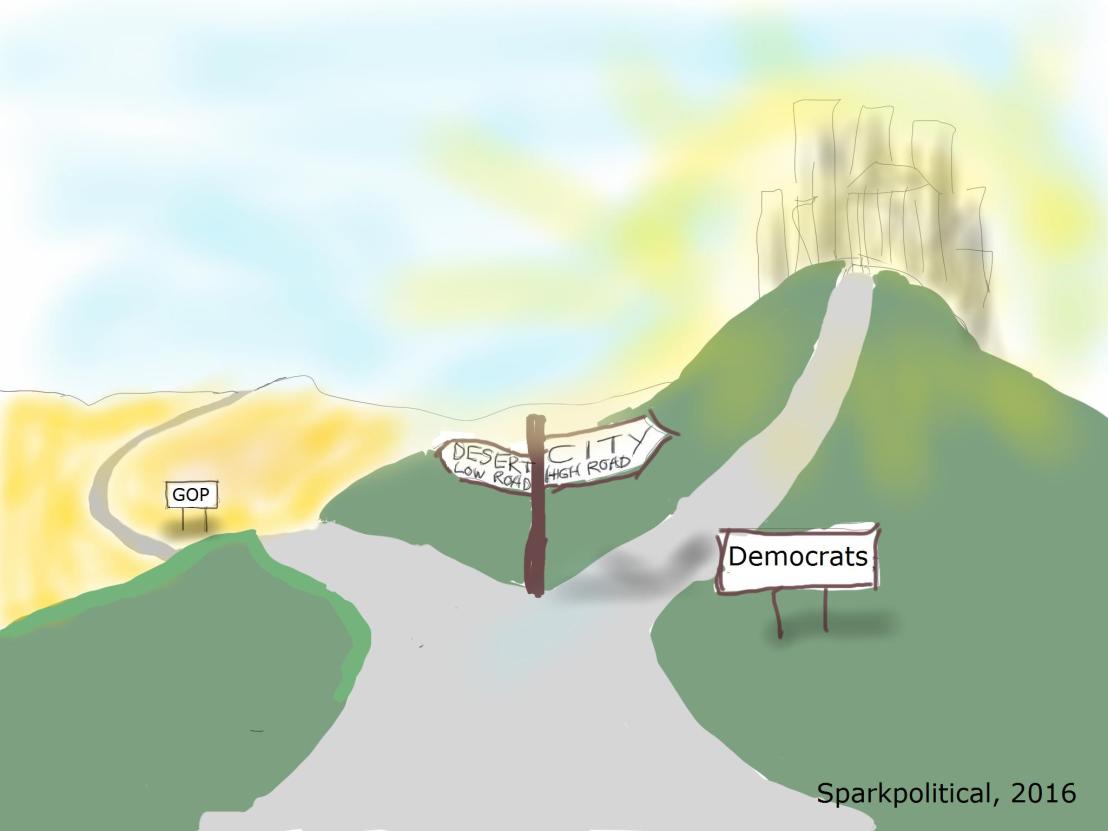
The Low Road and the High Road

High Road, Low Road

Quote of the Week:  He who would make his own liberty secure must guard even his enemy from oppression; for if he violates this duty he establishes a precedent that will reach to himself. –Thomas Paine

Thomas Paine’s words give us a lens with which to look at two diverging routes taken by American political forces.  On the one hand, we have the conservative low road, sinking our nation to its lowest depths of racism, xenophobia, and bigotry, taking us ever further away from our shining City on a Hill and the establishment of a liberal community of prosperity and care.  On the other, we have the liberal high road to the City, to using our wealth (as leading Americans since John Winthrop in the 1630s have urged us) to care for the poor, sick, and unemployed.  Paine informs us that while the low road allows us to apply our Constitution and other national principles only minimally, and only for established American citizens, the high road to the City requires a liberal application of constitutionality to all human beings, regardless of national status.

We have too long allowed our government (even under President Obama’s moderate hand) to traverse the conservative low road.  We have allowed our government to imprison, without charge and without any intention to prosecute, foreign nationals for an unlimited duration.  We have allowed our government to encourage other governments to torture and to evade American principles of legality and morality through machinations like extraordinary rendition.  We have allowed our government to target American citizens believed to be aiding foreign hostile forces, without providing the required basic constitutional protections to those citizens.  So it should come as no surprise when our government wants ever more invasive tools of espionage and oppression, as indicated by the latest court battle with Apple over cell-phone encryption.  It is no surprise that, allowing our government to forget our constitutional principles (and allowing the government to limit constitutional protections to established US citizens – and not even all of those), we now have an entire Republican party hostile to foreigners – immigrants and refugees, the very types of people who (together with slaves) built this country in the first place.  It is no surprise that a Republican candidate is having audiences replicate the Nazi salute as they swear allegiance to their Orangearschlochführer and as they loudly urge him to protect them from Mexicans and Muslims.  This is where the low road is taking us – away from our City on the Hill, and toward an ideological parking lot; empty, barren, and open for sale.

Instead, Paine urges us to take the high road.  Paine pushes us to build Winthrop’s City, a liberal community of care and ethics, and of prosperity and wealth.  Paine urges us to apply our Constitution to all human beings, not just established US citizens.  Paine urges our politicians to treasure all citizens – not just those supporting them at rallies (and unlike those like Trump openly mocking anyone not buying the cheap dime-store make-up job he wants to put on our national legacy and principles).  Paine urges us to remember that when foreign nationals at Guantanamo are denied constitutional protections, we are building precedents for our government to weaken and remove our protections here at home.  Paine urges America to remember its revolutionary principles.  Those principles can only truly shape our polity at home and the rest of the world abroad when we apply them as liberally as we can.  We must guarantee basic constitutional protections to all people, and not ask first where they were born, what language they speak, what faith they profess, or what citizenship they hold.

The Republicans, and extremist forces like Trump, will continue to take the low road away from our City on a Hill, and strive to tear our City down in favor of a parking lot.  We Americans must fight them at every step, and drive forward on the high road, to the City, to a greater community of care and wealth and social justice.  Else we establish a precedent that truly denies protection not just to some loosely defined “outsider,” but to our ideals, to our communities, and to ourselves.

Do We Watch, Enter, or Just Talk?

[After spending a week with some biological ick of some kind, I am just now returning to my writing, with this entry for Three Line Tales.  See Sonya’s latest post for rules and photo.]

Do we watch the circus of politics?

Or do we dare enter the arena, wrestling suit and mud in hand?

Or should we just talk amongst ourselves?

Photo by Samuel Zeller.  Concept for “Three Line Tales” by Sonya, and her blog Only 100 Words.

The Honor of Teaching, and Responsibility of Citizenship

Colin Powell Academy in Detroit, Michigan, one of the many schools abandoned since 2009. Teachers at the remaining schools are complaining about deteriorating conditions © Joshua Lott

Quote of the Week:  In a completely rational society, the best of us would be teachers and the rest of us would have to settle for something less, because passing civilization along from one generation to the next ought to be the highest honor and the highest responsibility anyone could have. –Lee Iacocca

The one-time chairman of GM (and president of Ford before that) would certainly be appalled to discover the condition of the Detroit Public Schools today, the very opposite of the high pedestal upon which he preferred education to be hoisted.  With teacher “sick-outs,” and protests against Governor Snyder’s emergency management controls over DPS, and with schools closed and budgets out of money, the conservative approach toward privatizing and profiteering our education system (and a financial “bottom-line” focus rather than a student-centered approach) has wrecked our communities, and the prospects of our next generation.  Instead of being able to compete globally with children educated for the 21st century, Detroit school-children under the Republicans’ oversight are almost entirely doomed to lives of dependence, poverty, and crime.

When Republicans claim to represent “family values,” they are hard pressed to explain how policies which damn entire families to perpetual poverty and servitude support modern American families.  “Family values” should focus on the long-term sustainability of the family as a unit, including most importantly the economic prospects of the children.  Republicans merely use the term “family values,” however, to promote the interests of those at the top (and, of course, the racial composition of the elite) against potential competitors from the middle and bottom.  Therefore, in the Republican view, teachers should not get the best pay and our schools should not be revered as temples of learning.  Instead, teachers are “eating off the public dole.” Schools are merely used as areas to test a new permissiveness in gun rights, and as opportunities for the corporations supporting Republican candidates to run for-profit, low-achieving charter schools.

There is a simple solution to this problem; but that solution has been available and avoided for years, especially in the state of Michigan.  It can be done, but it is difficult; and our citizens have long avoided implementing it.  That solution is a return to the City on a Hill, the building of a community of care and welfare, based on the financial strength of our wealthy (and a tax basis determined to use that wealth for the public good, as argued by John Winthrop in his sermon on the nature of a Christian nation in the 1630s).  That solution must be implemented either by the Democrats or by more progressive parties, as the Republicans are increasingly hostile to the formation of Winthrop’s vision of a Christian nation, of a City on a Hill, and of a community working together.  That solution requires liberals and progressives to vote, often and always; and to participate in the political process constantly (through letter/email writing, calls to officials, and self-education on issues and candidates).  That solution requires work, and an admission of individual responsibility for our community (something more than a “hobby,” more than an “interest in politics,” but an obligation of citizenship in a democratic society).  We can build Iacocca’s pedestal for education; but only if we choose to work for it.

Headline image: “Colin Powell Academy in Detroit, Michigan, one of the many schools abandoned since 2009.” Caption from rt.com; photo © Joshua Lott / Reuters.

Riding Uber into the Jobless Future

Professional taxicab drivers are fighting for survival in a new economy which is looking hungrily to replace them with other means of transporting customers.  New business models like those of Uber and Lyft are threatening drivers, customers, and bystanders alike; while at the same time offering potentially lower fares (outside of peak business hours) and wait-times.  However, cab drivers are joining a long list of people replaced by new technologies: grocery-store clerks, dockworkers, retail employees (especially from book, music, and video stores), etc.  As the twenty-first century proceeds, it is replacing jobs with apps; and concentrating more and more wealth at the very top.  The “trickle” of wealth to the lower classes by way of employment is rapidly drying up, as global information networks insulate the wealthy from the working classes through new lower-wage and even jobless models of business.  There are three problems at work, which are creating a new jobless economy, and are associated with, respectively, the business models of Uber, Wal-Mart, and Amazon.

The Uber Problem

The first problem with our transitioning economy is the Uberization of the work force and of our business models; replacing well-paid, full-time, professional workers (and the labor organizations that protect them) with lower-paid amateurs.  While Uber drivers bring in somewhat more revenue per hour for short shifts than do cab drivers (who make much more money per hour for long shifts than for short ones), they are also entirely self-financing (car, gas, insurance, maintenance, etc.), unlike most cab drivers (who depend on their companies to provide some or all of their operating costs).  Such jobs are often intended by car-owners to supplement other income, or while looking for a better job, rather than (as for most cab drivers) serving as a long-term profession.  The Uber model of transportation has been deconstructing the regulatory environment designed to keep us safe, allowing drivers to work without undergoing local police investigation (generally required in most places for cab-driving licenses).  They also drive cars that are not inspected by any authority, in contrast to expensively inspected taxicabs.  Uber drivers have been involved in many physical and sexual assaults on passengers and bystanders, an ugly reality that existing regulations for taxi companies (which do not apply to new app-based amateur driving companies) have until now helped to prevent.

Unfortunately the dangers posed by Uber to our communities are not limited to the immediate physical dangers posed by improperly licensed and unvetted drivers, operating uninspected vehicles, and with no police intervention in the employment of potentially dangerous individuals (with criminal backgrounds, or with high accident rates).  Uber is also teaching passengers that any idiot with a car can replace a professional driver operating an expensively fitted, inspected, and insured vehicle.  Uber is teaching us to disrespect professional means of income-earning, and to prefer a cheap but dangerous alternative.  Uber is teaching us to prefer a less effective and less prosperous economy, and offers us discounted car rides in return for our safety, our jobs, and our souls.  As the Uber model passes (as it ultimately will) to cargo transport and other business sectors, our economy will replace more full-time jobs with low-pay, part-time work.  Wealth will be created for the designers of Uber, Lyft, and other services.  But such services are also transforming middle-class jobs of the 20th century into lower-class jobs of the 21st century.  Uberization is driving our income inequality to new heights, concentrating wealth and diminishing jobs as drivers themselves make less money and consume less, driving demand and production down as well.

Uber is not alone, nor is it the first manifestation of this problem.  From the 1950s through the 1980s, grocery-store clerks and cashiers earned income levels closer to the middle class.  Such workers had to memorize many prices and categories of products, and operate complicated registers.  They required training and experience to do their jobs properly; and could only be fired at the expense of the investment in training a new employee.  However, the development of bar-codes and scanners enabled grocery and retail stores to hire lower-paid workers, and to deploy new workers with little training and experience (enabling bosses to replace more easily those wanting raises or organizing for benefits).  A career profession became merely an entry-level job for adolescents; and a job capable of supporting a small family became a minimum-wage job pushing the professional into looking for work elsewhere.

A similar phenomenon took place in the 1960s, when factory farming began replacing family farming.  Factory farms employ low-wage workers with little to no experience (often illegal immigrants, including young children), and provide consumers with cheap food that also pushed family farm workers into seeking work elsewhere (perhaps becoming grocery-store clerks, or cab drivers).  While few would argue that high food prices are good for a population, the path from that step led to the replacement of other middle-class professions with part-time and/or lower-class pay rates, such as our retail workers and cab drivers.  Uber is merely the latest nail in the coffin of the middle-class worker, a coffin we have been building since the middle class first expanded so successfully in the middle of the last century.

The Wal-Mart Problem

Another effect impacting our economy is its growing Walmartization.  Wal-Mart has sought to provide low-cost products to consumers by encouraging (some have said, “forcing“) American manufacturers to push manufacturing jobs to overseas locations.  In order to gain customers, Wal-Mart has deliberately deconstructed the American middle class by shipping overseas the jobs on which we depend.  Consumers giving their money to Wal-Mart pay for the privilege of exporting and eliminating our jobs, our economic security, our union rights, our tax revenues, and our social services.

As with Uber, Wal-Mart is of course not acting alone.  Since the 1990s NAFTA has helped to globalize American manufacturing.  And the US has been bleeding manufacturing jobs for decades, as foreign nations have seen increases in educational levels, technical familiarity, physical health, and political stability; while also remaining below US rates of income (all things encouraging ever more investment in new overseas plant capital).  However, Wal-Mart developed a specifically targeted plan for pushing manufacturing overseas, and at the same time earned opprobrium for keeping its own workers at low wages (forcing many to seek government-funded welfare and social support), and for combating workers in their attempts to organize.  The company has not only exported middle-class American jobs; but also maintains pressure on the labor market to keep wages at or below poverty levels.  The company’s workers become absolutely dependent on companies like Wal-Mart for their cheap food and products, the only products they can then afford.  Wal-Mart cooperates with Uber and other sectors in deprofessionalizing the labor market (by continuing to push retail wages lower), and in depressing wages and income.  Wal-Mart has been steadily converting the middle class into the lower class (driving down consumption and demand and production); and the working class into the unemployed.

The Amazon Problem

The final effect driving us toward universal unemployment is the Amazonification of business; and the related automation of all work areas.  Amazon has amassed an enormous financial empire by replacing “brick and mortar” businesses with instantaneous touch-screen or keyboard shopping by computer, phone, or tablet.  In the process, the “Amazon Effect” has put out of business bookstores (including major chains like Borders), record stores (also killed by iTunes and other music-sharing technologies), and video stores (with an even more forceful shove by businesses like Netflix).  These impacts have hurt large companies and family-owned businesses alike; and they have killed off more jobs than the growing empires of Amazon and other such companies have created.  Amazon’s deconstruction of “brick and mortar” retail operations did not merely (like Uber) push middle-class jobs into the lower class; or (like Wal-Mart) push middle-class jobs overseas.  Instead, the jobs lost to the Amazon business model (and to data services that replace stores providing books, music, and video) are lost completely, and forever.  For example, Netflix has effectively replaced video stores across the nation; and yet it currently employs fewer than 4,000 people (Netflix has also, in contrast to Wal-Mart, been lauded for its exemplary treatment of its employees; but that is a standard that only a relative few can enjoy).

Some businesses have survived the scorched earth left by the “Amazon effect” by emulating the workerless e-commerce model (like Barnes and Noble, which while still maintaining physical book-stores sells a great deal of its merchandise through its automated online ordering system).  Other businesses have survived by becoming tributary fiefdoms of the Amazon empire, selling their products through Amazon’s order processing service (which provides small businesses with a potentially global clientele).  But the failure of 20th century, labor-intensive retail to compete with 21st century, information-intensive business models tells the full story.  Even though some businesses have held on by bowing to the inevitable, the inevitable has killed far more business opportunities and actual jobs than it has created.  Those opportunities created on the information super-highway have largely been monopolized by a few powerful corporations like Amazon, Netflix, Apple, etc.

As with Uber and Wal-Mart, Amazon did not create this phenomenon, but jammed its foot down on the accelerator of the process already underway.  Other technologies have also helped to decimate the work force while creating – and concentrating – wealth for those at the top.  In the 1960s, for example, the development of the now ubiquitous “TEU” (“twenty-foot equivalent unit”) steel shipping container revolutionized cargo transportation (especially at the links connecting road, rail, and sea transport).  Since the container was first used, sea cargo traffic has exploded, carrying a vastly greater tonnage of cargo across the seas than ever before – and has literally decimated the dockworkers as a work force, replacing hundreds of thousands of manual laborers with about a tenth of their number of automated crane specialists and software engineers.  Some of the income changes from the container revolution have strengthened the middle class; the few longshoremen working today are very well paid.  But roughly nine times that number have had to retire or find other work.  A great deal of wealth has been concentrated into a smaller population by the containers, which helped to trigger globalization, as the costs of ocean shipping fell to preposterously low levels.  Wal-Mart could never have pushed manufacturing overseas without the container’s effect on almost eliminating shipping costs from the equation.  But that wealth has also been insulated from the lower classes by the container revolution of the 1960s; and by the information systems of the 21st century.

The container revolution and the “Amazon effect” are the results of automation and the improvement of technology and software.  Grocery stores also automate and eliminate jobs by using self-checkout lanes (enabling a smaller work force to manage larger numbers of customers and products).  Apps replace workers and specialists.  Expensive farming technology pushes small farms into larger, automated corporate farms employing less than 2% of the US labor force.  Computer-controlled 3D “printers” are projected in the next two decades to replace many current manufacturing models – as well as the workers employed by them.  Expanding technologies are going to increase also the number and diversity of jobs lost to automation and applications, including many previously seen as “untouchable” (requiring too much dexterity, skill, creativity or intuition, etc.; all of which are now being surpassed by better technologies and software).

In the next decade, self-driving cars are going to replace many of today’s cars.  The self-driving car will launch the next work-force revolution.  Customers frustrated by sketchy and unstable Uber drivers (who by then will have out-priced cab drivers into obsolescence) will enjoy new services which simply send them self-driving car-bots.  Owners of self-driving cars will realize that having their car sitting in the driveway, or in the parking lot at work, is a lost opportunity to have the car make money.  New apps will enable owners of such cars to release their cars to leasing services until they need them back.  Fewer and fewer people will own (and buy) cars, as it becomes easier and cheaper to simply share cars through such systems.  And fewer people will make them.  Soon, no one will be driving cars for a living.  And in the meantime, the information revolution will find other, new ways for the rich to make money without having to share profits with pesky employees.

Into the Jobless Economy We Go!
These three effects are combining to create the new, jobless economy of the 21st century.  Uberization and related effects are helping to deconstruct middle-class incomes and our respect for middle-class professions.  Walmartization is transferring ever more jobs overseas, and maintaining ever more poor people on low-level incomes that force their dependence on government assistance.  Amazonification and automation are reducing and eliminating the work force entirely, insulating wealth from the need to employ people at all.  These effects are progressively transforming capitalism from a labor-intensive means of generating wealth (which “shares” at least a portion of the wealth with the working classes responsible for actually creating it) into an information-intensive model no longer requiring workers.  Conservatives have longed argued against the maintenance of welfare systems, insisting that the poor are somehow encouraged to avoid work and stay poor if such supports are available.  They conclude that the poor should instead be encouraged to “pull themselves up by their bootstraps” through productive employment.  This argument is rapidly approaching the same obsolescence faced by dockworkers, retail workers, and cab drivers, in an economy hemorrhaging jobs as rapidly as it concentrates its remaining wealth at the top.

The jobless economy also inhibits the formation of small businesses by those without inherited or pre-established wealth.  Small businesses cannot compete on the information superhighway with major corporations able to make and exploit new applications and technologies (and economies of scale) which push their operating costs below those of local businesses.  Local businesses are dependent on many other large businesses to move outside and attract global clientele.  As the century progresses, both work and entrepreneurial opportunities are going to be increasingly monopolized at the top, and are going to be increasingly absent at the middle and bottom.

Ultimately, there are three places these effects can lead us.  The first is the realization that, if people are not going to have either work or business opportunities available to them, then the state is just going to have to provide them with food, clothing, housing, medical care, etc.  This will create the conservatives’ ultimate nightmare: the total welfare state.  An uglier option is a dystopian future of mass hunger, disease, suffering, and death  – as well as controls by the state of reproduction, to keep the useless unemployed from breeding.  Finally, a third path takes us through violent revolution by the hungry masses; although that option will likely still lead to one or the other of the first two (welfare state, or dystopia of hunger and death).  Are you ready to explore these exciting new vistas?   Then, hop into an Uber car, load up your Kindle, and enjoy the ride!

Headline image from ClubZone, Uber vs Taxi vs Driverless Cars?

Feeding the Poor, and Building a City

Quote of the WeekWhen I feed the hungry, they call me a saint. When I ask why people are hungry, they call me a communist. –Hélder Câmara

Brazilian Archbishop and liberation theologist Hélder Câmara committed himself fully to what he saw as a Christian mandate to protect the poor and oppressed from the evils of military dictatorship and economic inequality.  He fought against Brazil’s military government, and at times even against his own Roman Catholic Church, to protect his flock from oppression.  But Câmara’s mission was not a uniquely Brazilian one.  His mission touches deeply upon the fundamental mission of the United States: the establishment of our City on a Hill.

When John Winthrop evoked the mission of our City in 1630 (a moment cited by American liberals and conservatives alike as a key foundation of our shared national ideology), he infused our nation with a liberal mandate to use all of our economic wealth to feed and care for those in need.  This mandate came (in Winthrop’s sermon on Christian charity) not from a vague political or philosophical viewpoint, but from the teachings of Christianity.  The City on a Hill calls for the foundation of America as a new, Christian nation – defined not by the faith of its citizens; but by the charity of its work, of its society and of its government.  By definition, a “Christian nation” uses (that is, taxes) its wealth to feed, clothe, and house the poor; to provide medical care to all needing it; and to ensure individual safety and prosperity through shared public goods like education, transportation, and public safety.  This is precisely what the City on a Hill, described by Winthrop, means.  When American politicians refer to it, they are citing specifically what today we would call liberal values.

Câmara’s mission in Brazil also sought these objectives, within his specific fight to protect the poor from the oppression of his time.  But Câmara points out a fundamental truth for our City:  it is not enough to see individual points of need and darkness, and to assuage those points.  We must move past individual welfare and charity, and push (as Winthrop commanded us in his sermon) to a collective, societal change, asking not merely what this or that person needs, but why that need exists at all, and how to prevent that need from arising in the first place.

Not “asking why people are hungry” is the first step toward accepting the failure of our City – to accepting the concentration of wealth and the permanence of social injustice.  Instead, our City (and for the religious, their faith) endow upon us a liberal imperative to reshape our government, and our society; and to understand that a society only truly prospers so long as it ensures opportunity, comfort, and security to all its members, not just an economically predetermined few.  We must feed the poor.  But we must also ask why they are hungry, and then solve the problem discovered by that inquiry.  That problem is poorly restrained capitalism and an acceptance of accelerating income inequality.  The answers are a more efficient and progressive regulatory environment, and a more progressive tax structure that fulfills the nation’s oldest formative vision.

Câmara’s words, and his work, remind us of our liberal mission to build a City on a Hill.  He also reminds us to ask why injustice exists, as the initial step toward solving that injustice.  Together, Winthrop and Câmara remind us that building and protecting our nation, building the City on a Hill, are moral compulsions to liberal standards of political and social welfare, and to enact and solidify our City’s community of care.

Headline image of Archbishop Câmara, via Google Image Search, posted on a US Catholic commentary.


The Second Round of the Primaries

The opening round of the primaries is over, and the pace of the primaries process is about to accelerate dramatically.  The various candidates each have their own strengths going into this next round, from now through March 15 (there are, of course, primaries and caucuses going on throughout March, April, May, in into early June; but the significance of March 15 makes it a good point at which to stop and begin the next phase).

The story thus far:  The primaries have begun with the Iowa Caucus (on February 1), the New Hampshire Primary (on February 9), two separate Nevada caucuses (the Democratic caucus on February 20 and the Republican caucus on February 23), and the Republican South Carolina Primary (on February 20).  Here’s where the two parties’ separate battles for their nominations are looking so for:

Democratic Campaigns:

In terms of basic delegate counts, the Democratic candidates have won:

Hillary Clinton: 52

Bernie Sanders: 51.

While the two Democrats are almost tied, the Democratic Convention also assigns a significant number of votes to so-called “superdelegates” (key party members and legislators, designated beforehand by the Democratic National Committee).  Thus far, Clinton has 451 likely superdelegate votes (based on endorsements), while Sanders has only 19.  A convention vote based only on states voting thus far, plus the superdelegate endorsements, would hand an overwhelming victory to Clinton, 504-70.  However, these numbers also represent only 15% of the total delegates and superdelegates count in Philadelphia in July.  The next round (up to March 15) will finally put the Democrats at the 50% mark for voted delegates.

The last Democratic primary before Super Tuesday is in South Carolina (an open event, in which both independents and Republicans can also vote).  Current polling among likely Democratic voters in South Carolina shows 57% supporting Clinton and 33% Sanders (with the rest still mulling things over).  If those numbers stay true, Clinton should go into Super Tuesday with 82 or so delegates and 533 convention votes total, to Sanders’s 69 or so delegates and 88 convention votes total.  While Clinton’s advantage is (to borrow a favorite Sanders word) huge, Super Tuesday’s 860 delegates could potentially seal the deal for Clinton (as if those numbers did not seem to do so already).  The question is how many of those delegates could Sanders get.

A quick look back at the Public Policy Polling (PPP) tracking poll released earlier this month (which matched initial voting preferences to respondents’ racial identity), combined with the racial composition of South Carolina and the Super Tuesday states (and the proportionate delegates count from those states) demonstrates that of the 911 delegates to be produced from these collective states, at least 500 should go to Clinton, and at least 278 should go to Sanders.  The battle is for the remaining 133 delegates (many responding to the poll were still uncertain for whom they were voting).  Together with the superdelegates, but not including those 133 “undecided” delegates, Clinton still has a massive advantage, 1,004 to Sanders’s 348.  Even if Sanders gets all of those 133 extra delegates, that only brings him to 481, still less than half of Clinton’s take.  To put a dent in Clinton’s advantage and keep himself alive into the convention, Sanders therefore has to exceed expectations founded upon polls like the PPP tracking poll, and convince already pro-Clinton as well as undecided Democrats to vote for him.  With only a week left to do so before Super Tuesday, the Sanders campaign clearly has its work cut out for it.

Republican Campaigns:

Donald Trump has exceeded the expectations of everyone (except himself, and his own trumpenproletariat), and also exceeded the simplistic expectations implied by previous polls.  He now stands as the powerhouse of a newly re-organizing (or disintegrating) Republican Party.  He has a significant majority of delegates thus far (albeit from only four not very large states; so there is ample time for some yet-to-be-imagined counter-strategy by other Republicans to put him in his place).  As of last night (the Nevada Republican Caucus), the current convention delegate counts among the five remaining contenders are:

Donald Trump: 81

Ted Cruz:  17

Marco Rubio: 17

John Kasich:  6

Ben Carson:  4

There are also 8 delegates unaccounted for from states already voted (7 bound to candidates who have dropped out; and one Nevada delegate left to be determined as polls are still being counted).  Trump has a plurality of his party’s popular vote, winning not quite one third (31.9%) of the Republican popular vote.  This first phase of the primaries diminished the largest ever number of contenders for any American primary (17 candidates to start with) to the five current hopefuls.  For at least two of the remaining candidates (John Kasich and Ben Carson), the state primary and caucus rules in many of the state Republican parties doom them to irrelevance.  Only fifteen of the 52 remaining primaries and caucuses have no inclusion thresholds (which mandate some specific minimum performance level in order to gain any delegates); and most inclusion thresholds effectively mean that Kasich and Carson will get few delegates even from states that use proportionate delegation.  Realistically, the three reasonable contenders for the nomination are Trump, Cruz, and Rubio.

Despite showing both in opinion polls and in the popular vote thus far that barely a third of Republicans can get behind Donald Trump, the jobs-to-China billionaire has an advantage in that a number of states (including the key states of California, Florida, and Ohio) assign delegates on a winner-takes-all system (with a mere plurality as the qualifying measure of victory).  Trump needs only to do what he has been doing – beating Cruz and the rest for the greatest number of votes – to win all of those states’ delegates (a total of 744 delegates).  Add those (and the delegates from other winner-takes-all states) to the fact that thus far he has come in first in all of the states voting since Iowa (where he took only one delegate less than the winner, Ted Cruz); and Trump has a shot at going into the Cleveland convention with a majority of delegates.  The prediction of a brokered convention may not turn out, and Trump may well get the nomination on the first ballot.

In the meantime, while Ted Cruz started from a polling advantage over all other Republicans with the exception of Trump, Marco Rubio has come from behind and tied him for second place.  Rubio’s campaign has achieved that underdog campaign dream, the “big mo” (for momentum).  Although on January 7, Cruz topped the polls at 31.8% of Republican respondents (beating Trump’s 27.8 and Rubio’s third-place 11.3), the evidence suggests that as other candidates drop out, Rubio is attracting their votes and getting delegates.  The significance of Rubio’s race goes far beyond the mere triviality of the second-place holder; and Rubio’s accelerating campaign will have some advantages over both Trump’s and Cruz’s in the days ahead.

Thus far, with each state’s primary or caucus the sole event of the day, and with numerous days between these events to prepare for them, Trump has used a combination of campaign strategy and his cult-of-personality approach to public appearances to defeat traditional conservatives like Bush and Tea Party conservatives like Cruz.  Trump has carpet-bombed states with his own form, and with hats and T-shirts (made, of course, in China); while Cruz and the others have spent money on phone banks, door-to-door canvassing, and other direct vote-getting operations.  Trump’s minimalist strategy has worked, in the environment of the first round, an environment that allows candidates time to breathe and to move resources (themselves most especially) to the places where they most need them.  The next round, however, will have an entirely different environment.

The Next Round:

The next sequence of primary events (from now through March 15) are as follows:

February 27 (Saturday):  South Carolina’s Democratic Primary (an open event in which both independents and Republicans can vote as well), apportioning 51 more delegates.

March 1: Super Tuesday.  The largest single electoral event of the primaries season.  10 states will have primaries or caucuses for both parties simultaneously (AL, AR, GA, MA, MN, OK, TN, TX, VT, and VA); plus 6 more single-party primaries and caucuses (American Samoa D, Alaska R, Colorado D, Democrats abroad, North Dakota R, Wyoming R).  652 Republican delegates, and 860 Democratic delegates, will be apportioned by these events.

March 5 (Saturday):  Louisiana and Kansas have closed primaries and caucuses for both parties.  In addition, the Republicans hold closed caucuses in Kentucky and Maine; while the Democrats hold a closed caucus in Nebraska.  155 Republican delegates, and 113 Democratic delegates will be apportioned by these events.

March 6 (Sunday):  The Republicans hold an open primary in Puerto Rico to apportion 23 delegates; and the Democrats hold a closed caucus in Maine for 25 delegates.

March 8 (Tuesday):  Michigan and Mississippi both hold open primaries for both parties.  In addition, the Republicans hold a closed caucus in Hawaii and a closed primary in Idaho.  140 Republican delegates, and 184 Democratic delegates are apportioned.

March 12 (Saturday):  Republican closed events in Guam (a territorial convention) and the District of Columbia (a caucus), for 28 delegates.

March 15 (Mini-Super Tuesday):  The second largest electoral event of the primaries season.  Five states hold simultaneous primaries for both parties: FL, IL, MO, NC, and OH.  Also, the Republicans of the Northern Mariana Islands out there in the Pacific get to throw their two cents (and nine delegates) in.  Some 367 Republican delegates, and 697 Democratic delegates, are up for grabs.  By the end of the day, 1,535 of the 2,472 Republican delegates (62%) will have been apportioned.  Also, some 1,889 of the 3,782 (50%) voted Democratic delegates will have been apportioned.  Both parties should have a pretty good idea of how the candidates will be looking, although for the stronger candidates the game will be far from over.

The two largest electoral battle days of the primaries season are March 1 and March 15.  These days will challenge all campaigns alike; the “establishment” candidates like Clinton and Rubio, and the “insurgent” campaigns of Sanders and Trump.  Unlike the first round of primaries, which allow campaigns long preparation times to saturate each state with public appearances and local campaign operations, and where each campaign can focus squarely upon the only state coming up next, putting all their chips on one square, the political meeting engagements of March require more actual strategy.  Campaigns have three principal resources to divide between the multiple states up for battle:  the candidates themselves (a much more limited resource, especially in March), campaign finances, and supporting endorsements (politicians and celebrities to deliver speeches in support of or in place of the candidates themselves).  Campaigns have to decide how to measure out these resources, particularly the first one.

In Trump’s case, that first resource (Trump himself) is even more significant, because it is almost all that he has.  He actually has far less cash on hand, and almost no significant fund-raising system, than the other candidates; and his money has largely been spent on “swag” (hats and T-shirts) rather than on communication and vote-getting (phone banks, canvassing, etc.).  He also has virtually no endorsements of significance, outside of popular culture icons like Ted Nugent and Sarah Palin (McCain’s Folly from Seward’s Folly).  Super Tuesday will be a test of his ability to advertise himself nationally, and a test of his campaign’s already established support in those states.  In the meantime, Cruz and Rubio have larger actual organizations, and have much more money and public supporters of significance.  They can use these resources to blanket Super Tuesday and March 15 states with personal vote-getting, and to whittle down Trump’s apparent but not overwhelming advantage.  One disadvantage that these larger and better-organized campaigns face, however, is voters’ flexibility.  Most Republican candidates’ supporters show a far greater willingness to consider other candidates than do Trump’s.  With Trump’s supporters dug in, how much can the large-scale maneuver warfare of the Cruz and Rubio campaigns achieve?

Rubio has an additional advantage of “likeability” with respect to Cruz and Trump (both of whom are detested by many establishment Republicans), as well as the “big mo” (for the moment, at least).  Rubio and Cruz represent, to some, different names for the same candidate (the “token Latino” to attract ethnic votes, and established alternatives to Trump’s insurgency); but Rubio’s campaign platform is more moderate in scope than Cruz’s plan to shut down most of the federal government.  Rubio has more overall “electability,” measured by traditional standards – which themselves, in 2016, are coming increasingly into question and being discarded one after another.  Were this not 2016, Rubio would be the GOP’s dream candidate.  But the game is changing, and the measures for victory are changing with it.

On the Democratic front, Sanders, too, has exceeded expectations, particularly in groups which were most favorable to Clinton (women, Latinos, and African-Americans).  While those latter three groups still favor Clinton, Sanders has whittled down her advantage.  But as with Trump, Sanders has enjoyed the ease of the first round to gain points, and now faces the tough battles of March.  Clinton has developed her organization throughout the country, building support and working to disarm the “Clintonphobia” that the Republicans and Sanders have worked hard to reinforce.  The question of March will be the same for Sanders as for Trump: can the insurgencies fight a ground battle on numerous fronts simultaneously, against established campaign machinery backed by the party establishments?

Image from I Agree to See; via Google Image Search.

Fighting Evil, or Growing It

Quote of the Week:  The world is in greater peril from those who tolerate or encourage evil than from those who actually commit it. –Albert Einstein

Einstein warned us that those wishing to perpetrate evil (like Hitler in his time, or Trump in ours) are incapable of operating without two additional forces supporting them.  First, they need supporters who themselves may be unwilling to “speak their minds,” but who also applaud evil men for unleashing the darkest monsters of our psyche, man’s tendencies toward suspicion and hatred.  And evil is equally dependent on those who stay silent and inactive; who work, raise their families, and die while remaining distant from greater events around them.

The United States is at a crossroads, much like Germany was in 1933.  A generation from now, Trump may have disappeared into the footnotes of history, unremembered and without having accomplished anything of substance.  Or, Trump can – if we let him – turn our nation away from its democratic principles and economic prosperity and onto the path toward authoritarianism and poverty.  We can remain a powerful and independent democracy; or become, as Trump’s supporters would have it, a third-world dictatorship and economic colony to China, India, Russia, and Brazil.  Although Trump’s supporters would bristle at that objective, that is where their course will lead us.  The twenty-first century economy requires ever more education and cultural diversity, and pushes into poverty and history ever more twentieth-century (and older) sources of income.  Those on the Left, like Clinton and Sanders, who want to steer our nation forward understand the vital importance education and cultural diversity will have in this new century. Their policies of the Left can help keep our nation free, democratic, prosperous, and powerful.  But Trump, and his fellow Republicans, call for the dismantling of education and other public goods that build our City on a Hill.  Trump’s opposition to education is hardly surprising coming from a mogul who himself shipped jobs to China, helping China (to use his own monosyllabic diatribe) to “win.”  Trump calls for ever greater debts to China through lower taxes (while increasing defense and other spending), and also increasing our provocation of China into military conflict (thereby also risking a nuclear apocalypse as well).  But the trumpenproletariat do not think closely about his policies any more than Germans in 1933 could see past Hitler’s own simplistic “solutions” to German problems.

Americans who value their nation must also value its principles, not merely its strength.  What makes the US “great” is not its military, but the inclusiveness of its society and ideals, the openness of its discourse, and the prosperity of its economy.  To keep our nation “great,” we need to keep it inclusive and diverse – pushing that envelope ever further as we go.  We need to welcome immigrants and refugees to help build our nation with us.  We need to keep our discourse lively and open – engaging each other, rather than staying in the shadows and allowing evil to grow unmolested.  And we need to transform our economy to a 21st century model – green, sustainable, information dominated, and supported by a massively expanded and dramatically improved educational system.

Most of all, to keep Trump from becoming our own nation’s Hitler, to push him back into the ash-heap of history, we need to fight – all of us – against evil where we see it.  We need to combat stupidity and simplicity of thought (the preferred growing environment of hatred and fear).  We need to bring more people to the battlefield of political discourse, and use our weapons of logic and facts.

Talk to your people – your friends, family, coworkers, and neighbors.  Explain your views.  Learn theirs.  Engage and combat the evil in front of you – before it knocks on your door and throws you into a paddy wagon.  We can stop this now, in its tracks.  Or we can watch TV, shut our eyes, and bring our nation to its knees and its end.  Which way do you want this to go?  Will you be the evil, or be its end?

Headline image via Google Image Search.

A Brief Reprieve from the Stress of Politics

https://images.unsplash.com/photo-1455747567720-24b648967e1d?ixlib=rb-0.3.5&q=80&fm=jpg&crop=entropy&s=d25ef6ee49136e506b7e891676f509dd

Before you freak out over Trump, or over Democrats for supporting the “wrong” candidate,

Take a moment to stare into the sunset (or sunrise), and reflect:  This is just a moment

In history, that future citizens will forget after learning about in high school.

Posted as a “Three Line Tale (TLT).”  Photo and post concept by Sonya Oldwin; full image here.  Thanks also to jansenphoto’s blog, Dutch Goes the Photo, for his post inspiring my response.

Replacing Scalia: the Basic Math of Progress

With hard-line conservative Supreme Court Justice Antonin Scalia departed from the bench, President Obama has a rare opportunity – to appoint another liberal Justice to the bench, giving the Court a liberal majority.  There are four conservative justices left: Chief Justice John Roberts (appointed by George W. Bush), and Justices Anthony Kennedy (the last Reagan appointee; and at times a centrist rather than a true conservative), Clarence Thomas (appointed by George H.W. Bush), and Samuel Alito, Jr. (appointed by George W. Bush).  If the president were to get another liberal justice appointed, that justice would join Ruth Bader Ginsberg and Stephen Breyer (both Clinton appointees), and Sonia Sotomayor and Elena Kagan (both Obama appointees).  With five liberal justices, it is not unlikely that moderate Justice Kennedy might steer more toward the conservative side of the bench (being as he has a force of balance between the two sides); but a numerical majority of liberal justices would still be able to push litigation and judicial review significantly to the left of the Court’s recent performance.

For the president to get his third appointee on the bench, he has to select and vet a candidate.  Then the Senate would subject his candidate to review in what is likely to be a more than thorough screening under the direction of the Senate Judiciary Committee.  If the candidate is passed by the committee, the vote goes to the floor of the Senate for final approval.  The first problem obviously is that the Republican majority of the Senate gives them the majority in each of the committees, including specifically the Judiciary Committee (which currently has 11 Republicans and 9 Democrats).  As recalcitrant as the current rank of Republican Senators has been (and as uncooperative and openly hostile to the president specifically), it is optimistic to presume that the committee would value the president’s right to appoint a justice over their political objective of disenfranchising the left.  It is more optimistic to presume the floor of the Senate would be any friendlier to the president.

In fact, the Republicans are getting ready simply to block the president’s selection of a new justice for the remainder of his term, keeping at least a balance of equals between the conservative and liberal sides of the bench.  Senator Ted Cruz (R-TX), presidential candidate and a member of the Senate’s Judiciary Committee, has been leading the Republicans’ pre-emptive assault on the president’s constitutional prerogative to appoint Supreme Court justices.  Leftist petitions have been flooding the internet in the vain hopes of pushing the Republican Senators to reverse course entirely and actually follow the exact kind of popular calls for action that they have studiously ignored since taking the majority in 2015.  However, the math, and senatorial procedure, simply allow the Senate to sit on its constitutional prerogative of approving appointees for the remainder of the president’s term.

While that seems like bad news, this can also be very good news to Democrats.  Current electoral math suggests (not irrevocably, of course) that the Democrats are going to get large masses of new voters to the polls in November, and are going to get the White House on Inauguration Day in 2017.  Those large masses of new voters are also going to vote for one third of the Senators.  There are some 24 Republican senators, and 10 Democrats, up for re-election in 2016 (serving six-year terms, one third of the Senators are elected every two years; “Class 3” is the current rank up in 2016).  With 54 Republicans, 44 Democrats, and two Democratic-allied independents currently sitting in the Senate, to get a bare majority in the Senate in 2017 the Democrats need to re-elect all ten of their current “Class 3” senators, plus five more to take over Republican seats.  To beat the filibuster threshold (60 senators from the same caucus), the Democrats would need to take 14 seats from the 24 Republican senators up for re-election.  Incidentally, should Senator Sanders (I-VT) win the general election, the Democrats would need to fill that seat as well through another election; Senator Sanders is not up for re-election in 2016, so if he loses the nomination he gets to stay in the Senate for now.  Also, should some Democratic senators lose their seats, the Democrats would obviously need to unseat even larger numbers of Republican senators elsewhere.  Either way, the Democrats need five more seats in the Senate to gain a bare majority, and 14 more seats to beat the filibuster threshold.

If the Democrats do, indeed, push many new voters to the polls and beat the Republicans in doing so, they will also have the opportunity not just to keep their current senators, but also to unseat some of the 24 Republican senators up for re-election, and to gain a majority (possibly, but unlikely to include beating the filibuster threshold).  With a majority, the new Senate Majority Leader (perhaps Harry Reid, who held the post from 2007-15) would put together a new Judiciary Committee with a Democratic majority.  Under a new Democratic White House backed by a Democratic majority in the Senate, the President could appoint a far more liberal Justice than President Obama would ever be able to get through the current Senate, pushing the Court even further to the left.  As so many of the Republican strategies in recent years have backfired disastrously for the GOP, Cruz’s pre-emptive attack may also be the harbinger of a greater, more progressive America to come.  A more progressive Supreme Court could overturn its own recent Citizens United ruling, could reverse Scalia’s opinion on gun rights not being seated upon militia responsibilities, could find ways to restore some of the recently disemboweled Voting Rights Act, and could back ever more progressive legislation and presidential policy.  Senator Cruz’s pre-emptive attack could, under certain not yet guaranteed conditions, prove to be the greatest thing Democrats could hope for, and could show the Republicans why some things are best not wished for, let alone sought.

Headline image from The Atlantic, “A Closer Look at Confirmed Federal Judges,” (August 12, 2001), via Google Search.